
Last Updated: November 3, 2026
Quick Summary
You cannot create new follicles, so natural ways to increase hair density focus on protecting existing follicles, supporting thicker strands and reducing breakage. Expect three to six months of consistent scalp care, targeted nutrition and graded remedies like rosemary oil before you can judge results.
- Rosemary oil and red light therapy have moderate support; peppermint oil, onion juice and fenugreek have traditional use only.
- Dilute essential oils in a carrier oil and patch test on the inner forearm for 24 to 48 hours.
- Get blood tests for iron, thyroid, vitamin D and B12 before supplementing for shedding.
- Shedding reduction is often noticeable within four to eight weeks of consistent care.
- See a doctor or dermatologist if nothing changes after six months of consistent effort.
Table of Contents
- What Hair Density Actually Means (and What You Can Change)
- Natural Remedies for Thinning Hair, Graded by Evidence
- Foods for Hair Growth and the Nutrients That Matter
- Scalp Health Habits That Support Density
- A Hair Care Routine for Thinning Hair That Won't Irritate Your Scalp
- How Long Does It Take to Increase Hair Density?
- Building Your Scalp Care Routine With Pepcare Lab
- Frequently Asked Questions
What Hair Density Actually Means (and What You Can Change)
Hair density is the number of hair strands growing per square centimetre of scalp, and it is only one of three things people mean when they say their hair looks thin. This guide breaks down natural ways to increase hair density, and it starts with an uncomfortable truth: you cannot create new follicles. What you can do is protect the ones you have, help them function better, and make the hair you grow look fuller.
That distinction matters. Most "thick hair" advice online blurs three separate measurements together, so people chase the wrong fix for months.
Follicle density, strand diameter and cosmetic volume
Follicle density is how many active follicles you have per area of scalp. Strand diameter is how thick each individual hair shaft grows. Cosmetic volume is what you actually see in the mirror, and it depends on both of the above plus styling and cuticle health.
You are born with a set number of follicles. No oil, food or supplement adds more. But follicles can shrink over time, and a shrinking follicle produces a finer strand before it stops producing at all.
So the realistic goal is threefold:
- Keep existing follicles healthy and active
- Support thicker strands where the hair-growth cycle allows
- Reduce breakage so length and volume are not lost
Common causes of thinning worth investigating
Before buying anything, rule out the obvious drivers. A common mistake is treating thinning as a purely cosmetic problem when it often has an internal cause.
Worth checking with a doctor:
- Iron deficiency, which is common and treatable (Iron deficiency - symptoms, causes, treatment & prevention)
- Thyroid dysfunction
- Recent illness, surgery or significant weight loss
Pattern matters too. Diffuse shedding across the whole scalp points somewhere different from a receding hairline or a widening part. If you suspect early thinning and want a practical plan, our guide on how to treat early hair thinning walks through the next steps.
Natural Remedies for Thinning Hair, Graded by Evidence
Natural remedies for thinning hair vary enormously in how much clinical evidence sits behind them. Some have reasonable support. Others have almost none.
We grade each option on three things: strength of evidence, likely benefit, and safety burden. A remedy can be promising and still be a poor first choice if it irritates the scalp or takes a year to assess.
How we grade each remedy
- Moderate support: more than one small trial or consistent clinical observation, plausible mechanism, manageable safety profile.
- Preliminary support: at least one small trial or strong in-vitro data, but not replicated.
- Traditional use only: long folk history, little or no clinical data.
Time to assess matters as much as evidence. The hair-growth cycle sets the pace, so most topical or oral remedies need three to six months of consistent use before you can judge them. Judging at four weeks tells you almost nothing.
The graded list
Rosemary oil, moderate support. It needs dilution in a carrier oil (a common starting point is a few drops per tablespoon of carrier) and a patch test 24 to 48 hours before first use.
Red light therapy, moderate support.
Pumpkin seed oil, preliminary support. At least one small trial, taken orally. Evidence is thin but not absent. Assess at three to six months.
Caffeine, preliminary support.
Peppermint oil, onion juice and fenugreek seeds, traditional use only.
What the evidence supports, what it doesn't
None of these will regrow a follicle that has fully stopped producing hair, and none replaces treating an underlying cause such as iron deficiency or thyroid dysfunction.
For a closer look at the peptide side of this conversation, our breakdown of copper peptides for hair covers what the science does and does not support.
Watch out: essential oils applied undiluted can irritate the scalp and worsen shedding through inflammation.
Safety and product-use guidance
Natural does not mean risk-free.
Dilution is not optional. Carrier oils such as jojoba, argan or fractionated coconut oil reduce irritation risk and help spread the active oil across the scalp.
Supplements deserve the same caution. Herbal and botanical capsules can interact with medications, and high-dose biotin can interfere with pathology tests.
Here is how the natural remedies stack up by strength of evidence.
| Remedy | Evidence level | Notes |
|---|---|---|
| Rosemary oil | Moderate support | Dilute in carrier oil; patch test 24 to 48 hours |
| Red light therapy | Moderate support | , |
| Pumpkin seed oil | Preliminary support | Taken orally; at least one small trial |
| Caffeine | Preliminary support | , |
| Peppermint oil | Traditional use only | Little or no clinical data |
| Onion juice | Traditional use only | Little or no clinical data |
| Fenugreek seeds | Traditional use only | Little or no clinical data |
Foods for Hair Growth and the Nutrients That Matter
Foods for hair growth work by correcting deficiencies, not by performing magic. If your levels are normal, eating more of a nutrient will not add density.
A hair shaft is mostly protein, so intake matters. Iron carries oxygen to the follicle. Zinc supports tissue repair. Biotin and folate play roles in cell division. Omega-3 and omega-6 fatty acids support scalp health.
Protein, iron, zinc and the rest
Practical food targets:
- Protein: eggs, fish, chicken, legumes, tofu. Aim for a palm-sized portion at each main meal. Hair is largely protein, so chronic under-eating shows up in the hair before it shows up anywhere else.
- Iron: lean red meat, lentils, spinach, fortified cereals. Pair plant iron with vitamin C (citrus, capsicum, tomato) to improve absorption, and keep tea and coffee away from iron-rich meals because tannins reduce uptake.
- Zinc: oysters, beef, pumpkin seeds, chickpeas.
- Biotin and folate: eggs, leafy greens, nuts, legumes.
A balanced diet beats supplementation unless a blood test shows a deficiency. Iron is the classic example: it is common to be low, it is treatable, and it is also easy to over-supplement, which causes constipation and other problems. Get tested before you supplement.
Testing before you supplement
A common pattern is months of supplements taken on a hunch. A better sequence is a blood test first, then targeted correction. Ask your doctor about iron studies (including ferritin), thyroid function, vitamin D, and vitamin B12 and folate.
Watch out: high-dose biotin supplements can interfere with pathology tests, including thyroid and cardiac markers, so tell your doctor if you take them and stop a few days before testing if advised.
What food can and cannot do
Diet can correct a deficiency. It cannot add follicles, reverse genetic hair loss, or override a hormonal cause. If your levels are normal and your diet is balanced, adding more of the same nutrients will not change your density.
Hydration and adequate sleep support the whole system, including the hair-growth cycle. Neither is dramatic, but both are cheap, safe and worth getting right before you spend money on products.
Scalp Health Habits That Support Density
A healthy scalp is the foundation, and it is the area most people neglect. Follicles sit in skin. If that skin is inflamed, flaky or clogged with product, follicle function suffers.
The woman is Australian.
Keep the basics consistent:
- Wash when the scalp feels oily, not on a rigid schedule
- Avoid heavy products directly on the scalp
- Do not scratch or pick at flakes
- Manage stress where you can, since stress is linked to shedding
Scalp massage and gentle cleansing
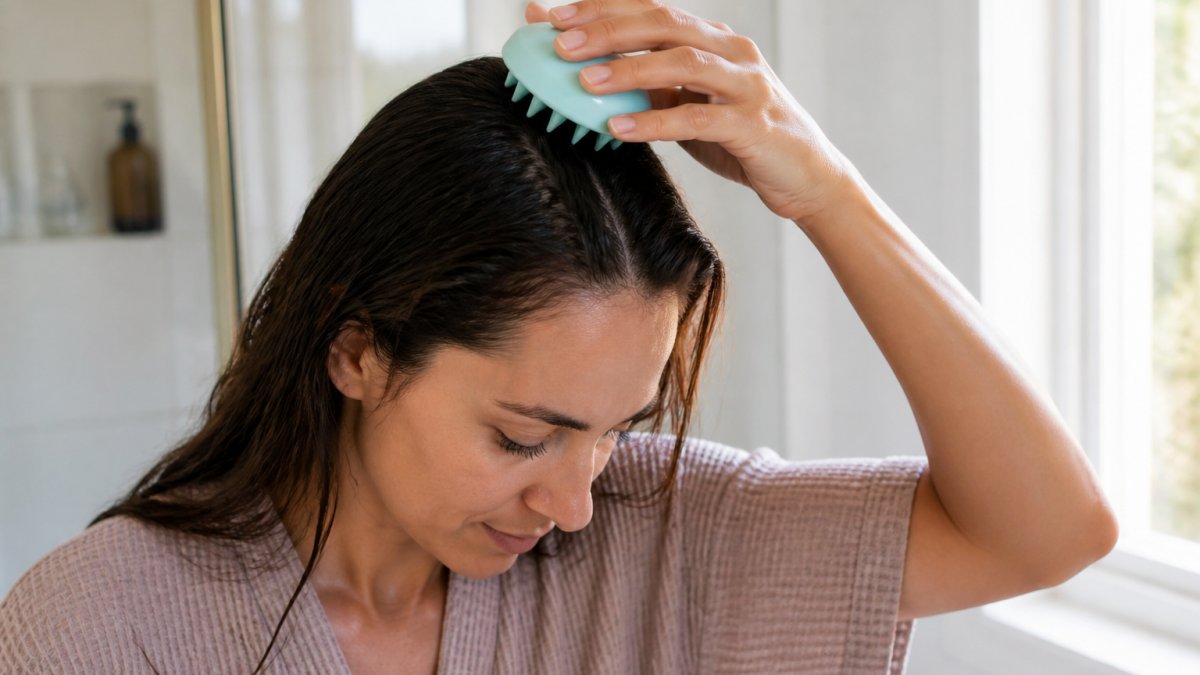
A few minutes of scalp massage daily is a simple habit to try.
Gentle cleansing matters just as much. Harsh scrubbing damages the skin barrier. If you want to understand the mechanics, read why use a scalp brush for hair health.
If your scalp is dry and itchy, our step-by-step guide on how to treat a dry itchy scalp at home covers a practical routine.
A Hair Care Routine for Thinning Hair That Won't Irritate Your Scalp
A hair care routine for thinning hair should be short, gentle and repeatable. Long ingredient lists and aggressive treatments tend to backfire on a sensitive scalp.
Here is the routine we recommend:
- Brush before washing. Gentle detangling reduces breakage.
- Wash with a mild shampoo. Focus on the scalp, not the ends.
- Exfoliate weekly. Use a soft silicone brush to lift build-up.
- Apply a scalp serum to damp or dry scalp. Part the hair and target the skin.
- Massage for two to three minutes. This helps distribution and blood flow.
- Skip heat and tight styles. Both cause breakage and traction damage.
- Be patient. Consistency beats intensity.
If you want a routine built around this, the silicone scalp brush is designed to exfoliate, massage and remove build-up on wet or dry hair.

How Long Does It Take to Increase Hair Density?
Expect three to six months before you see meaningful change, because the hair-growth cycle sets the pace. The anagen phase, when a hair actively grows, lasts years, but a follicle that has been pushed into a resting state takes time to recover.
Realistic timelines:
- Shedding reduction: often noticeable within four to eight weeks
- Improved scalp condition: a few weeks of consistent care
- Visible density change: three to six months, sometimes longer
- Full assessment: twelve months
Track progress with monthly photos in the same light and position. If nothing changes after six months of consistent effort, see a doctor or dermatologist.
Building Your Scalp Care Routine With Pepcare Lab
Consistency is the hard part, and it is where most routines fail. A simple, repeatable system beats an elaborate one you abandon in three weeks.
Pepcare Lab builds science-led, peptide-focused formulations designed for sensitive skin.
The Hair and Scalp Duo pairs that serum with our silicone Scalp Brush for a complete daily ritual. Together they support exfoliation, massage and even serum distribution.
Frequently Asked Questions
Can you naturally increase hair density?
You can support the conditions for healthier-looking hair, but genetics and age set limits. Natural approaches work best on hair density that is affected by scalp health, nutrition or breakage rather than permanent follicle loss. Avoiding harsh styling and keeping the scalp comfortable are sensible habits to adopt. If thinning is sudden, patchy or accompanied by scalp inflammation, see a doctor before relying on home remedies.
Does scalp massage help with hair density?
Scalp massage is a simple habit many people enjoy as part of their routine. A silicone scalp brush makes this easier and gentler than fingernails. Use it on wet or dry hair for a few minutes most days. Pair massage with a peptide scalp serum so the stimulation and the product work together rather than in isolation.
How long does it take to notice a change in hair density?
Expect weeks to months, not days. The hair-growth cycle means any change in shedding or thickness takes at least one full cycle to show, often three to six months. Track progress with monthly photos in the same lighting and angle, and note shedding when washing. If you see no change after six months of consistent effort, or the thinning is worsening, speak to a GP or dermatologist about causes such as iron deficiency or thyroid issues.
Can natural oils help with thinning hair?
Some people choose to try botanical oils, but results vary and are not guaranteed. Oils can also irritate sensitive scalps or worsen build-up, so patch-test first and avoid applying heavy oils to an inflamed scalp. If you prefer a lighter option, our lightweight, non-greasy Hair/Scalp Serum is designed for everyday use without weighing hair down.
The challenge is not finding another remedy. It is sticking with a gentle routine long enough to see what your scalp can do. If you want a simple starting point, explore our Hair and Scalp Duo and build a routine you will actually keep.
