
Table of Contents
- Is Hyaluronic Acid Good for Sensitive Skin? The Short Answer
- How Hyaluronic Acid Works on Sensitive Skin
- Signs of a Compromised Skin Barrier You Should Not Ignore
- The Hyaluronic Acid Sensitivity Paradox
- How to Repair a Damaged Skin Barrier Before Adding New Actives
- Copper Peptides for Skin Barrier Support: A Sensitive-Skin Alternative
- Patch Testing Protocols and Environmental Humidity Factors
- Conclusion: Should You Use Hyaluronic Acid?
- Frequently Asked Questions
Last Updated: October 3, 2026
Is Hyaluronic Acid Good for Sensitive Skin? The Short Answer
Hyaluronic acid is generally well tolerated by sensitive skin, but "generally" is doing a lot of work in that sentence.
Here is the part most guides skip. Hyaluronic acid is a humectant, meaning it draws water into the upper layers of the skin rather than adding oil.
But humectants need water to pull from, and they need something on top to hold that water in place. Get either half of that equation wrong and a gentle ingredient starts behaving like an irritant.
Below, we break down how it works, the signs your skin barrier needs repair first, and a patch testing protocol you can run at home before committing to anything new.
How Hyaluronic Acid Works on Sensitive Skin
Hyaluronic acid is a sugar molecule found naturally in the dermis and epidermis that binds water and helps skin hold onto moisture.
Two variables decide whether that process soothes or stings.
Molecular weight determines how deep the molecule travels. Larger molecules sit on the surface and hydrate the outermost layer. Smaller, lower-weight fragments penetrate further. Some people with reactive skin report stinging from very low-molecular-weight formulas, though this is not universal.
The surrounding formula matters just as much as the HA itself. A serum built on HA plus ceramides, niacinamide or squalane supports the skin barrier while it hydrates. A serum built on HA plus fragrance, alcohol or preservatives your skin dislikes does the opposite.
Signs of a Compromised Skin Barrier You Should Not Ignore
A compromised skin barrier shows up as stinging, redness, tightness or flaking from products that previously caused no reaction. When the barrier is damaged, transepidermal water loss rises, moisture escapes faster, and irritants that would normally sit on the surface get through.
Watch for these signals:
- Products that used to feel fine now sting or burn on contact
- Persistent redness or flushing across the cheeks and nose
- Skin that feels tight minutes after moisturising
- Flaking, rough patches or a dull, grey cast
- New sensitivity to water temperature or to products you have used for years
- Breakouts that behave differently from your usual pattern
If several of those sound familiar, your barrier needs attention before you layer in new actives. Adding a humectant serum to a damaged barrier is like watering a cracked pot. The water goes in, then straight back out.
The Hyaluronic Acid Sensitivity Paradox
The paradox is this: the ingredient most often recommended for sensitive skin is also one that a subset of sensitive-skin users report reacting to. That contradiction is not a myth, and it is not a sign you are imagining things.
Three mechanisms explain most of it.
First, low-molecular-weight HA can penetrate deeper than the surface layers, and for some reactive skin types, deeper penetration means more opportunity for irritation. Second, humectants applied to very dry skin in dry air can pull moisture from the lower layers upward, where it then evaporates. That leaves skin feeling tighter, not softer. Third, and most common, the reaction is not to HA at all but to something else in the bottle: fragrance, essential oils, certain preservatives or a pH that sits outside your skin's comfortable range.
How to Repair a Damaged Skin Barrier Before Adding New Actives
Repair comes before addition. Strip your routine back to three steps, hold it for two to four weeks, and only then reintroduce anything new. The reason the order matters is mechanical, not philosophical.
A healthy skin barrier is a brick-and-mortar structure: corneocytes (the bricks) held together by a lipid matrix of ceramides, cholesterol and free fatty acids (the mortar). When that matrix is depleted, transepidermal water loss (TEWL) rises.
Here is the sequence we recommend:
- Stop all exfoliating acids, retinoids and vitamin C. These are the most common aggravators of a struggling barrier. Give the lipid matrix time to rebuild without daily insult.
- Cleanse with a gentle, non-foaming cleanser and lukewarm water. Hot water strips lipids; a pH-balanced, sulphate-free cleanser removes less of the natural moisturising factor (NMF) that keeps corneocytes plump.
- Apply a barrier-supporting moisturiser while skin is still damp. Look for ceramides, niacinamide, squalane, glycerin or peptides. Ceramides are the single most studied lipid for barrier repair because they replace what the mortar is made of.
- Seal it in. An occlusive layer at night (petrolatum, shea, or a rich balm) reduces TEWL while the barrier rebuilds. This is the step most sensitive-skin routines skip, and it is the one that makes the difference in dry air.
- Reintroduce one product at a time, with at least a week between additions, so you can attribute any reaction to a single variable.
A practical marker of progress: if lukewarm water no longer stings and your usual moisturiser stops burning within two weeks, the barrier is likely tolerating more.
Copper peptides are worth knowing about at this stage. Our Barrier Cream combines 1% copper peptides with niacinamide and squalane, which is the kind of pairing that supports the barrier while it moisturises rather than simply adding water.

Copper Peptides for Skin Barrier Support: A Sensitive-Skin Alternative
Copper peptides for skin barrier support work differently from humectants. Instead of pulling water into the skin, they signal the skin to do its own repair work, supporting collagen production and encouraging natural renewal over time.
That makes them a reasonable option for reactive skin that cannot handle retinol. Retinol is effective, but it is also one of the most common causes of the redness, flaking and stinging that sends people searching for barrier repair advice in the first place.
A few practical notes:
- Copper peptides play well with niacinamide, hyaluronic acid and ceramides
- They do not play well with strong acids or high-dose vitamin C in the same layer, so separate them by time of day
- Results are gradual. Expect changes in how skin feels and looks over weeks, not days
Our Face Serum pairs 1% copper peptides with niacinamide and hyaluronic acid in a lightweight base. For anyone whose skin reacts to everything, starting with one serum and one moisturiser beats a ten-step routine every time.

| Approach | How It Works | Best For | Watch Out For |
|---|---|---|---|
| Hyaluronic acid serum | Humectant, draws in water | Dehydrated but stable skin | Needs sealing; can tighten in dry air |
| Copper peptides | Supports collagen and renewal | Reactive skin avoiding retinoids | Slow results; separate from acids |
| Barrier cream with ceramides | Replaces lipids, reduces water loss | Compromised, flaking barriers | Heavier texture for some |
| Retinol | Accelerates cell turnover | Tolerant, non-reactive skin | Common cause of irritation |
Patch Testing Protocols and Environmental Humidity Factors
Patch testing is the single most useful habit for sensitive skin, and almost nobody does it properly.
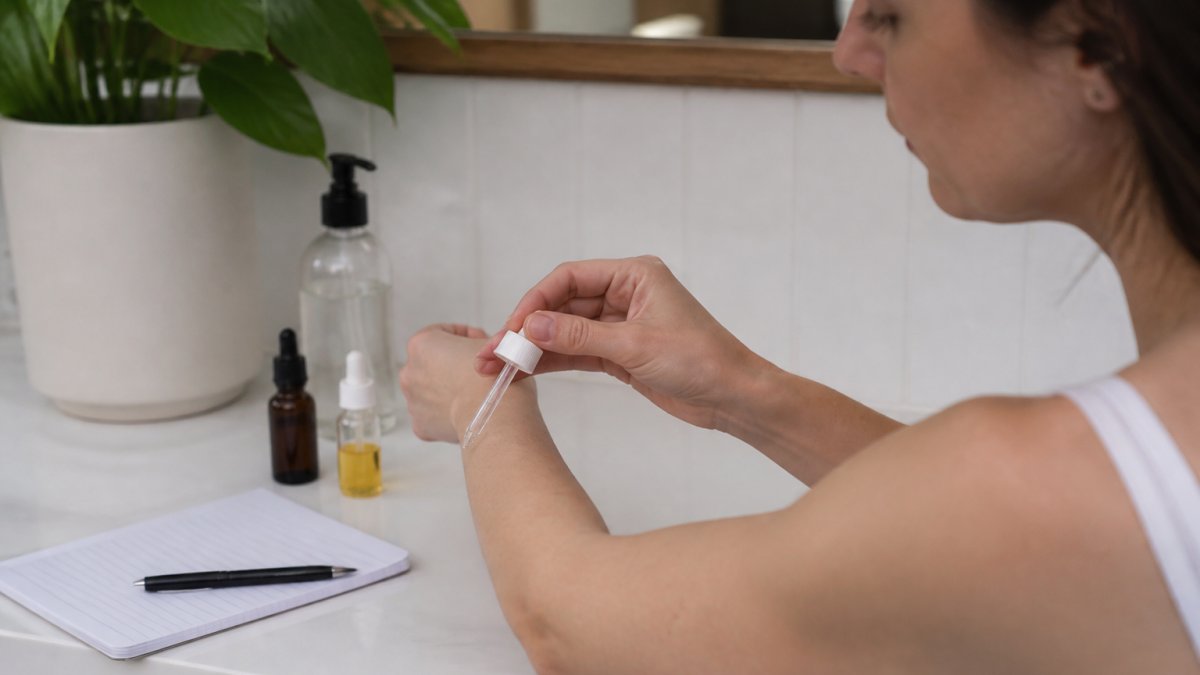
A refined patch test for HA serums
- Test one product at a time, never two together. If you react, you need to know which bottle caused it.
- Use the same amount you would use on your face, a pea-sized drop, not a smear. Dose matters for humectants.
- Apply to damp skin, then seal with your usual moisturiser, exactly as you would on your face. Testing a humectant on dry, unsealed skin tests the wrong thing.
- Note the result at 24 hours, 72 hours and five days. Delayed reactions happen, and low-molecular-weight HA irritation in particular can build over several days rather than appearing on contact.
- If you react, stop and photograph the area so you can compare later and show a clinician if needed.
- Re-test if the formula changes or you have not used it in several months. Skin reactivity shifts with season, hormones and barrier status.
Why humidity changes the result
Hyaluronic acid is a humectant: it attracts and binds water. In humid air, there is plenty of water vapour for it to draw from, so it hydrates the surface and feels comfortable.
This is the mechanism behind most "hyaluronic acid dried me out" complaints, and it is why the same serum can feel lovely in a humid summer and uncomfortable in a dry winter.
Practical adjustments by environment
- Humid conditions: apply to damp skin and follow with a light moisturiser. The air is doing some of the work for you.
- Dry or air-conditioned conditions: apply to damp skin, then seal immediately with a ceramide or squalane-based moisturiser, and consider a richer occlusive at night.
- Very dry conditions: a humectant-only serum may not be the right first step. A barrier cream with lipids may serve reactive skin better until the barrier is intact.
For more on identifying irritant contact reactions, the Australasian College of Dermatologists patient information on contact dermatitis is a useful starting point. If you want to understand how Australian products are regulated and what ingredients must be declared, the Therapeutic Goods Administration's guidance on cosmetic ingredients sets out the rules. And for general skin health guidance written for the public, Healthdirect Australia's information on sensitive skin is worth reading before you change your routine.
Conclusion: Should You Use Hyaluronic Acid?
For most people with sensitive skin, yes, provided the formula is simple and you apply it to damp skin before sealing it in. For a smaller group, the honest answer is that it may not suit you, and the way to find out is a proper patch test rather than guesswork.
The bigger point is that sensitive skin rarely needs more products. It needs fewer, better-chosen ones and a barrier that is intact enough to tolerate them.
If you are starting from a damaged barrier, our Face Duo pairs a 1% copper peptide Face Serum with a Barrier Cream built on niacinamide and squalane, a two-step routine designed for reactive skin rather than an eight-step one.

Frequently Asked Questions
Who should not use hyaluronic acid?
People with very dry or dehydrated skin living in low-humidity environments may find hyaluronic acid draws moisture out of the skin rather than into it. Those with a compromised skin barrier or active rosacea should repair the barrier first. If you react to multiple skincare products, patch test any new hyaluronic acid serum on your inner forearm for 48 hours before applying it to your face.
Can hyaluronic acid cause redness or irritation?
Yes. While hyaluronic acid is generally well tolerated, some people with sensitive skin report stinging, redness or tightness after application. This is more common with low-molecular-weight formulas that penetrate deeper, or when applied to damp skin in a dry climate without an occlusive moisturiser on top. If irritation persists beyond a few minutes, stop using the product and focus on barrier repair.
What should I never mix with hyaluronic acid?
Avoid layering hyaluronic acid with strong exfoliating acids like glycolic or salicylic acid in the same routine, as this can overwhelm sensitive skin. Retinol is another ingredient to introduce separately. If you use vitamin C, apply it in the morning and hyaluronic acid in the evening. Always follow with a barrier-supporting moisturiser to seal in hydration.
How does hyaluronic acid support the skin barrier?
Hyaluronic acid is a humectant, meaning it attracts and holds water in the upper layers of the skin. This added hydration helps keep the skin barrier flexible and supports its natural repair processes. However, it works best alongside occlusive ingredients like ceramides or squalane that prevent that moisture from evaporating, especially in dry or air-conditioned environments.
How long does it take to see results from hyaluronic acid on sensitive skin?
Most people notice improved hydration within a few days, but visible plumping and smoother texture typically take two to four weeks of consistent use. If you have a compromised barrier, allow four to six weeks of gentle barrier repair before expecting hyaluronic acid to deliver its full benefits. Stop use if redness or irritation develops and consult a dermatologist if symptoms persist.