
Last Updated: November 4, 2026
Quick Summary
Common environmental triggers for reactive skin include UV radiation, thermal stress from heat, cold and humidity swings, and airborne pollutants such as particulate matter and indoor allergens like dust mites, pet dander and mould. Fragrance in cleaning and laundry products is a further hidden trigger. These stressors disrupt the skin barrier, raising water loss and letting irritants past the surface.
- Indoor relative humidity can fall well below 40% in winter, accelerating transepidermal water loss.
- Relative humidity above roughly 60-65% raises dermal sensitivity through sweat, friction and occlusion.
- Apply barrier cream before going outside, not after, so the occlusive layer is in place first.
- Weekly hot washing of bedding and a mite-proof pillow cover reduce dust mite exposure.
- Pause retinoids, exfoliating acids and vitamin C for two weeks when repairing the barrier.
Table of Contents
- Why Reactive Skin Flares When the Environment Changes
- Sun Exposure and UV Radiation: The Trigger You Can Feel
- Heat, Cold and Humidity: How Temperature Swings Stress the Barrier
- Airborne Pollutants, Particulate Matter and Indoor Allergens
- Signs of a Compromised Skin Barrier
- How to Repair Damaged Skin Barrier Function Step by Step
- Best Ingredients for Reactive Skin and Long-Term Barrier Repair
- Building a Simple Trigger-Aware Routine with Pepcare Lab
- Frequently Asked Questions
Why Reactive Skin Flares When the Environment Changes
Reactive skin is skin that overreacts to stimuli most people tolerate, producing redness, stinging, tightness or flaking within minutes to hours of exposure.
The mechanism is worth understanding once, because it explains almost every trigger in this guide.
Below, we break down the common environmental triggers for reactive skin, the signs your barrier is struggling, and a repair protocol you can follow without a ten-step routine.
Sun Exposure and UV Radiation: The Trigger You Can Feel
The trap most people fall into is overcorrecting. If you are weighing up your options, our guide to chemical vs physical sunscreen for sensitive skin explains which filter types suit a compromised barrier.
Watch out: applying a new sunscreen for the first time on a full day outdoors is the fastest way to confuse a UV reaction with a product reaction.
Heat, Cold and Humidity: How Temperature Swings Stress the Barrier
Thermal stress is the most underrated trigger on this list, and it works through two separate mechanisms. The first is vasomotor instability: rapid shifts between heated indoor air and cold outdoor air force cutaneous blood vessels to dilate and constrict repeatedly, and a compromised lipid barrier handles that poorly, which is why flushing and tightness often appear within minutes of stepping inside. The second is humidity-driven water loss.
Very high humidity is not a safe haven either.
You cannot control the weather. You can control the transition and the indoor microclimate:
- Measure before you humidify. A cheap hygrometer will tell you whether your bedroom is at 30% or 55%; adding moisture to an already humid room makes friction and sweat worse, not better.
- Apply barrier cream before going outside, not after. The occlusive layer needs to be in place before cold wind and dry air strip water from the surface.
- Shorten and cool hot showers. Long, hot water raises skin temperature, dissolves surface lipids and worsens post-shower tightness; lukewarm water for a short time is generally easier on reactive skin.
- Layer for transitions. A scarf or buff over the cheeks and nose reduces direct cold-air exposure during the commute, and removing it indoors prevents overheating.
Watch out: a humidifier left running overnight in a small, closed bedroom can push humidity past 65%, encouraging condensation, dust mite activity and mould, the very indoor allergens covered in the next section.
The article sets out the humidity and temperature ranges that matter for reactive skin, along with practical steps for managing them.
| Factor | Value or action | Note |
|---|---|---|
| Indoor relative humidity in winter | Can fall well below 40% | Accelerates transepidermal water loss |
| Relative humidity above roughly 60-65% | Raises dermal sensitivity | Sweat, friction and occlusion increase |
| Hot showers | Shorten and cool them | Long hot water dissolves surface lipids |
| Barrier cream | Apply before going outside | Occlusive layer in place before cold wind |
| Humidifier in small closed bedroom | Can push humidity past 65% | Encourages dust mites and mould |
| Hygrometer | Measure before you humidify | Tells whether room is at 30% or 55% |
Airborne Pollutants, Particulate Matter and Indoor Allergens
Particulate matter and urban pollutants settle on skin and generate oxidative stress that weakens skin homeostasis over time. Fine particles can carry pollutants such as polycyclic aromatic hydrocarbons and metals, which may contribute to inflammation and reduce the skin's own antioxidant defences.
Indoors, the culprits change but the effect is similar. Environmental allergens such as dust mites and pet dander, plus mould spores in damp rooms, drive contact dermatitis and skin sensitisation in people already prone to reactions. What most guides miss is how specific the indoor sources are, and how fixable:
- Bedroom. Dust mites concentrate in pillows, mattresses and duvets; weekly hot washing of bedding and a mite-proof pillow cover reduce exposure more than any skincare step.
- Bathroom. Mould spores thrive where extractor fans are weak or absent; visible black spotting around silicone seals is a reliable sign of a spore load that will reach your face.
- Living areas. Pet dander is sticky and airborne for hours; if you react, keeping pets out of the bedroom is the single highest-impact change.
- Laundry and cleaning. Fragrance and preservatives in detergent, fabric softener and surface sprays deposit on skin and bedding continuously, and are a common hidden driver of persistent cheek and neck redness.
Fragrance is the other half of this story. Synthetic fragrance can contribute to skin sensitisation, and it is found in cleaning products, laundry detergent and room sprays as well as in skincare. Fragrance-free formulas and a fragrance-free laundry routine remove a trigger most people never identify.
The workplace trigger most guides ignore
Office environments combine several triggers at once, which is why reactivity often worsens during the working week and settles at weekends. HVAC systems recirculate dry, filtered air and can drop relative humidity well below 40%, while fluorescent and blue-rich lighting sit close to the face for eight hours a day. Shared kitchens and printers add particulate matter, and desk fans or open windows near traffic push outdoor pollution directly onto skin. A practical workplace protocol:
- Keep a small fragrance-free barrier cream at your desk and reapply after lunch, when cumulative dryness peaks.
- Request a desk away from direct air-conditioning vents, or angle the vent away, direct cold airflow is a common cause of one-sided cheek redness.
- Wipe shared desk surfaces and phone screens with a fragrance-free wipe; phones carry both particulate matter and skin residue to the cheek.
- If your building has no humidity control, a small desk humidifier used briefly is more effective than leaving one running all day.
Watch out: 'natural' and 'clean' formulations are not automatically safer for reactive skin. Some essential oils can act as botanical sensitisers for reactive skin. A short, fragrance-free formula with well-understood barrier ingredients is often a simpler starting point than a longer 'clean' ingredient list.
Signs of a Compromised Skin Barrier
A compromised skin barrier shows up as persistent tightness after cleansing, stinging from products that previously felt neutral, visible redness across the cheeks and nose, and flaking that does not resolve with moisturiser.
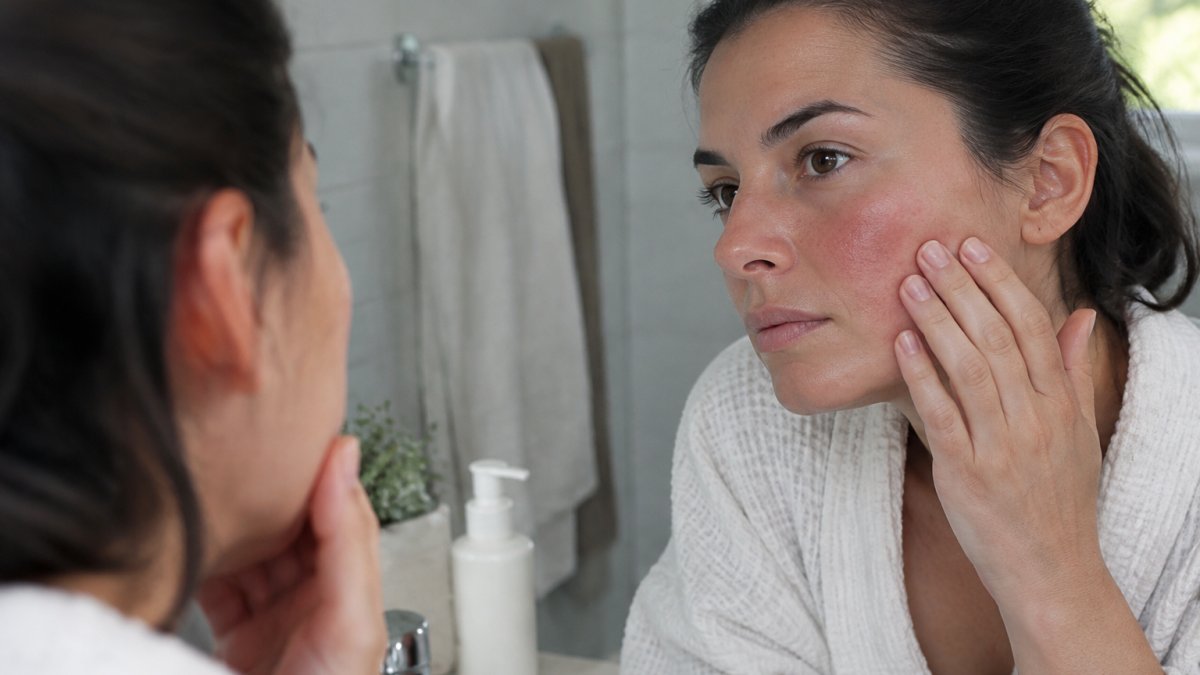
Not every flush is a damaged barrier, though. If you want to confirm what you are actually looking at before changing your routine, this breakdown of how to tell if your skin barrier is damaged walks through the distinguishing signs.
How to Repair Damaged Skin Barrier Function Step by Step
Repair follows a predictable sequence, and the order matters more than the products. Strip back first, then rebuild.
- Pause actives for two weeks. Retinoids, exfoliating acids and vitamin C all increase turnover; a barrier under stress cannot keep up. This is the step most people skip.
- Switch to a gentle, fragrance-free cleanser. Lukewarm water, no flannel scrubbing, morning and night.
- Apply a hydrating serum to damp skin. This is where skin hydration is won or lost, before any occlusive layer goes on.
- Seal with a barrier cream containing ceramides, niacinamide or peptides. This is the step that reduces water loss overnight.
- Add sunscreen every morning, indoors included. UV exposure undoes repair faster than any product can fix it.
- Reintroduce one active at a time, two weeks apart. If stinging returns, stop and rebuild again.
Expect the tightness and stinging to settle within one to two weeks. Visible redness takes longer, often four to six weeks, because barrier repair is a lipid-replacement process, not a surface fix. For the full protocol with product sequencing, our 2026 guide to repairing a damaged skin barrier goes deeper.
Best Ingredients for Reactive Skin and Long-Term Barrier Repair
The best ingredients for reactive skin fall into three jobs: replace lipids, calm inflammation, and support the skin microbiome. Ceramides and squalane replace what the barrier has lost. Niacinamide supports ceramide production and reduces visible redness. Soothing agents such as panthenol calm reactive episodes. Copper peptides support collagen production and skin renewal, which matters for long-term resilience rather than quick relief.
What most guides miss is that ingredient count is not the goal. A short formula with three or four proven anti-inflammatory and lipid-replenishing ingredients outperforms a long one that includes a sensitiser halfway down the list.
Our 1% copper peptide barrier cream is built on that logic: 1% copper peptides with niacinamide and squalane, in a rich but lightweight formula designed to support the barrier rather than overload it.

Building a Simple Trigger-Aware Routine with Pepcare Lab
A trigger-aware routine starts with subtraction. Identify your two or three worst environmental triggers, remove them where you can, and protect against the rest with a routine short enough to repeat every single day.
For most reactive skin, that means three steps: a gentle cleanse, a peptide serum, and a barrier cream. Our Face Duo pairs the Face Serum and Barrier Cream for $79 AUD, and the Complete Collection for $149 AUD includes a Hair & Scalp Serum and Scalp Brush if hair and scalp care are part of your routine. If you are still working out which products suit reactive skin day to day, our gentle skincare guide for reactive skin covers routine-building in more detail.


Best for: adults with recurring redness or stinging who want a minimal, fragrance-conscious routine. Skip if: you are mid-flare with broken skin, in which case see a GP or dermatologist before starting anything new.
Frequently Asked Questions
What are the most common environmental triggers for reactive skin?
The usual culprits are UV radiation, sharp temperature swings, low or high humidity, airborne particulate matter, indoor allergens such as dust mites and pet dander, and fragranced or chemical irritants. Reactive skin tends to react to combinations rather than one single factor, which is why a hot, windy day in a polluted city can cause more erythema than any one trigger alone. Tracking your flares against weather, heating use and cleaning products for two weeks usually reveals your personal pattern.
How does air pollution affect sensitive skin barrier function?
Particulate matter and traffic-related pollutants settle on the skin and drive oxidative stress and inflammation, which weakens the lipid barrier and raises transepidermal water loss. Over time this shows up as dryness, stinging and visible redness. Cleansing gently at the end of the day and keeping the barrier hydrated can support skin comfort, especially in built-up areas or near busy roads.
What role do peptides play in protecting skin from environmental stressors?
Copper peptides such as GHK-Cu support collagen production and skin renewal, and they are used in formulas designed to reinforce the barrier that environmental stressors wear down. They are not a sunscreen or a pollutant shield, so pair them with sun protection and gentle cleansing. A simple approach is a 1% copper peptide serum followed by a barrier cream containing niacinamide and squalane, which helps lock in hydration and keep skin comfortable through temperature and humidity swings.
How do I know if my skin is reacting to my environment or to a product?
Environmental reactivity usually follows a pattern: flares after sun exposure, heating, wind, a hot shower or time outdoors, and settles when conditions change. Product reactions more often appear within hours to days of starting something new and stay localised to where it was applied. Stop new products for two weeks, keep your routine to a gentle cleanser and a barrier cream, and note weather and indoor conditions alongside your symptoms before reintroducing anything.
Reactive skin is manageable once you stop treating it as a product problem and start treating it as an environmental one. At Pepcare Lab, we build around 1% copper peptides, niacinamide and squalane, with transparent formulas and three-step routines designed for skin that reacts easily. Get started with Pepcare Lab and give your barrier the consistent, uncomplicated support it needs to settle.
