
Table of Contents
- Chemical vs Physical Sunscreen for Sensitive Skin: The Core Differences
- Chemical Sunscreen: Pros, Cons and Irritation Triggers
- Physical Sunscreen: Pros, Cons and Who It Suits
- Sunscreen Ingredients to Avoid for Eczema and Rosacea
- Hybrid Sunscreens: The Middle Ground for Reactive Skin
- How to Repair a Damaged Skin Barrier While Wearing SPF
- TGA Sunscreen Regulations Australia: What They Mean for Sensitive Skin
- Layering Sunscreen With Peptides and Active Skincare
- Frequently Asked Questions
Last Updated: September 29, 2026
Chemical vs Physical Sunscreen for Sensitive Skin: The Core Differences
Chemical vs physical sunscreen for sensitive skin comes down to one question: does your skin react to the filter or the texture? Chemical filters absorb UV rays and convert them to heat; physical blockers sit on top and deflect them. That difference explains most reactions, white casts, and dermatologist recommendations for reactive skin.
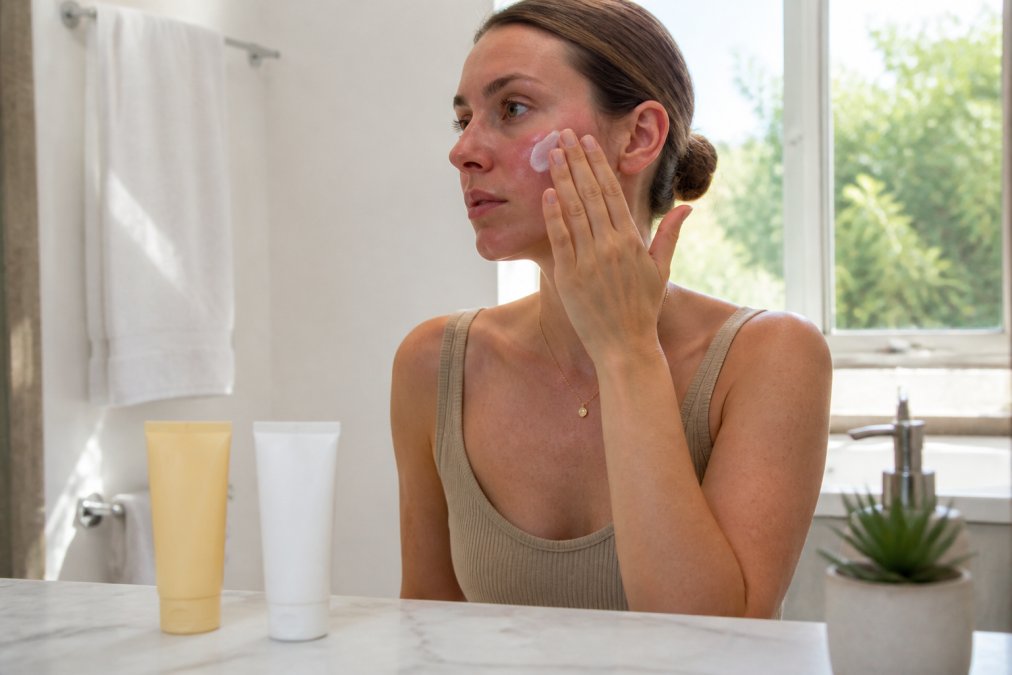
How Chemical Filters Work
Chemical sunscreens use organic compounds that absorb UV radiation and turn it into heat, which then leaves your skin. Common filters include avobenzone, octocrylene, and oxybenzone. They feel light, spread easily, and leave no white cast on deeper skin tones. The catch: absorption takes about 20 minutes, and that heat conversion is exactly what triggers flushing in people with rosacea.
How Physical Blockers Work
Physical sunscreens use zinc oxide or titanium dioxide. These minerals sit on the surface and both absorb and scatter UV rays. Zinc oxide covers a broader spectrum than most single chemical filters and has soothing properties, which is why it appears in post-procedure care. The trade-off is texture: older formulas left a heavy white cast, and modern micronised versions are better but not invisible on every skin tone.
Chemical Sunscreen: Pros, Cons and Irritation Triggers
Chemical sunscreens win on cosmetic elegance. But "chemical sunscreen" is not one ingredient, it's a family of organic UV filters with very different irritation profiles, stability, and regulatory status. Treating them as one category is why so many sensitive-skin users cycle through bottles that all sting.
Pros:
- Lightweight, invisible finish
- Easy to layer under makeup
- Works well in sprays and gels
- No white cast on any skin tone
- Modern filters (Tinosorb S, Tinosorb M, Uvinul A Plus) are photostable and cover broad spectrum at low concentrations
Cons:
- Needs 20 minutes to activate
- Generates heat on the skin as UV is converted to thermal energy
- Higher irritation risk for reactive skin
- Some older filters carry environmental concerns
- Stability varies enormously between filters
Why Chemical Filters Cause Reactions
Chemical filters absorb UV photons and re-emit the energy as heat, the mechanism behind flushing in rosacea-prone skin, which is warmed from the inside for as long as you're in the sun. Some filters are also small enough to penetrate the stratum corneum, bind to proteins, and trigger a delayed contact allergy, which is why reactions often appear 24-72 hours after application.
Filter-by-Filter Irritation Profile
| Filter | Common name on label | Irritation pattern | Notes for reactive skin |
|---|---|---|---|
| Oxybenzone | Benzophenone-3 | Most frequent contact allergen among UV filters; photoallergy possible | Avoid if you've had any unexplained facial rash after sun exposure |
| Octocrylene | Octocrylene | Linked to stinging and redness in eczema-prone skin; also a marker for ketoprofen photoallergy | Common in "sensitive" formulas, check the back of the bottle |
| Avobenzone | Butyl methoxydibenzoylmethane | Unstable alone; degrades in sunlight unless stabilised | Often paired with octocrylene or a stabiliser that itself causes reactions |
| Homosalate | Homosalate | Mild sensitiser; endocrine-activity questions under review in some markets | Usually fine for non-reactive skin |
| Octinoxate | Ethylhexyl methoxycinnamate | Moderate sensitiser; weaker UVA coverage | Often combined with avobenzone |
| Tinosorb S | Bis-ethylhexyloxyphenol methoxyphenyl triazine | Very low irritation reports; photostable | One of the better tolerated modern filters |
| Tinosorb M | Methylene bis-benzotriazolyl tetramethylbutylphenol | Low irritation; partly particulate so sits closer to the surface | Good option if you react to older filters |
| Uvinul A Plus | Diethylamino hydroxybenzoyl hexyl benzoate | Low irritation; photostable UVA filter | Frequently used in modern hybrid formulas |
The pattern worth remembering: the filters most likely to cause reactions are the oldest and cheapest. Newer broad-spectrum filters, Tinosorb S, Tinosorb M, Uvinul A Plus, have far better tolerability records but appear less often in mass-market formulas because they cost more to formulate with.
The Supporting-Cast Problem
Even a well-tolerated filter can sit in a base that ruins it. Fragrance, denatured alcohol, essential oils, and some preservatives cause more facial reactions than the filters themselves, so scan the whole label, not just the active ingredients block.
Physical Sunscreen: Pros, Cons and Who It Suits
Physical sunscreen is the safer default for sensitive skin, but not automatically problem-free.
Pros:
- Works immediately after application
- Zinc oxide covers broad-spectrum UVA and UVB
- Low allergy risk
- Suitable for rosacea, eczema, and post-procedure skin
- Reef-safe formulas are widely available
Cons:
- Can feel thick or tacky
- White cast on medium to deep skin tones
- Rubs off with sweat and towelling
- Harder to apply evenly over beards
Sunscreen Ingredients to Avoid for Eczema and Rosacea
If you have eczema or rosacea, the full ingredient list matters more than the filter, the supporting cast causes just as many flare-ups as the actives. Reaction type matters too: irritant reactions show up within minutes to hours and sting, while allergic contact reactions are delayed, itchy, and can spread beyond the application site.
The Avoid List, With Mechanisms
| Ingredient | Reaction type | Why it's a problem | Better alternative |
|---|---|---|---|
| Oxybenzone | Allergic (delayed) | Common contact allergen; can photoallergise | Zinc oxide |
| Octocrylene | Irritant + allergic | Stinging, redness in eczema; marker for ketoprofen photoallergy | Titanium dioxide |
| Avobenzone | Irritant | Unstable alone; degradation products can sting | Tinosorb S or zinc oxide |
| Fragrance (parfum) | Allergic | Top rosacea trigger; "fragrance-free" and "unscented" are not the same claim | Fragrance-free formulas |
| Denatured alcohol | Irritant | Strips the skin barrier, worsens transepidermal water loss | Glycerin-based bases |
| Essential oils (lavender, citrus, peppermint) | Allergic | Cumulative irritation; citrus oils are phototoxic | Minimal ingredient lists |
| Methylisothiazolinone (MI) | Allergic | Potent contact allergen; restricted in leave-on cosmetics in many markets | Phenoxyethanol-free options |
| Propylene glycol | Irritant | Stings on broken or eczematous skin | Butylene glycol or glycerin |
| Chemical UV filters in spray form | Irritant | Alcohol propellant + fine mist reaches eyes and nasal passages | Cream or lotion formats |
The pattern is simple: fewer ingredients means fewer chances of a reaction. But "fewer" isn't "none", some single-ingredient formulas still contain a filter you personally react to.
Hypoallergenic, Dermatologist-Tested, Sensitive: What the Labels Actually Mean
These terms are marketing, not regulated claims. No defined allergen list exists for "hypoallergenic," and "dermatologist-tested" only means a dermatologist was involved somewhere, not that the product passed a tolerability threshold. Read the ingredient list rather than trusting the front of the bottle.
Layering SPF With Actives: The Interaction Most Guides Skip
Sensitive-skin users rarely apply sunscreen to bare skin. They layer it over vitamin C, niacinamide, retinoids, or acids, and the order and pairing change how the SPF behaves.
- Vitamin C (L-ascorbic acid): Apply first, under mineral sunscreen. L-ascorbic acid is acidic and can sting if a chemical filter with alcohol sits on top of it. Mineral formulas buffer this better.
- Niacinamide: Generally compatible with both filter types. Apply before sunscreen.
- Retinoids (at night): Never layer under daytime SPF, retinoids are photosensitising and increase your burn risk. If you're mid-retinoid adjustment, a mineral SPF is the safer daytime choice because it doesn't add heat or penetration stress.
- AHAs and BHAs: Don't apply a chemical sunscreen directly over freshly exfoliated skin. The barrier is temporarily compromised and chemical filters sting more. Wait 10-15 minutes, or use mineral.
- Benzoyl peroxide: Can bleach tinted mineral formulas and destabilise some chemical filters. Apply, wait, then use a mineral SPF.
- Peptides: Compatible with both. Apply before sunscreen as part of your serum step.
Hybrid Sunscreens: The Middle Ground for Reactive Skin
Hybrid formulas combine zinc oxide or titanium dioxide with one or two chemical filters to cut the white cast without loading up on actives. A hybrid might pair zinc oxide with a small amount of a modern, stable filter, giving broad-spectrum coverage, a lighter finish, and a lower concentration of any single chemical.
How to Repair a Damaged Skin Barrier While Wearing SPF
A compromised skin barrier lets irritants through and moisture out. Sunscreen protects it, but only if the formula doesn't add stress.
Start with the basics:
- Switch to a mineral or fragrance-free formula
- Apply SPF 30 or higher, every morning
- Reapply every two hours outdoors
- Use a gentle, non-foaming cleanser at night
- Add barrier-supporting ingredients like ceramides and peptides
- Pause strong actives until redness settles
- Keep water temperature lukewarm
TGA Sunscreen Regulations Australia: What They Mean for Sensitive Skin
Sunscreen in Australia is regulated as a therapeutic good by the Therapeutic Goods Administration. That's a stricter framework than cosmetics, and it matters if you have sensitive skin.
What this means for you:
- SPF ratings on primary sunscreens are tested, not marketing
- "Broad-spectrum" claims must meet a defined standard
- Active ingredients must appear on the label
- Water-resistant claims are regulated
Layering Sunscreen With Peptides and Active Skincare
Order matters more than most people realise: thinnest to thickest. Watery serums first, then creams, then sunscreen last.
A workable morning routine:
- Gentle cleanser
- Peptide serum
- Light moisturiser
- Sunscreen as the final step
Frequently Asked Questions
Do dermatologists recommend physical or chemical sunscreen for sensitive skin?
Most dermatologists lean toward physical sunscreens for sensitive skin because zinc oxide and titanium dioxide sit on the surface and are less likely to trigger reactions than chemical filters. That said, a well-formulated chemical or hybrid sunscreen can work if you patch test first and avoid known triggers like oxybenzone. The best sunscreen for sensitive skin is one you will actually wear every day, so texture and finish matter as much as the filter type.
What are the common triggers in chemical sunscreens for reactive skin?
Oxybenzone, octocrylene and avobenzone are the most frequently reported irritants for reactive skin, along with fragrance and alcohol added to lighten the formula. If you have eczema or rosacea, check the label for these and patch test on your inner forearm for three days before applying to your face. Physical blockers like zinc oxide are generally better tolerated, though titanium dioxide can occasionally cause dryness.
How does a damaged skin barrier affect which sunscreen I should choose?
A compromised skin barrier lets irritants and allergens penetrate more easily, so chemical filters that absorb into the skin can sting or cause inflammation. Physical sunscreens sit on top and are less likely to provoke a reaction. While you repair your barrier with ceramides, niacinamide and gentle cleansing, stick to a mineral SPF with soothing properties and avoid exfoliating acids until the barrier recovers.
What do TGA sunscreen regulations in Australia require on the label?
The TGA regulates sunscreens as therapeutic goods, so any product claiming primary sun protection must list an AUST L number on the label and meet the AS/NZS 2604 standard for broad-spectrum UVA/UVB protection and SPF rating. This means you can trust the SPF number on a TGA-listed product. Secondary sunscreens, like moisturisers with SPF, follow cosmetic rules instead, so check for the AUST L number if sun protection is the main purpose.
Sensitive skin doesn't have to mean skipping SPF. It means choosing the right filter and reading the full label. At Pepcare Lab, our peptide-led formulas are built for exactly this problem: supporting your skin barrier with copper peptides (GHK-Cu) while keeping routines simple and transparent. Explore our bestsellers and find a routine your skin won't fight back against.