
Table of Contents
- Understanding Copper Peptides and Rosacea
- Best Peptides for Rosacea: What to Look For
- How to Patch Test Skincare for Rosacea
- Skin Barrier Repair for Rosacea
- Potential Side Effects and Irritation Risks
- Ingredient Compatibility Matrix
- Building a Copper Peptide Routine for Rosacea
- Frequently Asked Questions
Last Updated: September 24, 2026
Understanding Copper Peptides and Rosacea
If you have rosacea, "is copper peptide safe for rosacea" is a fair question to ask before you buy anything. The short answer: copper peptides are generally well tolerated by rosacea-prone skin, but only at low concentrations and only after patch testing. At Pepcare Lab, we build our formulas around this exact problem, because reactive skin needs proof before it needs promises.
What Are Copper Peptides (GHK-Cu)?
GHK-Cu is a copper-binding peptide that occurs naturally in human plasma and supports collagen synthesis and dermal repair. It works by delivering copper, a trace mineral involved in tissue remodelling, to the skin.
Why Rosacea-Prone Skin Reacts Differently
Rosacea skin is not just "sensitive." It has higher baseline inflammation, more visible blood vessels, and a weaker barrier. Cutaneous inflammation and vasodilation are already switched on.
- Concentration of the peptide
- Molecular weight and how deep it penetrates
- What else is in the formula
- Whether you introduced it slowly
Best Peptides for Rosacea: What to Look For
The best peptides for rosacea are low-concentration copper peptides paired with calming agents like niacinamide, squalane, and pro-vitamin B5. Avoid high-dose actives, fragrance, and alcohol-heavy formulas.
Look for these on the label:
- Copper peptides (GHK-Cu) at 1% or less
- Niacinamide to support the barrier
- Squalane and pro-vitamin B5 for hydration
- Zinc for oil control and calming
- Hyaluronic acid for water retention
Concentration Thresholds and Molecular Weight
This is where most guides stop short, so here's the part that matters.
How to Patch Test Skincare for Rosacea
How to patch test skincare for rosacea comes down to one rule: test on a small area for at least three days before you go near your face. Most people skip this step. It's the single biggest mistake we see.
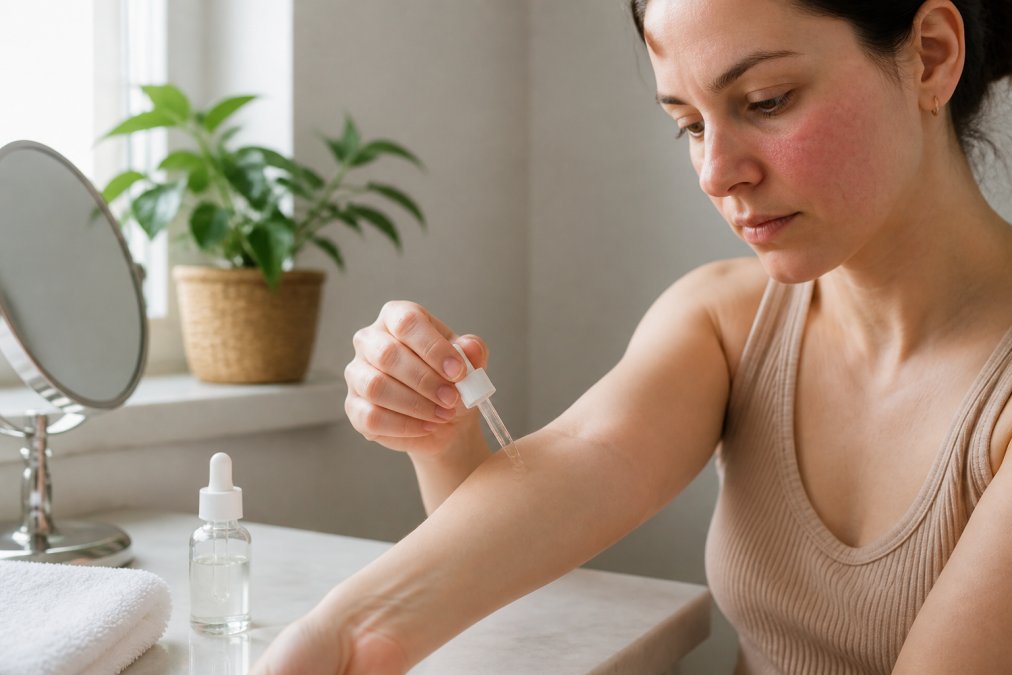
Here's the process:
- Clean a small patch on your inner forearm or behind your ear.
- Apply a pea-sized amount of the product.
- Wait 24 hours. Check for redness, itching, or heat.
- Repeat for three days. Some reactions are delayed.
- If clear, test near your jawline for two more days.
- Only then apply to your full face.
Skin Barrier Repair for Rosacea
Skin barrier repair for rosacea is the foundation everything else sits on. A stronger barrier tolerates more. A weak barrier reacts to almost everything, including water.
To rebuild it:
- Use a gentle, non-foaming cleanser
- Apply a barrier-supporting moisturiser twice daily
- Add peptides to support collagen and renewal
- Avoid over-exfoliating, which strips the barrier further
- Wear sunscreen daily, since UV worsens redness
Potential Side Effects and Irritation Risks
Potential side effects of copper peptides include mild redness, tingling, and irritation, especially in the first week. Most settle as your skin adjusts. But for rosacea-prone skin, the more useful question is not "what are the side effects", it is "is this reaction normal, or is it a flare?"
The Purge vs. Flare Distinction
A purge is a temporary adjustment reaction. It happens when an active ingredient accelerates cell turnover and brings existing congestion to the surface faster than usual. A purge:
-
Appears in areas you normally break out
-
Peaks within the first two to three weeks
-
Improves steadily after that peak
-
Does not spread to new areas of the face
-
Does not come with heat, swelling, or spreading redness
-
Appears in areas you do not normally break out
-
Worsens rather than improves after the first week
-
Spreads outward from the application site
-
Comes with heat, stinging, or visible vessel dilation
-
May include swelling, papules, or a burning sensation that does not settle within an hour
What a Reaction Usually Looks Like
Watch for these signs and match them to the lists above:
- Erythema that lasts more than a few hours after application
- Stinging that gets worse with each use rather than better
- Dryness or flaking around the application area
- A flare-up of existing rosacea symptoms, deeper redness, more visible vessels, new papules
- Contact dermatitis, a well-defined red, itchy patch exactly where you applied the product
Why Rosacea Skin Reacts Differently
Rosacea-prone skin already runs a higher baseline of cutaneous inflammation and vasodilation. The barrier is weaker, so irritants penetrate more easily and trigger a response at lower doses than they would on intact skin. That is why a product that a friend with normal skin tolerates fine can cause a flare on rosacea skin at the same concentration.
Ingredient Compatibility Matrix
Not all ingredients play nicely with copper peptides. The table below is the quick version. The reasoning underneath it is the part most guides skip, and it is the part that stops a flare before it starts.
| Ingredient | Pairs With Copper Peptides? | Why |
|---|---|---|
| Niacinamide | Yes | Supports barrier, calming, no pH conflict |
| Hyaluronic acid | Yes | Hydration, no conflict |
| Squalane | Yes | Locks in moisture, occlusive support |
| Pro-vitamin B5 | Yes | Soothes reactive skin |
| Ceramides | Yes | Rebuilds barrier lipids |
| Azelaic acid | Yes, with care | Rosacea-friendly, but introduce separately |
| Vitamin C (L-ascorbic acid) | Use separately | Low pH can destabilise the peptide |
| Retinol / retinoids | Use separately | Compounding irritation risk |
| AHA/BHA acids | Avoid together | Low pH and exfoliation raise irritation |
| Benzoyl peroxide | Avoid together | Can oxidise and destabilise the peptide |
| Fragrance / essential oils | Avoid | Most common flare trigger, not the peptide |
Why pH Is the Hidden Variable
Copper peptides are stable within a fairly narrow pH window, roughly around skin-friendly pH. Strong acids, L-ascorbic acid, glycolic acid, salicylic acid, sit well below that window. When you layer them in the same routine, you are not just adding two actives; you are changing the pH environment the peptide sits in. That can reduce the peptide's stability and, more importantly for rosacea skin, stack two irritation signals on a barrier that is already struggling.
Azelaic Acid: The Rosacea-Specific Case
Azelaic acid deserves its own note because it is one of the few actives commonly recommended for rosacea. It is generally well tolerated and pairs reasonably with copper peptides, but it is still an active. The safe pattern is:
- Introduce azelaic acid first and let the skin settle for two to three weeks
- Then introduce the copper peptide on alternate days
- Only combine them in the same routine once both are individually tolerated
Retinoids and Copper Peptides
Retinoids are the classic conflict. Both actives influence skin renewal, and both can cause irritation on their own. Stacked, the irritation risk compounds. The workable pattern most practitioners suggest is alternating nights, retinoid one night, copper peptide the next, rather than layering them. If your skin is currently reactive, pause the retinoid entirely and rebuild the barrier before reintroducing either.
The Layering Rule That Covers Everything
If you remember nothing else from this section, remember this: pair copper peptides with calming, hydrating ingredients, and keep strong actives for a different time of day. The peptide is rarely the problem. The stack around it usually is.
Build your routine in this order of introduction: gentle cleanser and moisturiser first, then sunscreen, then the copper peptide, then, only if your skin is stable, one active at a time. Adding two new products in the same fortnight makes it impossible to tell which one caused a reaction.
Building a Copper Peptide Routine for Rosacea
A copper peptide routine for rosacea should be short. Three steps, twice a day, is enough. Adding more products adds more chances for a reaction.
Step-by-Step Guide
- Cleanse with a gentle, fragrance-free cleanser.
- Apply serum to damp skin, using a pea-sized amount.
- Moisturise to seal in hydration and support the barrier.
- Sunscreen every morning, no exceptions.
- Introduce slowly. Start every second day for two weeks.
[Pepcare Lab's Face Serum](https://pepcarelab.com.au/products/face-serum-1-copper-peptides) uses 1% copper peptides with niacinamide and hyaluronic acid. Follow it with the Barrier Cream, which pairs 1% copper peptides with squalane to lock in moisture. If you want both in one step, the Face Duo covers the full routine for $79.


Common Mistakes to Avoid
- Starting daily. Begin every second day and build up.
- Using too much. A pea-sized amount covers the whole face.
- Mixing with acids. Keep them in separate routines.
- Skipping patch testing. Always test first.
- Quitting too early. Barrier changes take weeks, not days.
Frequently Asked Questions
Is copper peptide safe for rosacea-prone skin?
Copper peptides like GHK-Cu can be safe for rosacea-prone skin when introduced gradually and at low concentrations. Research shows GHK-Cu has anti-inflammatory properties that may help calm cutaneous inflammation and support barrier repair. However, because rosacea skin is reactive, always patch test first and start with a 1% concentration. If you experience persistent redness, stinging, or flushing, stop use and consult a dermatologist.
Can copper peptides cause redness or irritation in rosacea?
Yes, copper peptides can cause redness or irritation in some people with rosacea, especially at higher concentrations or when combined with exfoliating acids. The key is to distinguish between a temporary purge (mild flaking or purging of congestion) and a flare-up (increased erythema, burning, or swelling). A flare-up means the product is too strong for your skin. Start with a patch test on your inner arm for three nights before applying to your face.
How should I introduce copper peptides into a rosacea skincare routine?
Begin with a patch test on your inner forearm for three consecutive nights. If no reaction occurs, apply a pea-sized amount of a 1% copper peptide serum to one small area of your face every third night for two weeks. Gradually increase to every other night, then nightly if tolerated. Always follow with a barrier-supporting moisturiser. Avoid combining with strong acids or retinoids during the introduction phase.
What are the best peptides for rosacea?
GHK-Cu (copper peptide) is often considered among the best peptides for rosacea because of its anti-inflammatory and barrier-repair properties. Other beneficial peptides include palmitoyl tripeptide-1 and palmitoyl tetrapeptide-7, which can help reduce redness. Look for formulations with additional calming agents like niacinamide, zinc, and pro-vitamin B5. Always choose products with a simple ingredient list and no added fragrance or alcohol.
Rosacea-prone skin doesn't need a ten-step routine. It needs a short one built on ingredients that respect a fragile barrier. Pepcare Lab makes that simple with 1% copper peptide formulas designed for sensitive skin, from the lightweight Face Serum to the barrier-supporting Barrier Cream. Start with the Face Duo, patch test first, and give your skin the weeks it needs to respond. Shop our bestsellers and build a routine your skin can actually tolerate.