
Last Updated: October 25, 2026
Quick Summary
Peptide serums are generally safe for acne-prone skin because they are lightweight, water-based formulas that support the skin barrier rather than stripping it. The peptides themselves are rarely the cause of breakouts; congestion usually comes from other ingredients in the formula, such as heavy oils, esters or fragrance.
- Peptides do not exfoliate or kill acne bacteria, so they are supportive rather than a treatment.
- Research on peptides specifically for acne is thin; most studies cover wound healing and collagen.
- Ingredient lists are ordered by concentration until the 1% mark, so check the first five entries.
- Patch test on your inner forearm for three nights before starting a new serum.
- Use two to three drops every second evening for the first week, then build to daily use over three to four weeks.
Table of Contents
- Why Peptide Serums Usually Suit Acne-Prone Skin
- Peptides for Acne-Prone Skin: What the Evidence Can and Cannot Tell You
- Can Peptide Serum Cause Breakouts? Reading the Full Ingredient List
- How to Use Peptide Serum on Acne-Prone Skin: A Six-Step Introduction
- Copper Peptides and Retinol: Building a Routine That Works
- Layering Order, Frequency and What to Leave Out
- Start With One Serum and Give It Eight Weeks
- Frequently Asked Questions
Why Peptide Serums Usually Suit Acne-Prone Skin
Most people assume anything with "anti-ageing" on the label will clog their pores. Peptide serums are the exception, and that's why they've become a staple in routines built for acne-prone skin.
Peptide serums are lightweight, water-based formulas built on short chains of amino acids. They hydrate without the heavy occlusive feel that creams and facial oils can bring to oily or combination skin.
What Peptides Actually Do in a Formula
Peptides are fragments of protein that signal skin to behave differently. Copper peptides, or GHK-Cu, are one well-studied group. In a formula they support collagen production and skin repair, which is why they show up in products aimed at fine lines and barrier recovery.
They don't exfoliate. They don't kill acne bacteria. That distinction matters, and we'll come back to it.
Peptides for Acne-Prone Skin: What the Evidence Can and Cannot Tell You
Here's the honest answer: peptides are generally well tolerated, but the research on peptides specifically for acne is thin. Most studies look at wound healing and collagen, not breakouts.
That doesn't make them useless for acne-prone skin. It means you should read the evidence for what it is:
- Strong support for barrier repair and hydration
- Reasonable support for reducing redness and inflammation
- Limited direct evidence that peptides clear acne
The TGA guidance on cosmetic claims draws a firm line between cosmetics and therapeutic claims, so treat any "clears acne" promise with suspicion.
Can Peptide Serum Cause Breakouts? Reading the Full Ingredient List
A peptide serum can cause breakouts, but the peptides themselves are rarely the culprit. The problem usually sits elsewhere in the formula. This is the part most guides skip: acne risk is a property of the complete formulation, not the headline peptide. A copper peptide is not inherently comedogenic, but the base it is suspended in, the emollients, esters, fragrance and preservatives, can be.
Read the list by position, not by presence
Ingredient lists are ordered by concentration until the 1% mark, after which order is at the formulator's discretion. That single rule changes how you read a label:
- First five ingredients carry the most weight. If a heavy oil, butter or ester sits here, treat the product as a richer formula regardless of how it is marketed.
- After the 1% mark, beneficial actives and problematic extras are often present in small amounts. A fragrance or essential oil low on the list is less likely to be the trigger than one in the top third.
- "Fragrance" or "parfum" is a catch-all that can hide dozens of allergens. For reactive skin, a fragrance-free formula removes one variable at a time.
Ingredients worth flagging for acne-prone skin
None of these are universally bad, tolerance is individual, but they are the usual suspects when a new serum coincides with congestion:
- Heavy oils and butters (shea butter, coconut oil, cocoa butter) high on the list.
- Esters and fatty alcohols such as isopropyl myristate, isopropyl palmitate and cetyl/cetearyl alcohol. Some skins tolerate them; some do not.
- Fragrance and essential oils (limonene, linalool, citrus oils), common irritants for sensitive skin.
- Alcohol denat in large amounts, which can dry and disrupt the barrier.
A practical label check
Before you buy, ask three questions: Is the peptide formula water-based or oil-based? Is fragrance present, and where? Do the first five ingredients include anything your skin has reacted to before? If the answer to the last question is yes, that is your first suspect, not the peptide.
If you want to know which peptide ingredients to watch, our guide to copper peptide irritation breaks down the warning signs.
Purging, irritation or an ordinary breakout: telling them apart
Purging is a recognised response to cell-turnover actives such as retinoids and exfoliating acids: it appears in your usual breakout zones, peaks early and settles within roughly four to six weeks. Peptides are not exfoliating actives, so they are not expected to cause true purging. That leaves two realistic explanations for a new breakout:
- Irritation, redness, stinging, tightness or small bumps in new areas, often within days.
- Formula intolerance, congestion following your usual pattern but appearing after a new product, typically over two to six weeks.
A simple test: stop the serum for two weeks. If the breakout settles, reintroduce it and watch. If it returns, the formula, not your routine, is the likely cause.
How to Use Peptide Serum on Acne-Prone Skin: A Six-Step Introduction
Introduce one product at a time and give your skin a fair test. The steps below are the sequence we recommend, but the monitoring rules matter as much as the steps, most people quit too early or push through irritation that was a signal to stop.
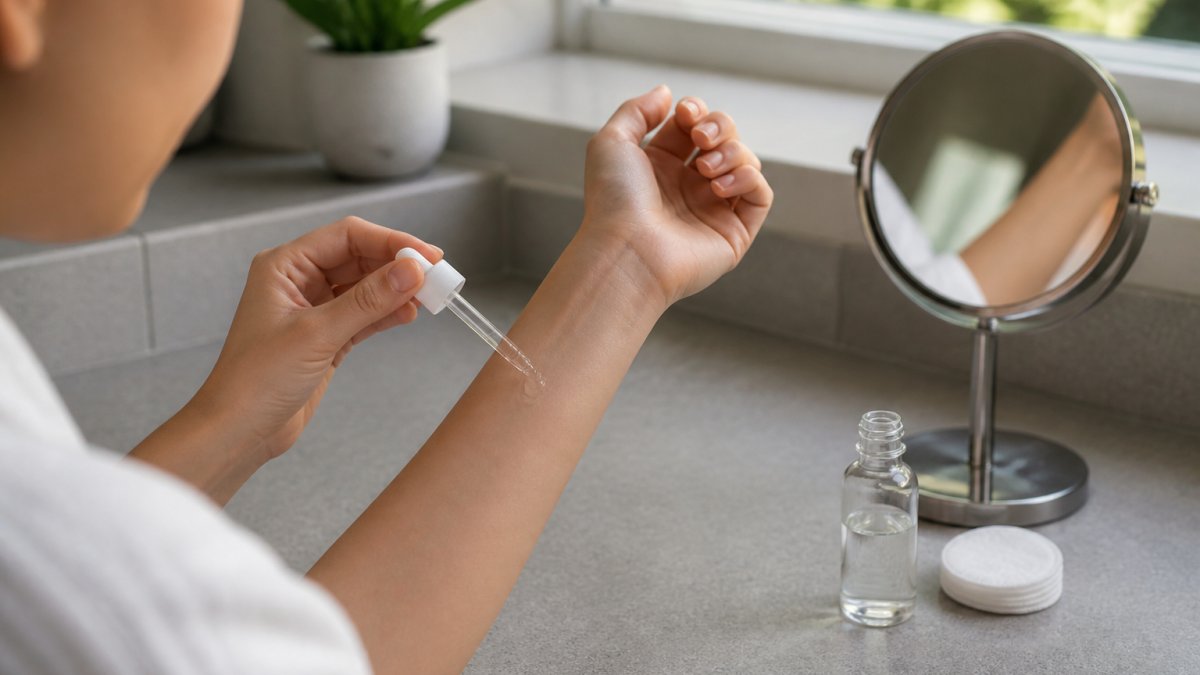
- Patch test on your inner forearm for three nights. A reaction here is a stop signal.
- Start slow with one application every second evening for the first week.
- Apply to clean, dry skin after cleansing and before heavier creams.
- Use two to three drops and press in gently, more product is not more effective.
- Follow with moisturiser to seal in hydration and support the barrier.
- Build to daily use over three to four weeks, adding a night only when the previous frequency has been tolerated for a week.
What to monitor, and when to stop
Keep a simple note of what you see each week. Use these rules:
- Mild tingling that settles within minutes is common and not a reason to stop.
- Redness, stinging or new bumps that persist beyond a few days: reduce to every third night, or pause.
- Breakouts in new areas that worsen over two weeks: stop the serum and simplify your routine to cleanser, moisturiser and sunscreen until skin settles.
- Any swelling, hives or spreading rash: stop immediately and seek advice from a pharmacist or doctor.
Combining with established acne treatments
Peptide serums are supportive, not a replacement for proven acne treatments. A cautious approach:
- Benzoyl peroxide and salicylic acid can be drying. Use the peptide serum on alternate nights or in the morning, and moisturise well.
- Retinoids speed cell turnover and can irritate. Keep them in separate layers or separate times of day (see the next section).
- Prescription treatments should be guided by your clinician. Tell them about every serum you use, including peptides.
If you want the full sequence laid out, our step-by-step peptide routine walks through it.
When to seek professional advice
See a doctor or dermatologist if acne is persistent, painful, leaving marks or scarring, or if you suspect an allergic reaction. Peptide serums are low-risk for most people, but they are not a treatment for moderate to severe acne, and no cosmetic serum should delay proper care.
Here is the introduction sequence we recommend, with the timing for each step.
| Step | What to do | Timing |
|---|---|---|
| 1 | Patch test on inner forearm | Three nights |
| 2 | Start slow with one application | Every second evening for first week |
| 3 | Apply to clean, dry skin | After cleansing, before heavier creams |
| 4 | Use two to three drops, press in gently | Each application |
| 5 | Follow with moisturiser | After the serum |
| 6 | Build to daily use | Over three to four weeks |
Copper Peptides and Retinol: Building a Routine That Works
Copper peptides and retinol can coexist, but timing matters. Retinol speeds cell turnover and can irritate; copper peptides support repair. Used together in the same layer, they can clash.
Our approach:
- Retinol at night, two to three times a week
- Copper peptides in the morning
- A barrier cream on retinol nights
For the full breakdown, read our guide to copper peptides vs retinol.
Layering Order, Frequency and What to Leave Out
Order your routine from thinnest to thickest. Cleanse, then serum, then moisturiser, then sunscreen in the morning.
Skip the urge to stack. Leave out:
- Multiple exfoliating acids in one routine
- Harsh scrubs on active breakouts
- New products introduced all at once
Start With One Serum and Give It Eight Weeks
Skin renews on its own schedule, and barrier changes take time. Eight weeks is a fair window to judge a new serum.
Start with a single copper peptide formula rather than a cabinet full of products. Our Face Serum 1 Copper Peptides is the one we'd begin with: 1% copper peptides, niacinamide and hyaluronic acid in a lightweight base, $49.00 for 30 mL.

If you're weighing options, our roundup of the best peptide serum for sensitive skin is a useful next read.
Frequently Asked Questions
Are peptide serums safe for acne-prone skin?
For most people, yes. Peptides are signalling fragments that support the skin barrier and collagen production rather than acids that strip oil, so they are generally well tolerated on oily, combination and sensitive skin. The caveat is the rest of the formula: a peptide serum built on a heavy oil base or loaded with fragrance can clog pores regardless of how gentle the peptide is. Check the full ingredient list, patch test on your jawline for five to seven days, and introduce one product at a time so you can tell what caused a reaction.
Can a peptide serum cause breakouts?
It can, but usually not because of the peptide itself. Breakouts after starting a serum typically trace back to a comedogenic carrier oil, a high concentration of fragrance or essential oils, or irritation from layering too many actives at once. There is also a timing issue: if you start a peptide serum in the same week as a new acid or retinoid, you cannot isolate the cause. Introduce it alone, keep the rest of your routine unchanged, and give it two weeks before judging. Persistent cysts or spreading redness warrant a visit to a GP or dermatologist.
Can you use copper peptides and retinol together?
You can, but separate them. Copper peptides work best at a skin-friendly pH, while retinol formulas and the acids often paired with them sit at a lower pH, and applying both at once can reduce how well each performs and raise irritation on sensitive skin. A workable split is copper peptides in the morning under sunscreen and retinol at night, or retinol at night and peptides the following morning. If your skin is reactive, start with peptides for a month before adding retinol back in.
How long before a peptide serum shows results on acne-prone skin?
Barrier comfort and hydration are usually the first changes, often within two to three weeks. Texture, tone and the look of fine lines take longer, generally eight to twelve weeks of consistent use. Peptides are not a spot treatment and will not clear an active breakout the way benzoyl peroxide or salicylic acid can. Judge them on how calm and resilient your skin feels over two months, not on whether a pimple disappeared overnight.
Building a routine that respects reactive skin takes patience, and most people quit before the eight-week mark. Pepcare Lab makes that simpler with a short, transparent lineup: a 1% copper peptide Face Serum, a Barrier Cream to lock in hydration, and simple two-step sets designed for sensitive skin. Start with one serum and give your barrier the time it needs. Get started with Pepcare Lab and build a routine your skin can actually tolerate.
