
Table of Contents
- Peptides for Aging Skin: What They Are and How They Work
- The Benefits of Peptides for Aging Skin
- Copper Peptides vs Retinol for Aging: How They Compare
- How Long Do Peptides Take to Work?
- How to Build a Peptide Skincare Routine
- Peptides vs Injectable Treatments: What You Are Actually Getting
- Frequently Asked Questions
Last Updated: September 10, 2026
Peptides for Aging Skin: What They Are and How They Work
Peptides for aging skin are short chains of amino acids that act as signalling molecules, telling your skin cells to produce more collagen and elastin. They are not a marketing invention. They are fragments of the proteins your skin already uses, and they work by mimicking the body's own repair signals. This guide explains why peptides for aging skin have become a cornerstone of evidence-based anti-aging routines, and how to use them without irritating sensitive skin.
Peptides are amino acid chains, typically 2 to 50 units long, that serve as messengers between cells. When applied topically, they can stimulate fibroblast activity and support collagen synthesis, which slows naturally with age. The American Academy of Dermatology's guidance on anti-aging ingredients notes that topical peptides are among the most studied over-the-counter options for supporting skin firmness.
Below, we break down the four peptide types, the penetration problem most brands ignore, and how to build a routine that actually delivers results.
The four peptide types used in skincare
- Signal peptides: Trigger collagen and elastin production by mimicking the body's wound-repair signals.
- Carrier peptides: Deliver trace elements like copper to enzymes involved in skin remodelling. GHK-Cu is the best-known example.
- Neurotransmitter-inhibiting peptides: Relax expression lines by interfering with the nerve signals that cause muscle contraction.
- Enzyme-inhibiting peptides: Slow collagen degradation by blocking the enzymes that break it down.
Each type targets a different part of the aging process.
Molecular weight and why it decides whether a peptide works
A peptide's molecular weight determines whether it can penetrate the skin barrier at all. Anything above roughly 500 Daltons struggles to cross the stratum corneum, which is why carrier peptides like GHK-Cu, at around 340 Daltons, are favoured in topical formulations (PubMed). This is the detail most marketing copy skips: a peptide that cannot reach the dermis cannot stimulate fibroblasts, no matter how impressive the ingredient list looks.
The Benefits of Peptides for Aging Skin
The core benefit of peptides for aging is collagen support. As collagen degradation outpaces synthesis with age, skin loses firmness and fine lines deepen. Peptides intervene by stimulating fibroblasts, the cells responsible for producing collagen and elastin, while also supporting the dermal matrix that gives skin its structure.

Beyond collagen, peptides offer several advantages for mature skin:
- Skin barrier repair: Certain peptides support the lipid barrier, reducing water loss and sensitivity.
- Anti-inflammatory properties: Copper peptides in particular have been studied for their calming effect on irritated skin.
- Improved skin texture: Consistent use supports smoother texture and more even tone.
- Photoaging support: Peptides can help address some effects of UV-driven collagen damage.
Many people with sensitive skin find peptides easier to tolerate than stronger actives, which is why they suit barrier-focused routines.
Copper Peptides vs Retinol for Aging: How They Compare
Copper peptides and retinol are the two most evidence-supported over-the-counter actives for aging skin, but they act on entirely different parts of the aging process. Understanding the mechanism difference is what lets you decide which one your skin actually needs, or whether you should use both.
How each one works
- Retinol is a vitamin A derivative. It binds to retinoic acid receptors in skin cells and accelerates cell turnover, thinning the stratum corneum over time and stimulating collagen in the dermis. It is the most studied topical anti-aging ingredient available without a prescription, and its effects on fine lines and pigmentation are well documented.
- Copper peptides, most commonly GHK-Cu, act as carrier peptides. They deliver copper ions to enzymes involved in tissue remodelling and support fibroblast activity, collagen synthesis and the skin barrier. Their mechanism is signalling and repair rather than turnover.
That difference explains the tolerability gap. Retinol works by disrupting the skin's surface, which is why the first four to six weeks typically bring flaking, redness and a stinging sensation (the American Academy of Dermatology). Copper peptides work with the barrier rather than against it, so most people can start daily use without a purge period.
| Feature | Copper peptides | Retinol |
|---|---|---|
| Primary mechanism | Collagen signalling, barrier support, antioxidant activity | Cell turnover acceleration, retinoic acid receptor binding |
| Onset of visible change | 8-12 weeks | 8-12 weeks, with a 4-6 week adjustment period |
| Irritation risk | Low | Moderate to high, especially in the first month |
| Sun sensitivity | None | Increased, daily sunscreen is non-negotiable |
| Pregnancy suitability | Generally considered suitable topically | Not recommended |
| Layering tolerance | Pairs with most actives | Requires careful pairing and buffering |
| Best suited to | Sensitive, reactive, barrier-compromised skin | Tolerant skin targeting deeper lines and pigmentation |
Can you use both?
Yes, and many dermatologists consider the combination more effective than either alone, because the two mechanisms are complementary rather than redundant. The practical constraint is timing and pH.
- Alternate nights is the simplest approach: retinol two or three nights a week, copper peptides on the other nights. This avoids the irritation stacking that happens when both are used in the same routine.
- Same routine, separated steps is possible for tolerant skin. Apply the copper peptide serum first, wait for it to absorb fully, then apply a low-strength retinol. Do not mix them in the palm of your hand.
- Never layer copper peptides with strong acids, glycolic, salicylic or ascorbic acid at low pH, in the same step. The acidic environment can destabilise the copper-peptide complex and reduce its activity. Separate them by at least 20 minutes, or use them on different days.
A note on injectable peptides
Copper peptides in a serum are cosmetic ingredients. Injectable peptides used in clinical settings, including some marketed for skin remodelling, are regulated differently and must be administered by a registered practitioner. They are not interchangeable with a topical serum, and no topical product can replicate the volume effect of an in-clinic injectable. If a brand implies otherwise, treat that as a red flag.
The short version
If your skin is sensitive, reactive or new to actives, start with copper peptides. If your skin tolerates retinol well and you want to target pigmentation and deeper lines, retinol remains the stronger single agent. If you can manage both, alternating them gives you turnover and repair support without overwhelming the barrier.
How Long Do Peptides Take to Work?
Most people notice early hydration and texture changes within two to four weeks of consistent use. Visible improvements in firmness and fine lines typically take eight to twelve weeks, because collagen remodelling is a slow biological process. Anyone promising overnight results is overselling.
A realistic timeline looks like this:
- Weeks 1-2: Improved hydration and skin comfort.
- Weeks 3-6: Smoother texture, calmer barrier.
- Weeks 8-12: Early changes in firmness and fine line appearance.
- Beyond 12 weeks: Continued support with ongoing use.
How to Build a Peptide Skincare Routine
A peptide routine works best when it is simple. The order you apply products, the pH of what you layer around them, and the ingredients you pair them with all affect whether the peptides reach the skin intact.
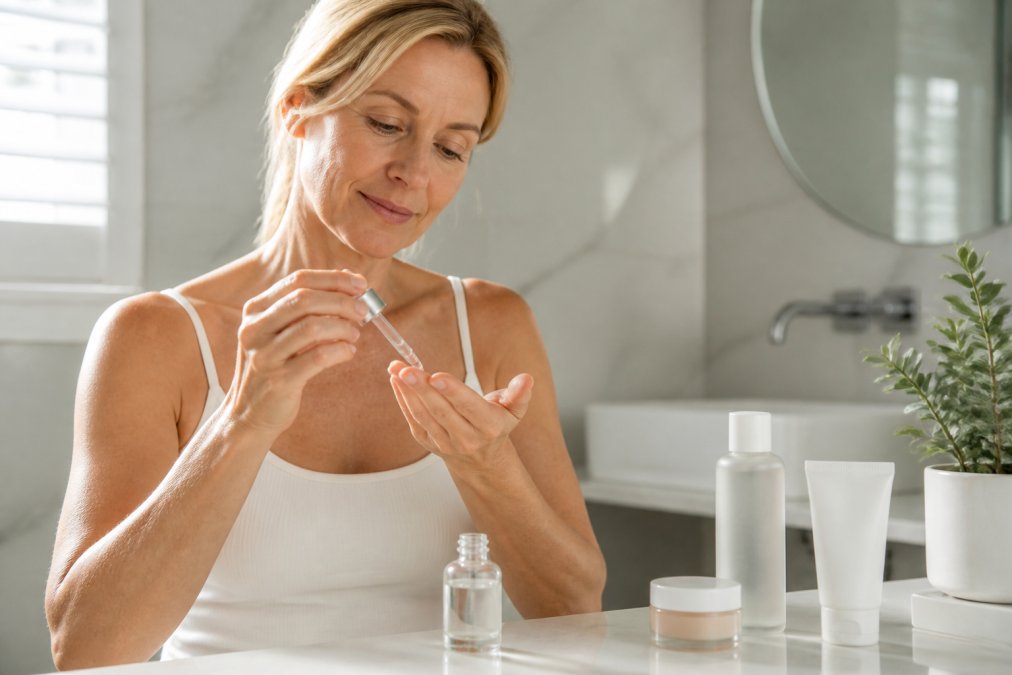
The core sequence
- Cleanse with a gentle, non-stripping cleanser. Avoid foaming cleansers with high surfactant loads, which can leave the barrier compromised before you have applied anything.
- Apply peptide serum to slightly damp skin. Damp skin improves spreadability and reduces the amount of product needed. Press rather than rub, friction is not helpful here.
- Follow with a barrier cream to seal in hydration. Look for squalane, ceramides, glycerin or niacinamide. These support the lipid barrier the peptides are working to reinforce.
- Use sunscreen every morning. UV exposure degrades collagen faster than peptides can support it. Without daily SPF, the rest of the routine is working against a headwind.
What to layer with peptides, and what to avoid

Peptides are generally compatible with most skincare ingredients, but a few pairings need care:
- Hyaluronic acid: layer underneath the peptide serum. It is pH-neutral and adds hydration without interfering.
- Niacinamide: compatible and often formulated alongside peptides. It supports the barrier and helps with tone.
- Vitamin C (L-ascorbic acid): use in the morning, peptides in the evening, or separate by at least 20 minutes. L-ascorbic acid is formulated at low pH, which can destabilise some peptide complexes.
- Retinol: alternate nights rather than layering in the same step. See the comparison section above for the full protocol.
- Strong acids (glycolic, salicylic, lactic): do not apply in the same step as copper peptides. Separate by 20 minutes or use on different days.
- Benzoyl peroxide: avoid layering with peptides. It is a strong oxidising agent and can degrade peptide structures.
Adjusting the routine for your skin type
- Sensitive or reactive skin: start with a single peptide serum at night, three times a week, and build to daily use over four weeks. Skip retinol entirely until the barrier is stable.
- Dry or mature skin: layer the peptide serum under a richer barrier cream and consider a hyaluronic acid step before the serum.
- Oily or combination skin: a lightweight peptide serum in a gel or water base is sufficient. You do not need a heavy cream on top unless the barrier is compromised.
- Post-procedure skin: peptide serums are often well tolerated after in-clinic treatments, but follow your practitioner's advice on when to resume actives.
How long before you see anything
Most people notice improved hydration and skin comfort within two to four weeks. Texture changes typically appear between weeks three and six. Visible firmness and fine-line improvement take eight to twelve weeks, because collagen remodelling is a slow biological process. Anyone promising overnight results is overselling.
Consistency matters more than concentration. The routine only works if you keep it.
Pepcare Lab's Face Serum pairs 1% copper peptides with niacinamide and hyaluronic acid, and the Barrier Cream seals the routine with squalane and skin-conditioning ingredients. For a complete face and scalp routine, the Complete Collection covers both.

Peptides vs Injectable Treatments: What You Are Actually Getting
Topical peptides and injectables like dermal fillers operate in completely different ways. Injectables physically add volume beneath the skin and are administered in a clinical setting. Topical peptides support the skin's own collagen production over time. They are not substitutes for one another.
What topical peptides offer is a realistic path to supporting skin health every day. They will not replicate the immediate effect of an in-clinic treatment, but they also carry no downtime, no needles, and no risk of overcorrection. For anyone wanting to support collagen synthesis without invasive procedures, a well-formulated peptide routine is a practical starting point.
The distinction matters because it sets expectations. Peptides are a long-term investment in skin function, not a quick fix.
Aging skin responds best to consistent, gentle support rather than aggressive intervention. Pepcare Lab builds science-led, peptide-focused formulations around 1% copper peptides, designed for sensitive skin and simple three-step routines. The Face Duo pairs the Face Serum with the Barrier Cream for $79, and free standard shipping applies to all orders. Get started with Pepcare Lab and support your skin barrier, collagen production, and long-term renewal with a routine you will actually keep.
Frequently Asked Questions
Do peptides really work for aging skin?
They support the skin rather than resurface it. Peptides are short amino acid chains that signal fibroblasts to produce more collagen and elastin, the proteins that keep skin firm. Because they work through cellular communication rather than acid exfoliation, results build gradually. Peptides for aging skin are best judged on skin firmness, hydration and barrier comfort over months, not overnight smoothing. They pair well with ingredients like niacinamide and hyaluronic acid.
Which is better for aging skin, retinol or peptides?
They do different jobs. Retinol speeds cell turnover and is well documented for fine lines and wrinkles, but it commonly causes peeling, redness and sun sensitivity, which is difficult for reactive skin. Peptides support collagen synthesis and skin barrier repair without that adjustment period. Many people use retinol two or three nights a week and peptides every day. If your skin stings easily, start with peptides and add retinol later.
How long do peptides take to work?
Expect the first changes in hydration and skin texture within two to four weeks, because barrier support shows up quickly. Collagen-related changes such as improved skin firmness and softened fine lines typically take eight to twelve weeks of consistent twice-daily use. Peptides are not exfoliants, so there is no dramatic overnight shift. Photograph your skin in the same light each month rather than checking daily.
Are peptides safe for sensitive skin?
Generally yes, and they are often recommended when retinol and strong acids cause irritation. Peptides work through signalling rather than stripping the skin, and copper peptides have anti-inflammatory properties that suit compromised barriers. Patch test on your inner forearm for three days before full-face use. Avoid layering peptides directly with strong exfoliating acids in the same step, as low pH can reduce how well the peptide complex performs.
Can peptides be used alongside vitamin C and other actives?
Yes, with sensible sequencing. Use vitamin C in the morning and peptides in the evening, or apply vitamin C first and wait a few minutes before your peptide serum. Avoid mixing peptides into the same layer as glycolic or salicylic acid, since the acidic environment can affect peptide stability. Niacinamide, hyaluronic acid and squalane all pair well with peptides and support the dermal matrix alongside them.
What is the difference between topical peptides and injectable peptides?
Topical peptides sit on the skin and rely on transdermal absorption, which is why molecular weight matters so much. Injectable peptides are delivered below the skin, bypassing the barrier entirely, and are regulated as prescription medicines or therapeutic goods rather than cosmetics. They are not interchangeable, and a serum cannot replicate what an injection does. For home use, topical application is the practical option and carries far lower risk.