
Table of Contents
- Copper Peptides for Sun Damaged Skin: What the Evidence Shows
- Copper Peptide Side Effects and Irritation: What Sensitive Skin Needs to Know
- How to Use Copper Peptides in Your Skincare Routine
- Copper Peptides vs Retinol for Sun Damage: Which Approach Fits You
- Ingredient Interaction Safety: What to Layer and What to Separate
- Pepcare Lab Copper Peptide Products Reviewed
- Conclusion: Building a Routine That Supports Sun-Damaged Skin
- Frequently Asked Questions
Last Updated: October 2, 2026
Copper Peptides for Sun Damaged Skin: What the Evidence Shows
Copper peptides are short chains of amino acids bound to copper ions; the best-studied form, GHK-Cu, is a naturally occurring compound that supports skin repair after UV exposure. This guide from Pepcare Lab examines what copper peptides for sun damaged skin reviews report.
Sun damage accumulates quietly: years of incidental exposure leave fine lines, mottled pigmentation and a weakened barrier. Copper peptides are among the few topical ingredients studied specifically for that deeper repair process.
How GHK-Cu Supports Epidermal Repair and Collagen Synthesis
GHK-Cu works by signalling, not stripping: the copper ion carries repair messages to skin cells while the peptide fragment supports renewal.
Three mechanisms matter most for sun-induced aging:
- Collagen synthesis support. GHK-Cu is studied for its role in supporting the skin's natural collagen production, which declines as photodamage accumulates.
- Antioxidant support. Copper peptides help the skin manage oxidative stress, the same process that drives much of sun-induced aging.
- Barrier function. By supporting the dermal matrix and epidermal repair, copper peptides help skin retain moisture and resist irritation.
According to research indexed by the National Center for Biotechnology Information, GHK-Cu has been examined for its role in wound healing and skin remodelling. The research is early-stage, but it points in a consistent direction.
Copper peptides are not exfoliants: they support repair from underneath rather than resurfacing skin, making them a better fit for sensitive or reactive skin than aggressive actives.
Copper Peptide Side Effects and Irritation: What Sensitive Skin Needs to Know
Copper peptide side effects are uncommon, but sensitive skin can still react: mild redness, tingling, and dryness when concentration is too high or the product is layered with strong acids.
The ingredient is generally well tolerated because it works with the skin rather than stripping it. To reduce irritation risk:
- Start with a lower concentration. A 1% copper peptide serum is a sensible entry point before moving to higher strengths.
- Patch test first. Apply to the inner forearm for two or three evenings before using it on the face.
- Avoid pairing with strong acids at the same time. Glycolic and salicylic acid can compromise the barrier and make irritation more likely.
- Introduce one new product at a time. If you add copper peptides and retinol in the same week, you will not know which one caused a reaction.
If your skin is already reactive, a non-acid regimen of copper peptides and a barrier cream is the safer start.

How to Use Copper Peptides in Your Skincare Routine
Using copper peptides well comes down to order, timing and consistency. Apply them to clean skin before heavier moisturisers, and give the routine several weeks before judging results.
Sun-damaged skin needs a split routine, because repair and protective ingredients belong at different times of day. Below is an AM/PM protocol for photodamaged, reactive skin.
The AM Routine: Protect First
- Cleanse gently. Use a non-stripping cleanser and lukewarm water; hot water worsens barrier function and triggers reactive skin.
- Antioxidant layer (optional). If you use a vitamin C serum, apply it here, on dry skin. Wait 60 seconds before the next step.
- Moisturise. A lightweight lotion or the barrier cream, depending on how dry your skin feels.
- Broad-spectrum SPF 50+. Non-negotiable: unprotected exposure undoes repair work, so reapply every two hours outdoors.
Copper peptides are deliberately not in the morning routine if you also use vitamin C: the low pH of an L-ascorbic acid serum can destabilise the copper peptide complex, so separate the two by time.

The PM Routine: Repair While You Sleep
- Cleanse gently. Remove sunscreen and the day's buildup with the same non-stripping cleanser.
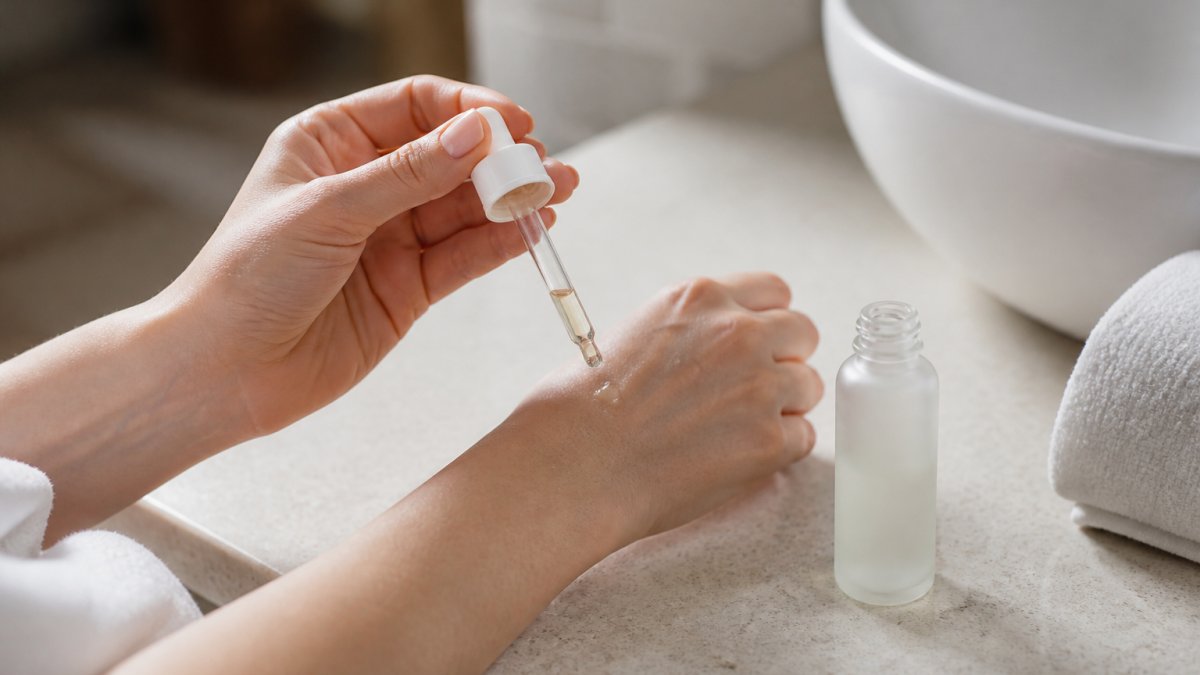
- Apply the copper peptide serum. Smooth a few drops over the face and neck on slightly damp skin. This is the step that supports collagen synthesis and epidermal repair.
- Wait 60 seconds. Let the serum absorb before the next layer so it is not diluted by the cream.
- Seal with a barrier cream. Lock in hydration and support the skin barrier overnight.
If you also use retinol, do not stack it on the same evening as your copper peptide serum while your barrier is compromised. Alternate evenings instead: copper peptides one night, retinol the next.
Timing, Frequency and What to Expect
| Stage | What to do | What you may notice |
|---|---|---|
| Weeks 1-2 | Copper peptide serum every second evening | Improved hydration and comfort |
| Weeks 3-4 | Move to nightly if no irritation | Skin feels calmer, less tight |
| Weeks 8-12 | Maintain nightly use | Subtle changes to texture and fine lines |
Consistency matters more than concentration: a 1% serum used nightly for three months typically outperforms a 2% serum used twice a week.
If your skin is reactive, start with the PM routine alone, cleanser, copper peptide serum, barrier cream, and add the morning antioxidant once your barrier feels stable.
Copper Peptides vs Retinol for Sun Damage: Which Approach Fits You
Copper peptides and retinol both target sun-induced aging but work through different mechanisms and suit different skin types. The choice comes down to tolerance, not potency, and for photodamaged skin, the better question is how to use both without wrecking the barrier.
How Each One Actually Works on Photodamage
Retinol is a vitamin A derivative that accelerates cell turnover, speeding the shedding of pigmented surface cells and stimulating collagen deeper in the dermis.
Copper peptides take the opposite approach. GHK-Cu signals the skin's own repair processes, collagen synthesis, antioxidant defence and barrier function, without retinol's peeling and redness. Progress is slower but easier to maintain, and it does not increase sun sensitivity.
| Factor | Copper Peptides | Retinol |
|---|---|---|
| Primary action | Supports repair and collagen synthesis via signalling | Accelerates cell turnover |
| Irritation risk | Low, suitable for sensitive skin | Moderate to high |
| Typical timeline | Gradual, over several weeks | Visible within weeks, with a purge phase |
| Sun sensitivity | Low | Increased, requires strict SPF |
| Best for | Reactive, dry or barrier-compromised skin | Resilient skin targeting texture and lines |
The Safe vs Avoid Matrix for Sun-Damaged Skin
When your barrier is already compromised by UV exposure, the question is not just which active to use but what can safely sit alongside copper peptides.
| Ingredient | Layer with Copper Peptides? | Why |
|---|---|---|
| Hyaluronic acid | Yes | Hydration supports absorption, no conflict |
| Niacinamide | Yes | Complementary barrier support, well tolerated together |
| Mineral SPF | Yes | Apply after, in the morning |
| Ceramides and squalane | Yes | Barrier support reinforces the peptide's work |
| Vitamin C (L-ascorbic acid) | Separate | Low pH can destabilise the peptide; use at different times |
| Retinol | Separate | Combined use raises irritation risk on sensitive skin |
| Glycolic or salicylic acid | Separate | Acid exfoliation compromises the barrier |
| Benzoyl peroxide | Avoid | Oxidising agent can degrade the peptide complex |
The practical rule: keep your copper peptide serum in a simple, non-acid routine and move strong actives to a different time of day. Vitamin C in the morning and copper peptides in the evening is a clean split; with retinol, alternate evenings.
Which Should You Start With?
If your skin is resilient and your main concern is texture and lines, retinol is the better-established option, with copper peptides alongside it on alternate evenings. If your skin is reactive, dry or barrier-compromised, start with copper peptides alone and reintroduce retinol later at low strength, only if you can commit to daily sunscreen, because retinol without consistent SPF makes photodamage worse.
Ingredient Interaction Safety: What to Layer and What to Separate
Layering copper peptides safely means avoiding combinations that destabilise the peptide or overwhelm the barrier. Most ingredients pair well; a few should be separated by time.
| Ingredient | Layer With Copper Peptides? | Why |
|---|---|---|
| Hyaluronic acid | Yes | Hydration supports absorption, no conflict |
| Niacinamide | Yes | Complementary barrier support, well tolerated together |
| Mineral SPF | Yes | Apply after, in the morning |
| Vitamin C (L-ascorbic acid) | Separate | Low pH can destabilise the peptide; use at different times |
| Retinol | Separate | Combined use raises irritation risk on sensitive skin |
| Glycolic or salicylic acid | Separate | Acid exfoliation compromises the barrier |
The practical rule: keep your copper peptide serum in a simple, non-acid routine and move strong actives to a different time of day, vitamin C in the morning, copper peptides in the evening.
Pepcare Lab Copper Peptide Products Reviewed
Pepcare Lab builds its range around 1% and 2% copper peptide formulas, with a deliberately short product list: three or four products cover the routine without a ten-step regimen.
Face Serum: The Entry Point for Photodamaged Skin
The Face Serum is the simplest starting point: 1% copper peptides with niacinamide and hyaluronic acid in a lightweight 30 mL formula, designed to support smoother, firmer, more radiant-looking skin.
This is the product most people should buy first: it absorbs quickly, sits comfortably under a moisturiser, and suits daily use. At $49.00, it is a low-commitment way to see how your skin responds to copper peptides.
Where it falls short: if your skin is very dry, the serum alone will not be enough. You will want the Barrier Cream over the top.
Face Duo and Barrier Cream: Supporting the Skin Barrier
The Barrier Cream is a rich yet lightweight moisturiser with 1% copper peptides, niacinamide and squalane, designed to lock in hydration after the serum and support a resilient-looking barrier.
The Face Duo pairs the serum and cream for $79.00, saving $19 against buying separately, with free Australian shipping, the sensible buy if you want both steps.
For photodamaged skin, this pairing does the heavy lifting: the serum supports repair while the cream holds the barrier together.
Complete Collection: Face, Skin, and Scalp in One Routine
The Complete Collection adds a 2% copper peptide Hair & Scalp Serum and a scalp massage brush to the face routine, for $149.00 with $37 saved and free shipping.
This is the pick for anyone dealing with both skin and early hair thinning, keeping everything in one coordinated system. If you only need face care, the Face Duo is the better value.
Conclusion: Building a Routine That Supports Sun-Damaged Skin
Sun-damaged skin needs repair support and barrier protection working together.
The Face Serum and Barrier Cream handle the core routine, while the Complete Collection extends the same approach to scalp and hair, all formulated around copper peptides, niacinamide and barrier-supporting ingredients.
Get started with Pepcare Lab and build a routine that supports your skin barrier while it repairs.
Frequently Asked Questions
Do copper peptides help with sun-damaged skin?
Copper peptides, particularly GHK-Cu, support skin repair by encouraging collagen synthesis and helping calm inflammation linked to sun-induced aging. They assist the skin's natural renewal process, which can improve the appearance of fine lines, mottled pigmentation, and rough texture over time. They work best as part of a consistent routine that includes sun protection, because they support repair rather than reverse existing damage on their own.
How long does it take for copper peptides to show results on sun damage?
Most people notice early changes in hydration and skin texture within four to six weeks of daily use. Visible improvements in fine lines and mottled pigmentation typically take three to six months, because collagen synthesis and dermal remodeling happen gradually. Consistency matters more than concentration. Using a 1% copper peptide serum daily, such as the Pepcare Lab Face Serum, gives your skin steady support without overwhelming it.
Can you use copper peptides with vitamin C for sun damage?
Copper peptides and vitamin C can be used in the same routine, but timing matters. Apply vitamin C in the morning and copper peptides in the evening, or wait at least 30 minutes between them if using both in one session. This separation avoids potential interaction at the skin surface while letting each ingredient do its job. If your skin is sensitive, introduce one at a time to see how it responds.
Are copper peptides safe for sensitive, sun-damaged skin?
Copper peptides are generally well tolerated, including on sensitive skin, because they support barrier function rather than stripping it. Start with a lower concentration, patch test on your inner arm for 24 hours, and apply every second day before moving to daily use. Signs of irritation such as persistent redness or stinging should ease when you reduce frequency. A non-acid regimen built around copper peptides can suit skin that reacts to retinol or strong exfoliants.
What are the side effects of using copper peptides on damaged skin?
The most common side effects are mild redness, tingling, or dryness when you first start, especially if your barrier is already compromised from sun exposure. These usually settle within a week or two as your skin adjusts. Using copper peptides alongside strong acids or retinol can increase the chance of irritation, so layer them at different times of day. If irritation persists, stop use and let your skin recover before reintroducing the product.