
Table of Contents
- Can You Use Copper Peptides and Retinol Together?
- Copper Peptides vs Retinol for Anti-Ageing: What Each One Does
- The Right Peptide Skincare Routine Order for Combining Actives
- How to Layer Skincare Products for Sensitive Skin Without Irritation
- Concentration Guidelines and Skin Barrier Repair
- Common Mistakes to Avoid When Combining These Actives
- Frequently Asked Questions
Last Updated: September 15, 2026
Can You Use Copper Peptides and Retinol Together?
Yes, you can use copper peptides and retinol together, but the timing matters more than most advice admits. This guide from Pepcare Lab explains how to combine copper peptides with retinol without wrecking your skin barrier.

The short answer: use them at opposite ends of the day. Retinol at night, copper peptides in the morning. That single scheduling decision sidesteps most of the problems people run into.
Copper peptides are short chains of amino acids bound to copper ions, most commonly the GHK-Cu complex. They support collagen production, wound healing signalling and skin barrier function. Retinol is a vitamin A derivative that speeds up cellular turnover and remodels the epidermis over time.
Both ingredients work. They just work through different pathways, at different pH levels, and at different times of day. Stacking them in the same layer is where things go wrong.
Why Some Sources Say They Clash
The clash warnings usually trace back to one mechanism: pH and stability.
Retinol performs best in a formulation around pH 5.5 to 6 (pubmed.ncbi.nlm.nih.gov). Copper peptides are stable across a wider range but can degrade when the environment shifts too far, particularly in strongly acidic vehicles. Some older guidance also flagged concerns about copper ions and retinoid degradation occurring in the same formula.
That concern is real in a single bottle. It is far less relevant when the two products sit in separate routines twelve hours apart.
What the pH and Stability Research Actually Shows
Stability is a formulation problem, not an ingredient feud. A well-made retinol serum buffers its own pH. A well-made copper peptide serum protects the peptide complex in its own vehicle.
When you apply them in separate routines, the skin's surface pH normalises within roughly 30 minutes of cleansing (pubmed.ncbi.nlm.nih.gov). That means the second product is not fighting the first one's chemistry.
What matters more is what you put between them. A barrier-supporting moisturiser applied after each active reduces irritation potential and supports the skin barrier while both ingredients do their work.
Copper Peptides vs Retinol for Anti-Ageing: What Each One Does
Copper peptides and retinol for anti-ageing work on overlapping but distinct problems, which is exactly why they pair well when scheduled correctly.
Copper peptides support collagen synthesis, help calm inflammation and reinforce the skin barrier. They suit sensitive skin because they rarely trigger the peeling and redness that retinoids can cause.
Retinol accelerates cellular turnover, softens fine lines and improves texture. It is the more aggressive of the two and the one that demands acclimatisation.
| Active | Primary Action | Best Time | Skin Sensitivity Risk | Barrier Support |
|---|---|---|---|---|
| Copper peptides | Collagen support, barrier repair | Morning | Low | High |
| Retinol | Cellular turnover, texture | Evening | Moderate to high | Low |
For sensitive skin, the peptide does the heavy lifting early on while the retinoid builds tolerance slowly.
The Right Peptide Skincare Routine Order for Combining Actives
Getting the peptide skincare routine order right is simpler than the ingredient list makes it look. The rule is thin to thick, water-based before oil-based, and actives before moisturiser.
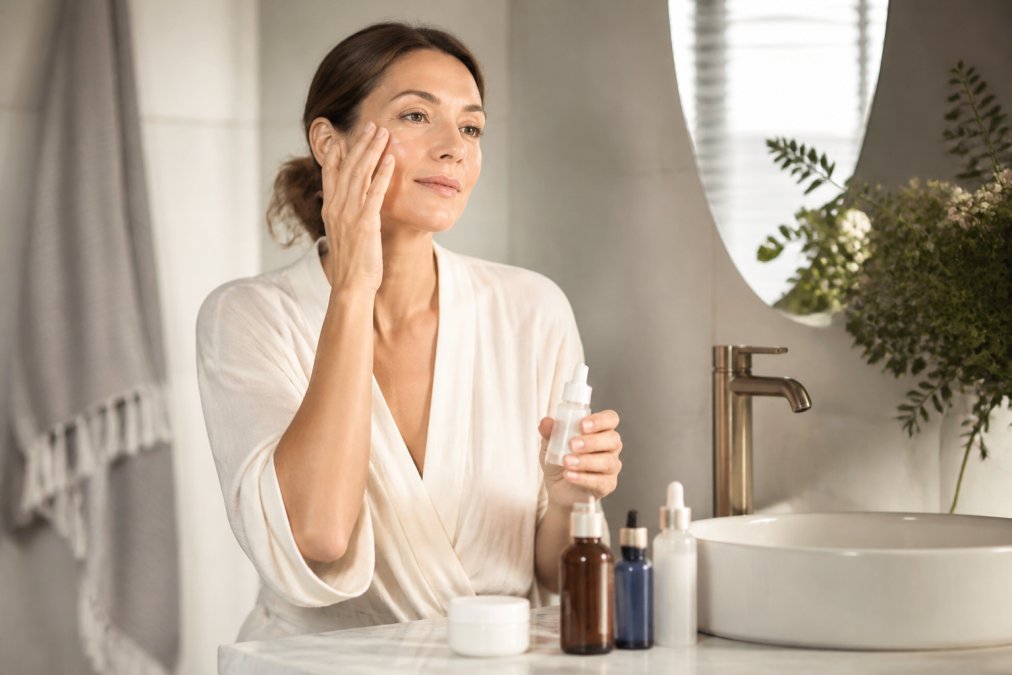
Morning Routine
- Cleanse with a gentle, non-stripping cleanser
- Apply copper peptide serum to damp skin
- Follow with a barrier cream
- Finish with broad-spectrum sunscreen
The morning slot belongs to copper peptides because they support the barrier through the day and layer cleanly under sunscreen.

Evening Routine
- Cleanse and pat dry
- Wait until skin is completely dry
- Apply a pea-sized amount of retinol
- Follow with a barrier cream
Dry skin before retinol reduces irritation. Damp skin increases penetration, which is not what you want while acclimatising.
How to Layer Skincare Products for Sensitive Skin Without Irritation
Learning how to layer skincare products for sensitive skin comes down to one principle: introduce one active at a time and never increase two variables in the same week.
Start with the peptide serum alone for two weeks. Your barrier needs to be stable before retinol enters the picture. Once it is, add retinol twice a week at night.
Patch Testing and Acclimatisation Schedule
Patch testing is not optional for sensitive skin. Apply a small amount behind the ear or on the inner forearm, wait 24 hours, then check for redness, itching or stinging.
| Week | Retinol Frequency | Peptide Frequency | Goal |
|---|---|---|---|
| 1-2 | None | Daily, morning | Establish barrier baseline |
| 3-4 | Twice weekly | Daily, morning | Introduce retinoid |
| 5-6 | Every other night | Daily, morning | Build tolerance |
| 7+ | Nightly if tolerated | Daily, morning | Maintenance |
If irritation appears, drop back one stage for a week. Acclimatisation is not a race.
Concentration Guidelines and Skin Barrier Repair
Concentration determines whether this pairing works or backfires, and the guidance changes depending on whether you are using an over-the-counter retinol or a prescription retinoid. Most articles lump them together. They should not be.
Over-the-counter retinol
- Start at the lowest concentration you can find, typically 0.2% to 0.3% (pubmed.ncbi.nlm.nih.gov).
- Move to 0.5% only after a full month of comfortable use at the lower strength.
- Encapsulated or sustained-release retinol formulations are gentler and pair more easily with peptides because they deliver the active more slowly.
Prescription retinoids (tretinoin, adapalene, tazarotene)
These are a different category. They are far more potent, far more irritating, and far less forgiving of a rushed routine.
- If you are on a prescription retinoid, do not introduce copper peptides in the same week. Establish tolerance to the retinoid first, often two to three months.
- Once tolerated, keep the peptide in the morning and the prescription retinoid at night. Never layer them.
- On retinoid nights, skip the peptide entirely and lean on barrier ingredients instead. The peptide's job is to repair what the retinoid disrupts; doing both at once defeats the purpose.
- If your prescriber has you on a short-contact or alternate-night schedule, follow that over any general advice here.
Copper peptide concentration
A 1% copper peptide serum is a sensible, well-tolerated strength for daily use. Higher percentages are not automatically better, the peptide works through signalling, not through brute concentration, and more copper does not mean more collagen.
Why higher retinol is not better
Higher retinol concentrations do not deliver proportionally better results. They deliver more irritation, more peeling and more downtime. The pattern most practitioners observe is that consistent low-dose use over months outperforms aggressive escalation that forces repeated breaks.
Barrier repair is the other half of the equation
Between retinol nights, prioritise:
- Ceramides, rebuild the lipid matrix that retinoids thin out.
- Niacinamide, supports barrier function and calms redness.
- Squalane, an occlusive that reduces water loss without clogging pores.
- Hyaluronic acid, draws water into the upper layers.
- Panthenol and centella, soothing agents for reactive skin.
These are not filler ingredients; they are what allow you to keep using the actives at all.
Common Mistakes to Avoid When Combining These Actives
The mistakes are predictable, and so are the fixes.
Frequently Asked Questions
What should I not mix copper peptides with?
Avoid applying copper peptides at the same time as strong acids like glycolic or salicylic acid, and keep them away from high-dose vitamin C serums in the same layer. These ingredients sit at very different pH levels, and mixing them directly can reduce how well the copper peptides absorb. The simpler approach is to separate them: use vitamin C or acids in the morning, then apply your copper peptides in the evening. If you use retinol, alternate nights rather than layering everything at once.
Do peptides go on before or after retinol?
If you use both on the same evening, apply the retinol first and wait 10 to 15 minutes before following with your copper peptide serum. Retinol is the thinner, more active layer and needs to go onto clean skin to work properly. The peptide serum then goes on top, followed by a barrier cream to seal everything in. Many people with sensitive skin find it easier to alternate: retinol one night, copper peptides the next.
Can copper peptides and retinol be used in the same routine?
Yes, they can be used in the same routine, just not always in the same layer at the same moment. Copper peptides support collagen production and skin barrier repair, while retinol speeds up cellular turnover. Used together over time, they address different parts of the ageing process. The key is timing: alternate nights for the first few weeks, then try layering on the same evening once your skin has adjusted. Always finish with a moisturiser.
How often should I use copper peptides on my face?
Copper peptides are generally well tolerated and can be used twice daily, morning and evening, once your skin has adjusted. Start with once daily for the first week if your skin is sensitive, then build up. Unlike retinol, copper peptides do not cause the same peeling or flaking, so most people do not need a rest period. If you are also using retinol, apply the peptides on your retinol-free nights or layer them after the retinol has absorbed.