
Table of Contents
- What the Skin Barrier Actually Does
- 7 Signs Your Skin Barrier Is Compromised
- What Causes a Compromised Skin Barrier
- How to Repair Damaged Skin Barrier
- Best Ingredients for Skin Barrier Repair
- How Long to Heal Skin Barrier (and What Slows It Down)
- Barrier-Safe Makeup and the Psychological Toll of Chronic Flare-Ups
- Frequently Asked Questions
Last Updated: September 14, 2026
What the Skin Barrier Actually Does
Your skin barrier is the outermost layer of skin, a thin sheet of cells and lipids that keeps water in and irritants out. When it works, you barely notice it. When it fails, everything stings.
At Pepcare Lab, we explain it this way: the barrier is a brick wall. Skin cells are the bricks, and a lipid bilayer of ceramides, cholesterol and fatty acids is the mortar. That mortar controls transepidermal water loss and maintains your acid mantle, the slightly acidic film that keeps your microbiome and pH stable.
Break the mortar and two things happen: moisture drains out, leaving skin tight and flaky, and irritants move in, triggering inflammation, erythema and stinging.
So the real question isn't whether your barrier matters. It's how to tell if your skin barrier is compromised before the damage compounds.
7 Signs Your Skin Barrier Is Compromised
The clearest sign of a compromised skin barrier is skin that reacts to products it previously tolerated. That shift from "fine" to "stings on contact" tells you more than any single symptom.
Watch for these seven signs:
- Stinging or burning when you apply products that never bothered you before
- Persistent tightness within minutes of washing your face
- Flakiness and rough patches that moisturiser doesn't fix
- Redness or erythema that lingers after cleansing
- Dullness where your skin used to look plump
- Breakouts in unusual places, often alongside dryness
- Increased sensitivity to heat, cold or wind
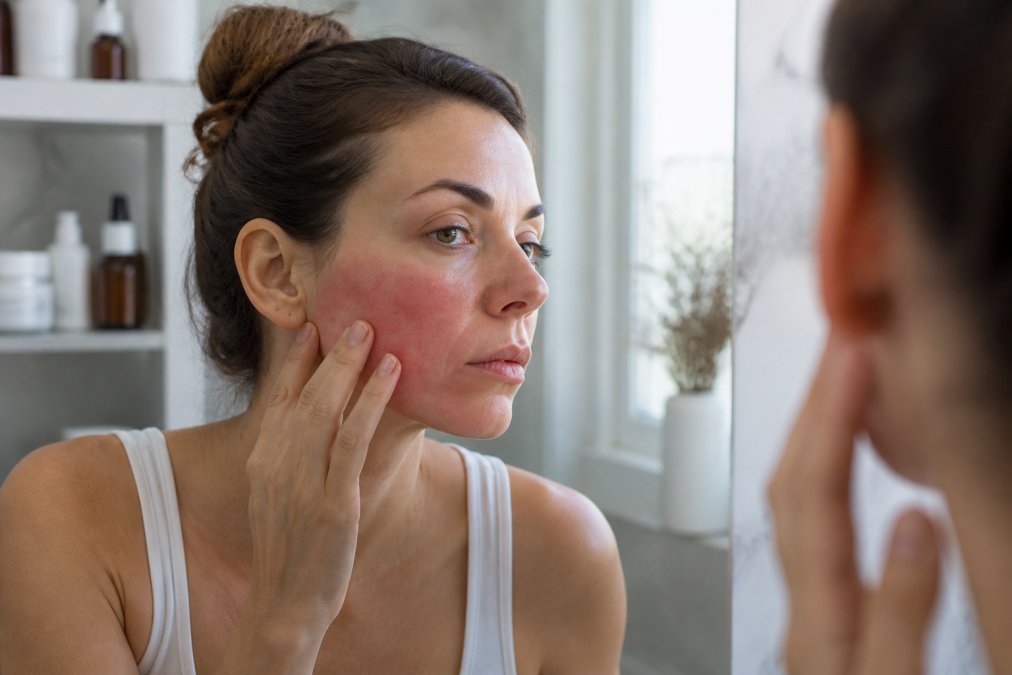
The signs that matter most
Stinging plus tightness together is the strongest signal. Redness alone can mean a dozen things. Stinging on contact with water-based products points squarely at a damaged barrier.
A common mistake is treating these signs as separate problems, a serum for flaking, a cream for redness, an exfoliant for dullness. Each new product adds another variable to irritated skin. Stop adding. Start subtracting.
What Causes a Compromised Skin Barrier
The most frequent cause is over-exfoliation. Acids, scrubs and retinoids strip the lipid bilayer faster than skin can rebuild it, and retinoid dermatitis is a well-documented result of pushing too hard, too soon.
Other common culprits:
- Harsh cleansers that leave skin squeaky-clean, a sign your acid mantle is gone
- Over-washing, especially with hot water
- Skipping moisturiser because skin feels "oily enough"
- Layering too many active ingredients at once
Lifestyle and environmental triggers beyond skincare
Skincare gets the blame, but the triggers often sit outside the bathroom. Air conditioning, heating and long hot showers pull moisture from your skin, UV degrades lipids in the stratum corneum, and cold wind irritates an already thin barrier.
Stress is linked with slower barrier recovery and more reactive skin, which is why flare-ups often arrive during difficult weeks. Poor sleep and low dietary fat intake can also leave you short on the fatty acids your barrier needs.
If your routine is gentle and your skin still reacts, look at your environment and stress load before buying another product.
How to Repair Damaged Skin Barrier
Repair works by subtraction first, addition second. Most people recover faster by removing irritants than by adding treatments.
Strip your routine back to three steps: a gentle non-foaming cleanser, a simple moisturiser and sunscreen. Pause exfoliants, retinoids, vitamin C and fragrance-heavy products for at least two weeks, then reintroduce one product at a time, patch testing on your inner forearm first.
Look for formulas built around barrier ingredients rather than active ingredients. [Pepcare Lab's Barrier Cream](https://pepcarelab.com.au/products/barrier-cream-1-copper-peptides) is built on 1% Copper Peptides with niacinamide and squalane, designed to replenish hydration and reinforce the skin's natural barrier rather than push it harder.

A step-by-step skin fasting protocol
Skin fasting means giving your barrier nothing to defend against for a set period. Run this protocol for 10 to 14 days:
- Days 1-3: Water rinse in the morning, gentle cleanser at night, moisturiser only
- Days 4-7: Add sunscreen each morning if you're heading outdoors
- Days 8-10: Reintroduce one hydrating product, such as a hyaluronic acid serum
- Days 11-14: Add a second product only if skin stayed calm for three straight days
If stinging returns at any step, drop back to the previous stage and hold there. Progress isn't linear, and a healing barrier will tell you when you've moved too fast.
Best Ingredients for Skin Barrier Repair
The best ingredients for skin barrier repair fall into three functional groups: humectants that pull water in, emollients that soften and smooth, and occlusives that seal moisture against the skin. A fourth group, barrier lipids, rebuilds the mortar itself rather than just managing water loss.
| Ingredient Type | Examples | What It Does |
|---|---|---|
| Humectants | Hyaluronic acid, glycerin, panthenol | Draw water into the upper layers of the stratum corneum |
| Emollients | Squalane, fatty acids, shea butter | Fill gaps between corneocytes so skin feels smooth rather than rough |
| Occlusives | Petrolatum, dimethicone, lanolin | Slow transepidermal water loss by forming a physical film |
| Barrier lipids | Ceramides, cholesterol, free fatty acids | Rebuild the lipid bilayer in the correct physiological ratio |
| Soothing agents | Niacinamide, panthenol, allantoin, colloidal oatmeal | Calm redness and reduce reactivity without adding irritation |
Why the ratio matters more than the ingredient list
The lipid mortar is not a random mix. It is roughly ceramides, cholesterol and free fatty acids in a specific proportion, and research shows the ratio matters as much as the presence of each lipid. A formula that lists ceramides but skips cholesterol and fatty acids is only doing part of the job. Look for all three on the ingredient list.
Ceramides make up a large share of the lipid mortar and are the first thing stripped by foaming cleansers and harsh exfoliants; topical ceramides replace what cleansing and ageing remove. Niacinamide supports the skin's own ceramide production and reduces inflammation. Panthenol (provitamin B5) is a humectant, soothing agent and wound-healing support in one molecule, well tolerated by most reactive skin.
Ingredients to avoid while the barrier is compromised
While your barrier is healing, these are the usual suspects behind stalled recovery:
- Alpha-hydroxy acids (glycolic, lactic, mandelic) and beta-hydroxy acid (salicylic), they accelerate desquamation, which is the opposite of what a thinned stratum corneum needs
- Retinoids in any form, including retinol, retinal and prescription tretinoin, pause these until skin has been calm for at least two weeks
- Vitamin C in its L-ascorbic acid form, which is acidic enough to sting compromised skin; gentler derivatives such as sodium ascorbyl phosphate are usually better tolerated
- Physical scrubs and cleansing brushes, mechanical exfoliation on a damaged barrier causes micro-tears and inflammation
- Fragrance, essential oils and denatured alcohol, common sensitisers that add reactivity without benefit
- High-concentration niacinamide (above roughly 5%), well tolerated by most, but a minority of reactive skin flushes at higher percentages
How to read a barrier-repair ingredient list
Ingredient order matters less than ingredient count. A short list of proven barrier ingredients beats a long list of trendy ones, because every extra botanical extract or fragrance compound is another chance for reactive skin to react. A well-built barrier formula typically has a gentle humectant near the top, a ceramide-cholesterol-fatty acid blend in the middle, an occlusive to seal it in, and no fragrance or essential oils.
[Pepcare Lab's Face Serum](https://pepcarelab.com.au/products/face-serum-1-copper-peptides) pairs 1% Copper Peptides with niacinamide and hyaluronic acid for exactly this reason: three jobs, no clutter. Copper peptides support the skin's own repair signalling, niacinamide calms and supports ceramide production, and hyaluronic acid draws water into the upper layers. The Barrier Cream layers squalane and niacinamide over the same peptide base to seal the work in.

Therapeutic Goods Administration guidance on cosmetic ingredient labelling
A note on 'clean' and 'natural'
Neither term has a regulated definition in Australian cosmetics, and neither guarantees a formula is barrier-safe. Some of the most irritating ingredients, certain essential oils, citrus extracts and botanical fragrances, are entirely natural, while well-studied synthetics such as dimethicone and petrolatum are among the most reliable occlusives for compromised skin. Judge a formula by what it does to the lipid bilayer, not by where its ingredients were sourced.
How Long to Heal Skin Barrier (and What Slows It Down)
Most people see meaningful improvement in two to four weeks with a stripped-back routine, when stinging subsides, tightness eases and skin stops reacting to products it previously tolerated (Back injuries - symptoms and treatments). Full recovery of the stratum corneum typically takes six to twelve weeks, because skin cell turnover runs on its own schedule.
It helps to think in phases rather than a single number:
- Days 1-7 (calming phase): Stinging and redness reduce. Skin may still feel tight. The goal is to stop adding new irritation, not to see visible improvement.
- Weeks 2-4 (rebuilding phase): Transepidermal water loss drops, flaking settles, and moisturiser starts to feel like it is absorbing rather than sitting on top. This is when most people notice a real difference.
- Weeks 4-12 (consolidation phase): The lipid bilayer thickens back toward its normal state. Skin becomes tolerant of products again. This is the phase where people get impatient and reintroduce actives too early.
What slows healing down
Several things reliably stall recovery:
- Continuing to exfoliate 'gently' while repairing, there is no gentle exfoliation on a compromised barrier
- Switching products every few days, which resets your baseline and makes it impossible to tell what is helping
- Hot showers and harsh cleansing, which strip the lipid bilayer faster than skin can rebuild it
- Ignoring sunscreen, which lets UV keep degrading newly formed lipids
- Reintroducing retinoids or acids the moment skin feels better, before the consolidation phase is complete
The lifestyle and environmental factors most guides miss
Skincare gets the blame, but a surprising share of stalled recoveries trace back to environment and daily habits. Audit these if your routine is already gentle and your skin still will not settle.
Humidity. The stratum corneum equilibrates with the air around it. In low-humidity environments, air-conditioned offices, heated homes in winter, long-haul flights, water is pulled from your skin into the air. A bedroom humidifier or a richer occlusive at night can measurably reduce transepidermal water loss.

Hard water. Water high in calcium and magnesium leaves mineral residue that can disrupt the acid mantle and interfere with cleanser rinsing. If your skin feels filmy after washing, or is calmer when you travel, hard water may be a contributor. A shower filter or a final rinse with filtered water is a low-cost test.
Dietary fat. The lipid bilayer is built from fatty acids you have to eat. Very low-fat diets, or diets low in omega-3 and omega-6 sources, can leave you short on the raw material your barrier needs. Include oily fish, nuts, seeds and olive oil regularly.
Sleep. Barrier recovery follows a circadian rhythm, with peak repair overnight. Consistently short sleep is associated with slower barrier recovery and more reactive skin. A night-time occlusive plus seven to nine hours of sleep does more for barrier repair than most serums.
Psychological stress. Stress raises cortisol, which is linked with slower barrier recovery and increased reactivity, which is why flare-ups often arrive during difficult weeks. If your skin is reacting and your routine has not changed, look at your stress load before buying another product.
When to stop experimenting and see a doctor
If skin has not improved after four to six weeks of genuinely gentle care, see a doctor or dermatologist rather than keep experimenting. Persistent redness, swelling, weeping skin or a rash spreading beyond the face needs clinical assessment, not another serum. Rosacea, perioral dermatitis, seborrhoeic dermatitis and contact dermatitis can all mimic a compromised barrier, and each needs different treatment.
Healthdirect symptom checker for persistent skin conditions
Barrier-Safe Makeup and the Psychological Toll of Chronic Flare-Ups
Chronic barrier problems wear people down in ways that rarely make the symptom lists. Constant reactivity makes you wary of every new product, self-conscious about redness, and reluctant to book things where you'll be photographed. That mental load is real.
Makeup can help, provided it doesn't interfere. Choose non-comedogenic, fragrance-free formulas, apply with clean hands or fresh brushes, and remove everything at night with a gentle cleanser rather than wipes. Mineral-based foundations tend to sit more comfortably on reactive skin than heavy long-wear formulas.
The simplest approach: treat makeup as a layer on top of a repaired barrier, not a cover-up for a damaged one. Fix the foundation first.
Repairing a compromised skin barrier takes patience and a shorter routine than most people expect. Pepcare Lab builds its range around that idea, with 1% Copper Peptides, niacinamide and squalane doing the barrier work in a simple three-step routine designed for sensitive skin. Start with the Face Duo, which pairs the Face Serum with the Barrier Cream, and give your skin two calm weeks before judging the results. Shop our bestsellers and rebuild from the barrier up.
Frequently Asked Questions
Can you fix a compromised skin barrier?
Yes. A compromised skin barrier can recover once you stop the irritation and give it what it needs. Pause actives such as retinol, AHAs and BHAs, switch to a gentle cleanser, and use a moisturiser with ceramides, niacinamide and peptides to support moisture retention. Most people see calmer skin within one to two weeks, with fuller barrier repair taking around four to six weeks. If stinging, erythema or flakiness continues past that, see a GP or dermatologist.
What heals the skin barrier the fastest?
The fastest route is removing the cause and simplifying your routine at the same time. Stop over-exfoliation and harsh cleansers, then apply a barrier cream containing ceramides, squalane, niacinamide and copper peptides morning and night. Occlusives help reduce transepidermal water loss while humectants like hyaluronic acid draw in moisture. Patch testing any new product on your inner forearm for 48 hours prevents a second round of irritation.
How long does it take to repair a damaged skin barrier?
Mild barrier damage often settles in one to two weeks once you remove the trigger. A compromised barrier from over-exfoliation or retinoid dermatitis can take four to six weeks of consistent, gentle care. Skin sensitivity, age and how long you used the irritating product all affect timing. Track tightness, redness and stinging rather than judging by appearance alone, since how long to heal skin barrier varies between people.
What vitamins and ingredients actually repair the skin barrier?
The best ingredients for skin barrier repair include ceramides and fatty acids to rebuild the lipid bilayer, niacinamide to support ceramide production, hyaluronic acid and glycerin as humectants, and squalane or occlusives to limit water loss. Copper peptides such as GHK-Cu support collagen production and skin renewal. Vitamins B3 (niacinamide) and E are useful; skip high-strength vitamin C and retinol until your barrier feels stable again.