
Quick Summary
Sustainable skincare means judging a product across its full life: its ingredients, packaging and supply chain. Start by using up what you own, keep the routine to what your skin needs, and favour concentrated formats and packaging your local council can actually recycle.
- Audit what you already own and finish half-used products before buying anything new.
- Keep a routine to a cleanser, a treatment and a moisturiser, adding steps only when skin needs them.
- Choose concentrated or waterless formats, which ship less water and last longer per gram.
- Check your council's recycling guide, since pumps, dropper bulbs and soft plastics are often not kerbside recyclable.
- Verify brand claims against specifics and current certifications rather than vague wording like eco-friendly.
Table of Contents
- What Makes a Skincare Product Sustainable?
- How to Build a Sustainable Skincare Routine Step by Step
- Choosing Sustainable Beauty Packaging That Actually Reduces Waste
- Setting Up a Low-Waste Skincare Routine at Home
- How to Check Sustainability Claims and Certifications in Australia
- Assessing Ethical Skincare Brands Without Getting Lost in Marketing
- Your Next Step: Starting With a Simpler Routine
- Frequently Asked Questions
What Makes a Skincare Product Sustainable?
Last Updated: November 5, 2026
Most people shopping for skincare want to do the right thing, but "sustainable" can mean almost anything on a label. A sustainable skincare product is one that considers its full life, from the ingredients it contains to the packaging it arrives in and the supply chain that brings it to your bathroom. Knowing what to look for helps you cut through the marketing.
Start with the basics. Our skincare ingredient transparency guide shows you how to read labels closely so you can judge what a product actually contains. A product that uses fewer harsh ingredients, ships in less packaging and is made close to home has a smaller footprint than one that doesn't. None of these factors works alone, which is why a sensible routine looks at all three.
Ingredients, Packaging and Supply Chain
Ingredients are the first place to look. Plant-derived and responsibly sourced ingredients are often a sign of more careful sourcing, but "natural" is not automatically better. Read the full ingredient list rather than relying on front-of-pack claims.
Packaging matters just as much. Glass, aluminium and recyclable plastics are common choices, while refills and concentrated formulas reduce how much material you buy over time. Some brands also use recycled content, which is worth checking.
The supply chain is harder to see but still important. Ask where a brand makes its products and how it sources its raw materials. Brands that are open about their suppliers usually have nothing to hide.
How to Build a Sustainable Skincare Routine Step by Step
Most guides stop at "use less and buy refills." A routine that genuinely lowers impact also accounts for water, product entering waterways, and the trade-offs between ingredients, transport and packaging. Work through these steps in order.
- Audit what you own before buying anything. Line up your current products and note what is half-used, expired or duplicated. Finishing what you have is almost always the lowest-impact choice, because the product's footprint has already been spent.
- Shorten the routine to what your skin actually needs. A cleanser, a treatment and a moisturiser cover most routines. Each additional step adds packaging, transport and eventually wastewater load.
- Choose multi-purpose formats where they genuinely work. A moisturiser with sun protection can replace two products, but check the sun protection rating rather than assuming. Fewer products mean fewer containers and fewer half-empty bottles.
- Prefer concentrated or waterless formats. Concentrates and solid formats ship less water, which cuts weight, transport emissions and packaging per use. They also tend to last longer per gram.
- Check how the product behaves in water. Rinse-off products go down the drain, so favour formulations that biodegrade readily and avoid unnecessary microbeads or non-biodegradable exfoliants. Water use at the sink also matters: a running tap while you cleanse wastes more water in a minute than most packaging savings recover.
- Replace one product at a time. Introduce a new item only when something runs out, and change one thing at a time so you can tell what caused a reaction.
- Verify before you trust. Before repurchasing, check the brand's specific claims against evidence rather than front-of-pack wording, and confirm the pack is accepted in your council's recycling stream.
Watch out: switching several products at once makes it impossible to tell which one caused irritation, and it usually leaves you with more half-used bottles, not fewer.
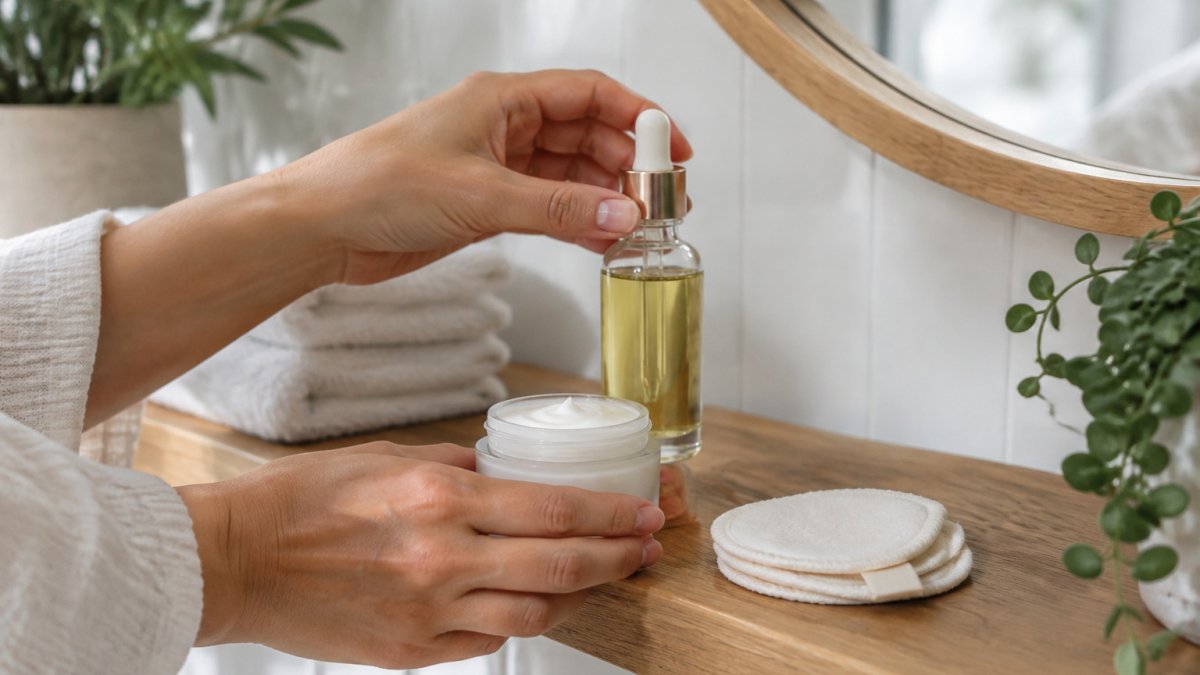
!Hands placing a glass dropper bottle and a small cream tub on a wooden shelf in a bright bathroom
The article's seven steps can be scanned at a glance, with the timing or frequency each one implies.
| Step | What to do | Time or frequency |
|---|---|---|
| 1. Audit what you own | List current products and note half-used, expired or duplicated items | Before buying anything |
| 2. Shorten the routine | Keep a cleanser, a treatment and a moisturiser | Only what skin needs |
| 3. Choose multi-purpose formats | Use moisturiser with sun protection if rating checks out | Check sun protection rating |
| 4. Prefer concentrated formats | Pick concentrates and solids that ship less water | Lasts longer per gram |
| 5. Check behaviour in water | Favour readily biodegradable, non-microbead formulas | Rinse-off products |
| 6. Replace one at a time | Introduce a new item only when something runs out | When a product is finished |
| 7. Verify before you trust | Check claims against evidence and council recycling rules | Before repurchasing |
Choosing Sustainable Beauty Packaging That Actually Reduces Waste
Packaging is where most skincare waste is generated, and it is also where labels are least reliable. The useful question is not whether a pack is "eco-friendly" but whether it will actually be recovered where you live, and whether it reduces material per use.
Start with what your council accepts. Kerbside recycling rules differ by council area, so check your council's own guide rather than the symbol on the pack. As a general pattern across most kerbside systems:
- Rigid plastic bottles and tubs are usually accepted if rinsed and lids are removed, but black plastic and compostable plastic are commonly excluded because sorting facilities cannot process them.
- Glass is widely accepted, but broken glass in the wrong stream is a safety hazard, so only place intact containers in the bin.
- Aluminium cans and tins are typically accepted; foil is less consistently collected.
- Pumps, spray triggers, dropper bulbs and airless cartridges are mixed-material components and are usually not recyclable kerbside. Separate them where possible and check whether the brand runs a take-back scheme.
- Soft plastics such as sachets, mailers and shrink wrap are generally not accepted kerbside. Use a dedicated soft-plastic drop-off point if one is available near you, and otherwise treat them as landfill.
Refills are the most reliable waste reduction because they cut the container, not just the material. A refill pouch typically uses far less plastic than a new bottle, but the pouch itself is often soft plastic, so the net benefit depends on whether it is recovered. Concentrated formats work on the same principle: less water shipped means smaller, lighter packs per use.
Complete Collection | Face, Skin & Scalp Routine →
Watch out: a glass bottle that breaks in transit can generate more waste than a sturdy plastic one, so match the material to the journey rather than assuming glass is always better.
ACCC guidance on environmental and green claims
Setting Up a Low-Waste Skincare Routine at Home
Small habits add up. Use reusable cotton pads instead of disposables, and keep a single cleanser for face and body where it suits your skin. Store products away from heat so they last longer.
Keep a simple log of what you use and when it runs out. This shows you which products you finish and which ones sit unused, so you can buy with more care next time.
How to Check Sustainability Claims and Certifications in Australia
Claims such as "eco-friendly" or "natural" have no fixed legal meaning, so check the evidence behind them. The Australian Competition and Consumer Commission (ACCC) explains how businesses must avoid misleading environmental claims under the Australian Consumer Law, which is a useful starting point for judging a brand's wording. ACCC guidance on environmental and green claims
Look for specific claims rather than vague ones. "Packaging is 100% recyclable through kerbside collection" is more useful than "planet-friendly packaging." If a brand names a certification, check it is current and covers the product you are buying.
Assessing Ethical Skincare Brands Without Getting Lost in Marketing
Start by reading a brand's own account of its practices. Our Our Story page covers the background, values and approach behind Pepcare Lab. A clear story about where it started, what it values and how it makes its products tells you more than a slogan. Pepcare Lab company background
Then test the claims. Ask whether the brand explains its supply chain, shares ingredient sources, and states its packaging materials. Brands that give specifics are easier to trust than brands that rely on feelings.
Your Next Step: Starting With a Simpler Routine
Pick one area to improve this month, whether that is packaging, ingredients or the number of steps you use. A short, focused routine is often the easiest place to start. You can explore the complete collection for a simple face, skin and scalp routine, or check delivery and returns terms before you buy.
Frequently Asked Questions
What makes a skincare product sustainable?
A sustainable skincare product usually combines a few measurable traits: ingredients sourced with traceable supply chains, formulas concentrated enough to need less product per use, packaging that is recyclable, refillable or made with less plastic, and a manufacturer that can explain its production practices. No single feature makes a product sustainable on its own. Look for brands that disclose ingredients fully and explain their packaging choices, rather than relying on a single green-looking label. Ask whether the claim can be verified, because vague wording like 'eco-friendly' is not evidence.
How can I make my skincare routine more sustainable?
Start by counting what you own and finishing it before buying more. Reduce steps where a multi-purpose product can replace two or three items, and choose concentrated formats that last longer. When you need to repurchase, pick products with recyclable or refillable packaging and avoid single-use extras like disposable pads. Replace disposable cotton with washable rounds. Changing one product at a time makes the transition easier on your budget and your skin, and lets you see what your skin actually responds to.
Are natural skincare products always more sustainable?
No. Natural or organic ingredients can carry their own environmental costs, including land use, water use and transport, and a product can be 'natural' while packaged in heavy, single-use plastic. Sustainability depends on the whole product: sourcing, formulation efficiency, packaging, manufacturing and disposal. A concentrated product made locally with recyclable packaging can have a lower footprint than a natural product shipped long distances in excess packaging. Judge the full picture instead of the ingredient list alone.
How do I use skincare products without wasting them?
Dispense only the amount the label recommends, usually a pea-sized amount for serums, and press products into your palm rather than squeezing directly onto a pad. Scrape out the last of a jar with a spatula and use the remainder on your hands or elbows. Store products upright and sealed to prevent oxidation, and keep track of opened dates so nothing expires unused. Small habits like these can meaningfully extend how long a bottle lasts.
