
Table of Contents
- Why Skincare Ingredient Transparency Matters
- How to Read Skincare Ingredient Lists
- Australian Cosmetic Labelling Requirements
- Evaluating Skincare Product Claims and Evidence
- Questions to Ask Skincare Brands About Ingredients
- Clean Beauty Standards and What They Actually Mean
- Building a Transparent Skincare Routine for Sensitive Skin
- Frequently Asked Questions
Last Updated: October 20, 2026
Why Skincare Ingredient Transparency Matters
Understanding what goes on your skin is fundamental to informed choices. When you can't read an ingredient list, you're trusting a brand to act in your interest, not always the case, especially for sensitive skin. Skincare ingredient transparency is the foundation of a working routine.

Many brands use confusing labelling, obscure ingredient names and vague claims to sell products. Some hide irritants under technical nomenclature; others make "clean" or "natural" claims without evidence.
At Pepcare Lab, transparency isn't optional, it's essential. Knowing exactly what's in your skincare lets you protect your barrier and avoid known triggers. This guide covers decoding ingredient lists, Australian labelling requirements and evaluating claims.
How to Read Skincare Ingredient Lists
Ingredient lists follow a strict order by concentration: the first five make up the bulk of the formula, while those near the end are minimal. A "hyaluronic acid serum" might list hyaluronic acid eighth or ninth, doing far less work than you'd expect.
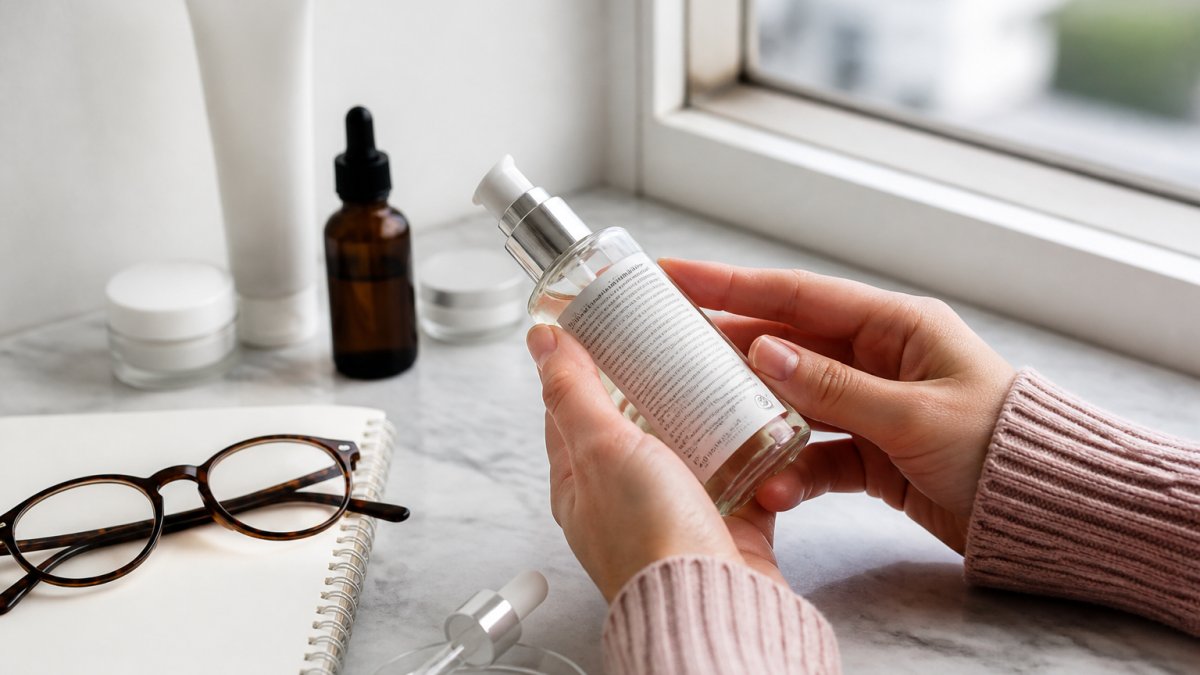
Start with the base: most serums and creams begin with water (aqua) or a humectant like glycerin, while moisturisers list emollients like squalane or plant oils early.
Next, look for the actives doing the targeted work, peptides, niacinamide, vitamin C, botanical extracts.
Watch preservatives and fragrance, usually listed toward the end. Common preservatives include phenoxyethanol, methylisothiazolinone and sorbic acid; a "preservative-free" product either uses a natural system or has a very short shelf life.
Look for the concentration percentages if they're listed. Brands increasingly disclose percentages for key actives, a 1% copper peptide serum is fundamentally different from one containing 0.1%. Higher percentages don't always mean better results, but they do mean the brand is confident enough to be specific.
Australian Cosmetic Labelling Requirements
Australian cosmetic labelling is governed by a patchwork of instruments rather than a single cosmetics act; knowing which applies to which claim is the difference between reading a label correctly and being misled.
The instruments that actually apply
The core ingredient-declaration rule sits in the Trade Practices (Consumer Product Information Standards) (Cosmetics) Regulations under the Australian Consumer Law.
Separately, the Poisons Standard controls which substances are scheduled, restricted or prohibited.
A third layer is chemical introduction and notification. Industrial chemicals used in cosmetics are notified under the Australian Industrial Chemicals Introduction Scheme (AICIS), which replaced NICNAS and maintains the Inventory of Industrial Chemicals in Australia.
What the label must and must not do
The ingredient list must be complete; 'proprietary blend' cannot hide an ingredient. Ingredients at 1% or less may be listed in any order after those above 1%, so the tail is not a reliable concentration ranking.
What the label need not do is explain function. INCI names are not plain English and no function descriptor is required, which is why a consumer-facing decoder, or a brand volunteering plain-English annotations, adds real value beyond the legal minimum.
Fragrance, allergens and the disclosure ceiling
Fragrance is the clearest disclosure ceiling. A mixture can be declared as 'fragrance' or 'parfum' as one entry even when it contains dozens of compounds.
The same logic applies to preservatives and botanical extracts: a declared INCI name tells you the substance is present, not how much, what it degrades into, or whether it is the grade the marketing implies.
Where to check a specific ingredient
Three public resources do most of the work: the Poisons Standard for scheduling and restrictions, the AICIS Inventory and assessment records for notification, and TGA guidance where a product crosses into therapeutic claims.
Evaluating Skincare Product Claims and Evidence
Claims like "clinically proven," "dermatologist-tested," and "scientifically formulated" sound authoritative but often mean little.
Ask for specifics: what was tested, how many people, over what timeframe, were there control groups, and were results peer-reviewed or only in marketing materials?
Look for ingredient-level evidence rather than product-level claims.
Third-party testing and certifications add credibility, but rigor varies widely, a "clean beauty" certification from one organisation might be meaningless from another.
Questions to Ask Skincare Brands About Ingredients
Direct communication reveals a lot.
Ask about sourcing and testing: where ingredients come from, whether they test for contaminants or heavy metals, and their quality control process.
Inquire about preservative systems and why they chose them, including alternatives considered and irritation risk.
Ask about fragrance specifically: essential oil-based, synthetic, or a blend, at what concentration, and whether allergens are listed separately. For sensitive skin this is crucial, because fragrance is a common irritant that's often hidden.
Finally, ask about contraindications: what ingredients shouldn't be combined, and which skin types or conditions should avoid the product.
Clean Beauty Standards and What They Actually Mean
'Clean', 'natural', 'green', 'non-toxic' and 'chemical-free' are marketing terms, not regulated categories. No Australian instrument defines them, no regulator certifies them, and no standard sets a threshold a brand must meet before using them, the fact most 'clean beauty' content avoids stating plainly.
What the law actually prohibits
The Australian Consumer Law prohibits misleading or deceptive conduct and false representations about the composition, quality or suitability of goods. The ACCC enforces this and has repeatedly acted on 'natural', 'organic' and 'free from' claims where the product did not match. The test is not what a formulator would understand, it is whether the ordinary reasonable consumer would be misled.
That framing matters for three claim types in particular:
- 'Chemical-free'. Water is a chemical. Glycerin is a chemical. Every cosmetic is a mixture of chemicals. A literal 'chemical-free' claim is therefore incapable of being true, and the ACCC's position on such absolute claims is that they risk contravening the misleading-conduct provisions. Treat 'chemical-free' as a signal that the brand is using chemistry language loosely, not as a safety assurance.
- 'Natural'. There is no minimum natural-content threshold. A product with a small botanical extract and a synthetic base can still be described as containing natural ingredients; whether calling the product itself 'natural' is misleading depends on the overall impression, including pack imagery and the proportion of natural content.
- 'Clean'. Because it has no defined meaning, a 'clean' claim is assessed on what the brand's own materials say it excludes. If the brand publishes a specific exclusion list, you can hold it to that list. If it does not, the claim is unfalsifiable and should carry no weight in your decision.
How to verify a claim in practice
A short, repeatable check works better than any certification logo:
- Find the brand's own definition. Look for a published exclusion list or standard the brand says it follows. If none exists, the claim is decorative.
- Check the ingredient list against that definition. A brand that says 'free from fragrance' but lists parfum has failed its own standard, and that is a concrete, reportable inconsistency.
- Check the 'free from' claims against the label. 'Paraben-free', 'sulfate-free' and 'fragrance-free' are verifiable: the INCI list either contains them or it does not. 'Toxin-free' and 'chemical-free' are not verifiable because they have no defined referent.
- Check for third-party certification and read what it covers. Certifications vary enormously in scope, some cover a single ingredient class, some cover the whole formulation, some are self-declared. A logo without a published standard behind it is not evidence.
- Check the concentration story. A 'clean' product can still contain an active at a concentration too low to do anything. Transparency about percentages is a better signal than any clean claim.
When a brand uses a term with no legal definition, ask it in writing what the term means for that specific product and which ingredients it excludes. A brand with a real standard will answer with a list. A brand without one will answer with adjectives, and that difference is the whole test.
The trade-off clean marketing obscures
Excluding an ingredient is not automatically safer. Some preservative exclusions push brands toward shorter shelf lives or higher irritation risk; some 'fragrance-free' products still contain masking fragrances; some 'natural' essential oils are common contact allergens. The useful question is never 'is it clean?' but 'what is in it, at what concentration, and what is the evidence?' A brand that answers those three is transparent regardless of its marketing vocabulary, and a brand that won't is not made transparent by a certification logo.
Building a Transparent Skincare Routine for Sensitive Skin
Start with the fundamentals: a gentle cleanser, a hydrating serum, and a barrier-supporting moisturiser.
Choose products with proven actives at meaningful concentrations.
Introduce new products one at a time, waiting at least two weeks between additions.
Read the full ingredient list before purchasing, not after.
At Pepcare Lab, our approach to transparency means every product lists its ingredients clearly, with concentrations disclosed for key actives. Our Face Serum and Barrier Cream both contain 1% Copper Peptides, giving you certainty about what you're applying.

Building a routine that works for sensitive skin starts with understanding what's actually in your products.
Frequently Asked Questions
What are the requirements for cosmetic labelling in Australia?
Cosmetic manufacturers and importers must list all ingredients on product labels in descending order of concentration, with ingredients above 1% listed by their International Nomenclature of Cosmetic Ingredients (INCI) names. Fragrances and colourants can be listed as 'fragrance' and 'colour' without naming individual components. Labels must include contact details and country of origin.
How can I tell whether a skincare brand is transparent about its ingredients?
Transparent skincare brands provide complete ingredient lists on product labels and websites, explain what each ingredient does, and share safety assessment information. Look for brands that disclose the full INCI names, avoid vague terms like 'proprietary blend,' and publish third-party testing or ingredient sourcing details. Brands that answer questions about ingredient safety, sourcing, and efficacy demonstrate genuine commitment to transparency. Pepcare Lab, for example, lists all ingredients with their functions and focuses on science-led formulations like copper peptides with clear safety backing.
Do skincare products have to list all their ingredients?
Yes, cosmetics sold in Australia must list all ingredients on the label. The only exception is fragrance and colour components, which can be grouped under the terms 'fragrance' or 'colour' without naming individual aromatic or colouring compounds. This protects proprietary fragrance blends while still requiring transparency for all other chemical substances. Ingredients must appear in descending order of concentration, so higher-concentration ingredients appear first, helping you understand what the product's main active components are.
What should I look for on a skincare ingredient label?
Start by checking the first five ingredients, these make up the majority of the formula. Look for active ingredients (like peptides, niacinamide, or hyaluronic acid) that match the product's claims. Verify the concentration of key actives if listed. Check for potential allergens or irritants if you have sensitive skin. Review the full ingredient list in INCI order to understand the formula's structure. For sensitive skin, simpler formulas with fewer ingredients often reduce irritation risk. Pepcare Lab's Face Serum, for instance, leads with hydrating and skin-barrier-supporting ingredients at meaningful concentrations.
How can I check whether a skincare claim is supported by evidence?
Ask brands for published research, clinical studies, or third-party testing data backing their claims. Legitimate skincare brands publish ingredient safety assessments and cite peer-reviewed studies. Be sceptical of vague claims like 'transforms skin' without specific evidence. Look for dose-dependent claims, if a brand says an ingredient supports collagen production, they should specify at what concentration. Request ingredient sourcing and assessment data directly from the brand. Brands transparent about their ingredients typically provide this information readily, demonstrating confidence in their formulations and commitment to consumer protection.
Are 'chemical-free' skincare products actually safer than those with synthetic ingredients?
No. All skincare products contain chemical substances, water, oils, and plant extracts are all chemicals. The term 'chemical-free' is misleading marketing. Safety depends on ingredient assessment, concentration, and purity, not whether something is natural or synthetic. Some natural ingredients cause allergic reactions; some synthetic ingredients are highly safe. Australian regulations require all cosmetic ingredients to undergo safety assessment regardless of origin. Focus on transparent labelling and ingredient safety data rather than marketing terms like 'chemical-free.' Pepcare Lab's science-led approach prioritises safety assessment over marketing claims.
What's the difference between 'clean beauty' and genuinely transparent skincare?
Clean beauty is a marketing standard without legal definition, different brands define it differently. One brand's 'clean' might exclude synthetic preservatives; another might exclude fragrance. Genuine transparency means the brand discloses every ingredient, explains their function, provides safety data, and answers consumer questions honestly. A truly transparent brand will tell you why they chose specific ingredients and what they do, rather than hiding behind vague 'clean' claims. Look for brands that publish full ingredient policies, safety assessments, and ingredient sourcing information, these signal real commitment to consumer knowledge, not just marketing positioning.