
Table of Contents
- Why Fragrance Is a Common Skin Irritant
- Fragrance-Free vs Unscented: What the Labels Really Mean
- How to Identify Fragrance in Skincare Ingredients
- The Benefits of Fragrance-Free Skincare for Sensitive Skin
- Fragrance Alternatives: Essential Oils and Botanical Extracts
- Masking Agents and Hidden Fragrance: What to Avoid
- Choosing Fragrance Alternatives for Your Routine
- Frequently Asked Questions
Last Updated: October 1, 2026
Why Fragrance Is a Common Skin Irritant
Fragrance is the single most common cause of allergic contact dermatitis in cosmetics, and it earns that reputation through chemistry rather than marketing. A single "parfum" entry on a label can legally conceal dozens of individual compounds, and each one is a potential trigger for reactive skin. This guide from Pepcare Lab breaks down the alternatives to fragrance in skincare products, what the labels actually hide, and which substitutions genuinely suit a compromised skin barrier.
The mechanism matters more than the marketing. Fragrance molecules are small, volatile compounds that penetrate the stratum corneum and bind to proteins in the skin, and it is that binding that provokes an immune response in sensitised people. Once sensitisation occurs, it is permanent. You do not build tolerance to a fragrance allergen the way you build tolerance to an active ingredient.
That is why "it never bothered me before" is such a common story in dermatology clinics.
Fragrance-Free vs Unscented: What the Labels Really Mean
Fragrance-free means no fragrance has been added to the formula for scent purposes. Unscented means the product has no noticeable smell, which is not the same thing at all.
This is the distinction most shoppers miss, and it is where the fragrance-free vs unscented confusion costs people money. An unscented product frequently contains a masking agent: a compound added specifically to neutralise the odour of the raw ingredients. That masking agent may itself be a fragrance allergen, just one you cannot smell.
Fragrance-free products, by contrast, are formulated without added scent at any stage. The trade-off is honest: some fragrance-free formulas smell faintly of their own ingredients, because nothing has been added to disguise them.
| Label claim | What it means | Contains fragrance allergens? |
|---|---|---|
| Fragrance-free | No fragrance added for scent | Usually no |
| Unscented | No detectable smell | Sometimes yes, via masking agents |
| Hypoallergenic | Fewer common allergens | Not guaranteed |
| Natural fragrance | Plant-derived scent compounds | Frequently yes |
How to Identify Fragrance in Skincare Ingredients
Read the INCI list, not the front of the pack. The International Nomenclature of Cosmetic Ingredients system requires ingredients to be listed in descending order of concentration, so anything appearing after the preservatives is present in trace amounts.
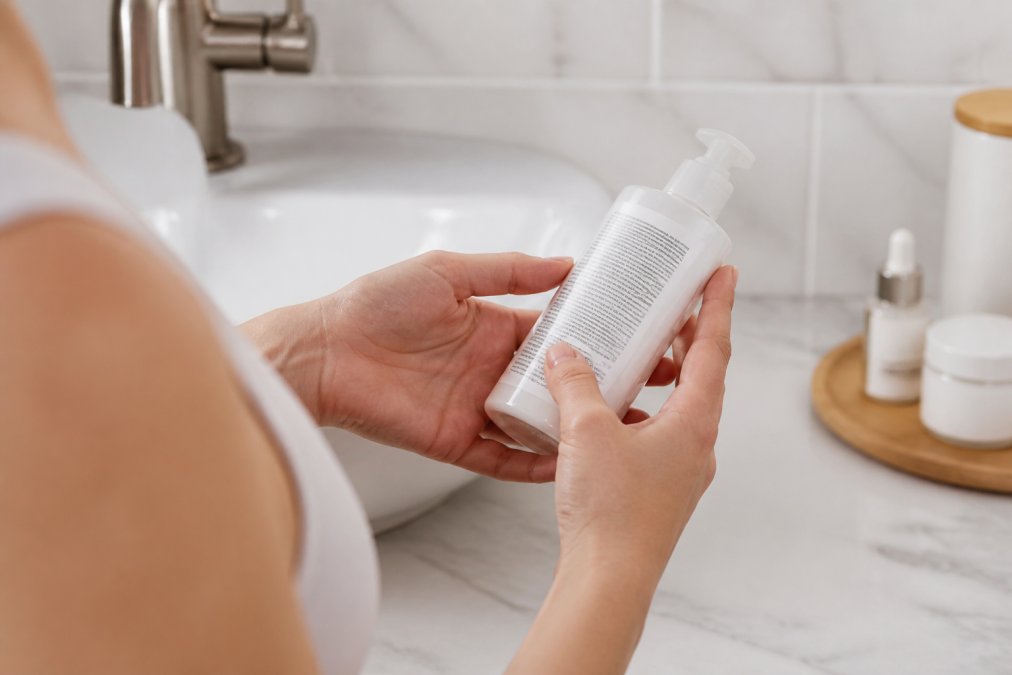
Watch for these terms on the label:
- Parfum / Fragrance: an umbrella term covering an undisclosed mixture
- Limonene, Linalool, Citronellol, Geraniol: individual allergens that must be declared above set thresholds
- Essential oils listed by botanical name, such as Lavandula angustifolia
- Masking agents such as benzyl acetate, which appear without any scent claim
The word "parfum" is the problem. It functions as a legal shorthand that lets a formulator declare a complex mixture under one word, and label transparency suffers as a result.
The Benefits of Fragrance-Free Skincare for Sensitive Skin
The clearest benefit of fragrance-free skincare is subtraction. Removing a known irritant reduces the number of variables your skin has to cope with, which makes every other product in your routine easier to assess.
For anyone managing contact dermatitis, rosacea, eczema or a generally reactive barrier, this is not a preference. It is the baseline. A compromised skin barrier lets irritants through more readily, so the same fragrance that a resilient person tolerates can provoke a flare in someone whose barrier is already struggling.
The practical benefits stack up:
- Fewer variables when you are trying to identify a trigger
- Better tolerance of active ingredients like retinoids and acids
- Less risk of cumulative sensitisation over years of daily use
- Simpler routines, because you stop layering scented products
Pepcare Lab formulates with sensitive skin in mind, which is why the range is built around barrier support rather than scent.
Fragrance Alternatives: Essential Oils and Botanical Extracts
Essential oils are not a safe alternative to synthetic fragrance. They are fragrance. Lavender oil, citrus oils and tea tree oil contain the same class of volatile compounds, including limonene and linalool, that trigger reactions in sensitised skin.
The "natural versus synthetic" framing is largely a marketing device. An allergen does not check whether it was synthesised in a lab or distilled from a plant before provoking an immune response. In fact, some botanical extracts carry a higher allergen load than their synthetic equivalents because plant material is chemically complex. A single essential oil can contain hundreds of individual chemical constituents, and the allergen profile varies with the plant's growing conditions, the extraction method and the batch. That variability is precisely what makes natural fragrance harder to standardise and, for reactive skin, harder to predict.
The mechanism is worth understanding. Essential oils are volatile terpenes and phenylpropanoids, small molecules that penetrate the stratum corneum and bind to skin proteins.
| Category | Typical INCI terms | Sensitisation risk | Label transparency |
|---|---|---|---|
| Synthetic fragrance | Parfum, Fragrance | High, undisclosed mixture | Low, umbrella term |
| Essential oils | Lavandula angustifolia, Citrus limon | High, variable allergen load | Medium, botanical name declared |
| Isolated aroma compounds | Limonene, Linalool, Citronellol | High, must be declared above threshold | High, individual allergens named |
| Masking agents | Benzyl acetate, Galaxolide | Variable, often undeclared as fragrance | Low, no scent claim required |
| Functional botanicals | Avena sativa, Camellia sinensis | Low, included for benefit, not scent | Medium, purpose not stated on pack |
If you are determined to use scented products, patch testing becomes more important, not less. Apply the product to the inner forearm and wait 48 hours before using it on your face. Repeat with each new batch if you are highly reactive, because natural ingredients are not standardised the way synthetic ones are.
Masking Agents and Hidden Fragrance: What to Avoid
Masking agents are the least transparent part of the fragrance problem. A masking agent is a compound added to neutralise an unpleasant odour from the base formula, and because it is not added for scent, it can appear in a product marketed as unscented.
Common masking agents and related compounds to watch for:
- Benzyl acetate
- Phenoxyethanol, which has a faint odour and is sometimes paired with masking compounds
- Ethylene brassylate
- Galaxolide
Choosing Fragrance Alternatives for Your Routine
Build the routine around barrier support, and let scent be the thing you sacrifice. A fragrance-free routine does not need to be complicated, and it does not need ten steps. But the transition is where most people go wrong, because they change too much at once and lose the ability to identify what is actually helping.
The order of priority when choosing any product:
- Check the INCI list first. Fragrance-free is a claim; the ingredient list is the evidence.
- Patch test anything new. Apply to the inner forearm and wait 48 hours before using it on your face.
- Introduce one product at a time. Two weeks between additions gives you a clean read on tolerance.
- Prioritise barrier ingredients. Peptides, niacinamide, squalane and hyaluronic acid support the barrier rather than challenging it.
- Keep the routine short. Fewer products means fewer potential triggers.
Frequently Asked Questions
What is the difference between fragrance-free and unscented skincare?
Fragrance-free means no fragrance has been added, so the product should contain no fragrance ingredients at all. Unscented means the product has no noticeable smell, but it may contain masking agents to neutralise the natural odour of raw ingredients. For sensitive skin, fragrance-free is the safer option because unscented products can still trigger irritation through hidden fragrance components.
Are essential oils a safe alternative to synthetic fragrance?
Essential oils are natural, but natural does not mean non-irritating. They contain volatile compounds such as limonene and linalool, which are known skin sensitisers. If your skin is reactive, essential oils can cause contact dermatitis just as synthetic perfume can. Patch testing a small area before full use is the practical way to check tolerance.
How can I identify hidden fragrance in skincare ingredient lists?
Check the INCI list for the word 'fragrance' or 'parfum', then look for individual fragrance components such as limonene, linalool, citronellol, geraniol, and eugenol. Masking agents may appear as 'fragrance' even when the product is labelled unscented. If a product claims to be fragrance-free but lists any of these terms, treat that as a red flag.
What are the benefits of fragrance-free skincare for skin barrier repair?
Fragrance is a common trigger for contact dermatitis and can disrupt the skin barrier, leading to redness, itching, and increased sensitivity. Choosing fragrance-free products reduces the risk of allergic reaction and sensitisation, giving your skin a chance to repair. A simple routine built around barrier-supporting ingredients, such as copper peptides, niacinamide, and squalane, supports moisture retention and long-term skin comfort.
Does fragrance-free skincare mean the product will have no smell?
Not necessarily. Fragrance-free means no fragrance ingredients have been added, but the raw ingredients themselves may have a natural aroma. For example, botanical extracts or preservatives can carry a faint scent. What matters is that the product contains no added fragrance or masking agents, so it is less likely to irritate sensitive skin.
Fragrance sensitivity is manageable, but it demands a routine built on transparency rather than scent. Pepcare Lab makes that simpler with science-led, peptide-focused formulations designed around sensitive skin: 1% copper peptides in the Face Serum and Barrier Cream, a simple two-step routine, and full ingredient transparency so you know exactly what you are putting on your barrier. Shop our Bestsellers and start with a routine that supports your skin instead of challenging it.