
Table of Contents
- What You'll Need: Peptides and Mature Skin Essentials
- How to Use Peptides for Ageing Skin: Your Complete Morning Routine
- How to Use Peptides for Ageing Skin: Your Complete Evening Routine
- Copper Peptides vs Retinol for Ageing: Which Works Better and How to Layer Them
- Building Your Peptide Serum Routine: Layering, Timing, and Adjustments for Sensitive Mature Skin
- How Long Does It Take for Peptides to Work on Mature Skin
- Common Mistakes to Avoid When Starting a Peptide Routine
- Conclusion
- Frequently Asked Questions
Last Updated: October 21, 2026
What You'll Need: Peptides and Mature Skin Essentials
A peptide routine for mature skin starts with what peptides do: short amino-acid chains that signal skin to produce more collagen and elastin, addressing fine lines, firmness and texture without the irritation of stronger actives.
Before you start, gather these essentials:
- A gentle cleanser suited to your skin type
- A peptide serum with active peptide concentrations
- A moisturiser with peptides to lock in hydration
At Pepcare Lab, our formulations are designed for sensitive mature skin.

The right peptide routine mature skin approach depends on your concerns: address your primary one first, then build from there.
How to Use Peptides for Ageing Skin: Your Complete Morning Routine
Keep mornings simple, since the barrier is often more sensitive after sleep.
Step 1: Cleanse gently (2 minutes)
Use lukewarm water and a pH-balanced cleanser; hot water strips natural oils from mature skin.
Step 2: Apply your peptide serum (1 minute)
Step 3: Lock in hydration with moisturiser (2 minutes)
Apply your peptide-rich moisturiser over the serum to prevent transepidermal water loss and support the barrier.

Step 4: Apply sunscreen (2 minutes)
Use SPF 30 or higher daily; sun damage accelerates ageing, so this protects your investment in peptides.
Total morning routine time: 7 minutes
Don't skip the morning serum: peptides work best on damp skin, and the step takes seconds.
How to Use Peptides for Ageing Skin: Your Complete Evening Routine
Your evening routine is where peptides do their deepest work.
Step 1: Remove makeup and sunscreen (3-5 minutes)
Step 2: Apply peptide serum to damp skin (1 minute)
Pat skin dry only until damp, not tight.
Step 3: Wait before layering actives (2-3 minutes)
Step 4: Apply your evening active, if you use one (1-2 minutes)
This is where routines diverge by skin type and tolerance:
- Retinoid nights: Apply a pea-sized amount of retinoid after the peptide serum. Peptides and retinoids can be used in the same routine; the peptide layer supports the barrier while the retinoid drives cell turnover. If you are new to retinoids, use them 2-3 nights per week and build up.
- Acid nights: Use exfoliating acids (AHA or BHA) on a different night from your retinoid. Peptides can go before or after the acid, either order works, as long as acid and retinoid are never layered together.
- Vitamin C nights: Usually a morning step; if used at night, apply thinnest first. Never combine vitamin C and retinoid in the same evening.
Step 5: Apply your barrier moisturiser (1-2 minutes)
Step 6: Spot-treat or add eye cream if needed (1 minute)
Apply eye cream before moisturiser, or after if richer than your face cream.
Total evening routine time: 10-15 minutes, including wait times
Evening adjustments by mature skin type:
| Skin type | Evening adjustment | Why |
|---|---|---|
| Dry, tight | Richer moisturiser; consider a facial oil on cheeks only | Limits overnight water loss without congesting the T-zone |
| Sensitive, reactive | Peptide serum 2-3 nights per week at first; no acid and retinoid on the same night | Gives the barrier time to adapt |
| Oily mature | Gel-cream moisturiser; skip facial oil; keep double cleanse for makeup days only | Prevents congestion while still supporting barrier repair |
| Acne-prone mature | Non-comedogenic moisturiser; apply peptide serum to dry areas and a lighter layer on the T-zone | Avoids triggering breakouts while treating ageing signs |
Introducing peptides gradually in the evening:
Copper Peptides vs Retinol for Ageing: Which Works Better and How to Layer Them
What each one does, in plain terms:
- Copper peptides are short amino-acid chains bound to copper, used to support the barrier and signal collagen and elastin production. Evidence is largely in-vitro and small cosmetic studies, so treat dramatic restructuring claims with caution; most people find them gentle, hydrating and compatible with daily use.
- Retinol is a vitamin A derivative that accelerates cell turnover, with a longer history of cosmetic evidence for fine lines and texture. It is more potent and faster-acting but more likely to cause dryness, flaking and stinging, especially in thin or reactive mature skin.
Realistic expectations:
Neither is a Botox alternative. Copper peptides typically improve hydration, smoothness and barrier comfort within weeks, while retinol produces more visible texture and fine-line changes over 12-24 weeks.
If your skin tolerates both, the simplest order is:
- Cleanse.
- Apply peptide serum to damp skin.
- Wait 2-3 minutes until absorbed.
- Apply a pea-sized amount of retinoid.
- Follow with moisturiser.
Peptides can be used daily; introduce retinoids 2-3 nights per week and increase only when comfortable. Alternating nights suits sensitive skin and makes irritation easier to trace.
Where other actives fit:
- Vitamin C: Usually a morning step. Do not layer vitamin C and retinol in the same evening; alternate them across the day or across nights.
- AHAs and BHAs: Use on separate evenings from retinoids. Peptides can be used on acid nights, but if your skin stings, apply the acid first, wait, then apply peptide serum and moisturiser.
- Niacinamide: Generally compatible with both peptides and retinoids and often included in peptide serums as a supporting ingredient.
A simple weekly pattern for mature skin:
| Night | Routine |
|---|---|
| Monday | Peptide serum + moisturiser |
| Tuesday | Peptide serum + retinoid + moisturiser |
| Wednesday | Peptide serum + moisturiser (barrier night) |
| Thursday | Peptide serum + retinoid + moisturiser |
| Friday | Peptide serum + moisturiser |
| Saturday | Peptide serum + exfoliating acid (if tolerated) + moisturiser |
| Sunday | Peptide serum + moisturiser (barrier night) |
This is a template, not a prescription. If you are new to retinoids or acids, start with one active night per week and build from there.
Building Your Peptide Serum Routine: Layering, Timing, and Adjustments for Sensitive Mature Skin
A successful peptide routine for mature skin types requires attention to layering order and timing, especially for sensitive skin that is often compromised.
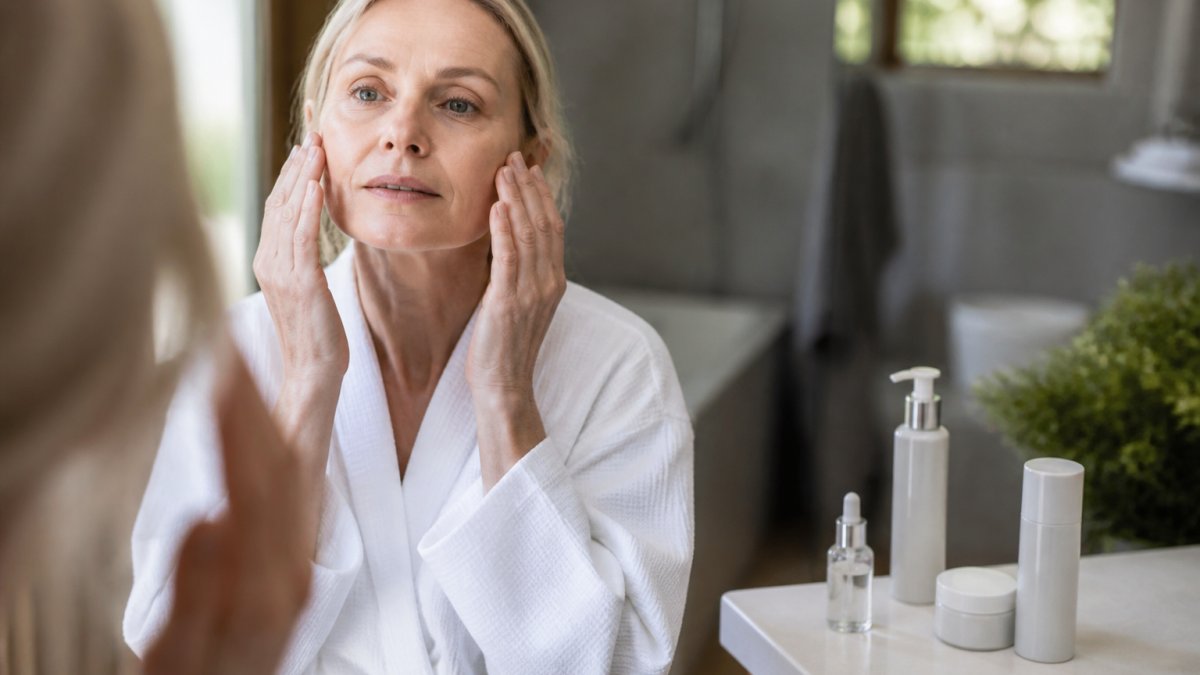
The correct layering order for sensitive skin:
- Cleanser
- Peptide serum (on damp skin)
- Lightweight hydrating toner or essence (optional)
- Any active treatments (retinol, vitamin C, exfoliating acids)
- Eye cream if needed
- Moisturiser
- Facial oil or occlusive (evening only)
Timing between products:
Allow 60-90 seconds between steps so products absorb and pilling or irritation is reduced.
Adjustments for different mature skin concerns:
| Skin Concern | Adjustment | Why It Helps |
|---|---|---|
| Dry, tight skin | Apply serum to damp skin, use richer moisturiser | Hydration is the priority; layering on damp skin boosts absorption |
| Sensitive, reactive skin | Start with 2-3x per week, increase gradually | Allows skin barrier to adapt without overwhelming it |
| Oily mature skin | Use lightweight serum, skip facial oil | Prevents congestion while still supporting barrier health |
| Acne-prone mature skin | Apply serum only to dry areas, use non-comedogenic moisturiser | Avoids triggering breakouts while treating ageing signs |
Introducing peptides gradually:
If your skin is very sensitive, start the peptide serum 2-3 times per week on alternate days, move to every other day after 2-3 weeks, then daily after another month if tolerated.
How Long Does It Take for Peptides to Work on Mature Skin
Patience is essential when starting a peptide routine mature skin approach. Peptides work gradually, strengthening the barrier while improving appearance rather than creating rapid surface changes that fade.
Timeline for visible results:
Most people notice better hydration and texture within 2-3 weeks. Fine lines soften around 6-8 weeks, deeper wrinkles may take 12 weeks or longer, and firmness and elasticity improvements typically appear around 8-12 weeks with consistent use.
Factors that affect timeline:
- Consistency matters most. Sporadic use delays results; daily use is necessary.
- Your starting point affects speed. Severely dehydrated or damaged skin takes longer.
- Other products influence results. Retinol, vitamin C and exfoliating acids speed up visible changes.
Don't expect overnight transformation, peptides support natural renewal, which is gentler and more sustainable but requires commitment.
Common Mistakes to Avoid When Starting a Peptide Routine
Most people make preventable errors when introducing peptides, delaying results or causing irritation.
Mistake 1: Applying peptides to completely dry skin
Peptides absorb better into damp skin. Dry skin creates a barrier that slows penetration.
Mistake 2: Using too much product
Mistake 3: Layering peptides with incompatible actives
Mistake 4: Expecting results too quickly
Impatience leads people to add products or increase frequency.
Mistake 5: Neglecting sunscreen
Peptides support collagen production, but sun exposure damages existing collagen.
Mistake 6: Skipping the moisturiser step
Some people assume peptide serums are enough.
Mistake 7: Using hot water when cleansing
Hot water strips your skin's natural oils and damages the barrier.
Conclusion
A peptide routine for mature skin effectively addresses fine lines, loss of firmness and texture changes without harsh actives. The key is consistency, proper layering and patience as your barrier strengthens and collagen production increases.
Start simple: cleanser, peptide serum and moisturiser, adding retinol or other actives once your skin adapts. Pepcare Lab's Face Duo gives you both essentials, the Face Serum with 1% Copper Peptides and the Barrier Cream, for AUD $79 (saving AUD $19 compared to buying individually).

Frequently Asked Questions
How do you use peptides for ageing skin without irritating sensitive skin?
Start with a low frequency: apply your peptide serum 2-3 times per week for the first two weeks, then gradually increase to daily use as your skin barrier adapts. Use only a pea-sized amount on clean, damp skin, then follow with a peptide-rich moisturiser like the Barrier Cream to lock in hydration. If redness or tightness develops, reduce frequency and always patch-test new products on your inner arm first. Peptides work best when your skin barrier is healthy, so prioritise hydration and avoid layering with too many active ingredients initially.
Can you use copper peptides with retinol?
Yes, but with caution. Copper peptides and retinol both support collagen production and skin renewal, so they complement each other well. However, both can be irritating on sensitive mature skin when used together too soon. Start by using retinol on alternate nights (e.g., Monday, Wednesday, Friday) and peptides on the other nights. After 4-6 weeks, if your skin is tolerating both well, you can layer them: apply your peptide serum first, let it absorb fully (2-3 minutes), then apply a light retinol product. Never use retinol in the morning; always apply it at night and use broad-spectrum SPF 30+ the next day.
How long does it take for peptides to work on mature skin?
Most people notice improved hydration and skin texture within 2-4 weeks of consistent daily use. Fine lines and skin firmness typically show visible improvement after 6-8 weeks. Mature skin often responds more gradually than younger skin because cell turnover slows with age, so patience is essential. Results depend on your starting point, skin type, and routine consistency. If you're using peptides alongside other actives like retinol or vitamin C, visible changes may take 10-12 weeks. Keep a baseline photo at week one and compare it to week eight to track progress objectively.
Which peptides are best for mature skin with fine lines and loss of elasticity?
Copper peptides (GHK-Cu) are particularly effective for mature skin because they support collagen and elastin production while strengthening the skin barrier, a priority for ageing skin. Signal peptides communicate with your skin cells to boost renewal, whilst carrier peptides like copper deliver trace minerals that support skin structure. For fine lines and elasticity loss, look for serums that combine multiple peptide types with hyaluronic acid and niacinamide, which work together to plump skin and improve firmness. The Pepcare Lab Face Serum contains 1% copper peptides alongside complementary peptides and hydrating ingredients, designed specifically to support smoother, firmer-looking skin in mature skin types.