
Quick Summary
No validated ghk-cu dosage exists for scalp microneedling, because the studies are small, mostly laboratory or animal work, and rarely test scalp use combined with needling. Any dose figure you see online is a suggestion, not a proven protocol.
- Concentration, such as 2% w/v, is not the same as the amount that reaches your scalp.
- A 2% w/v formula contains about 20 mg/mL, which helps estimate per-application amounts.
- Calibrate your applicator and track the same measured amount each session for consistency.
- There is no validated post-needling timing; check manufacturer instructions and patch-test first.
- Stop use and seek advice if burning, swelling, rash or scalp pain persists or worsens.
Table of Contents
- Why There Is No Validated GHK-Cu Dose for Scalp Microneedling
- What GHK-Cu Is and How Topical Serums Deliver It
- Working Out Concentration and Dose Math for Your Serum
- Scalp Microneedling Depth, Device Hygiene and Treatment Intervals
- Applying GHK-Cu After Microneedling: Timing and Steps
- Aftercare Signs to Watch and When to Stop
- Setting Realistic Expectations for GHK-Cu and Hair Thinning
- Frequently Asked Questions
Why There Is No Validated GHK-Cu Dose for Scalp Microneedling
Last Updated: October 30, 2026
If you are asking how much GHK-Cu to use for scalp microneedling, the honest answer is that nobody has settled a ghk-cu dosage for it yet.
GHK-Cu is a copper peptide that has been studied for wound repair and skin remodelling. That research is real, but it does not translate neatly into a dosing chart for your scalp.
Here is what that means for your ghk-cu dosage decisions:
- No standard scalp dose exists. Any figure you see is someone's suggestion, not a validated protocol.
- Concentration is not the same as dose. A 2% serum applied in a thin layer delivers a different amount than the same serum applied generously.
- Needling changes the picture. Microneedling creates tiny channels in the skin, which may affect how much product gets through. That effect is not well measured for GHK-Cu.
A common mistake is treating a confident number as proof. Use qualified language when you read claims, and check whether the source tested the exact scenario you plan to use.
What GHK-Cu Is and How Topical Serums Deliver It
GHK-Cu is a naturally occurring tripeptide bound to copper. It appears in human plasma and declines with age, which is one reason it attracts interest in skin and hair products.
Topical delivery is slower and less predictable than most people expect. Heavy application does not guarantee more penetration, and it can leave residue that stays on the surface.
Our Hair/Scalp Serum is a lightweight, fast-absorbing formula powered by 2% Copper Peptides, supported by peptides, niacinamide, biotin and botanical extracts. You can find the product here. For a side-by-side look at serum and powder formats, see GHK-Cu Serum vs Copper Peptide Powder for Scalp.

Working Out Concentration and Dose Math for Your Serum
Most confusion about GHK-Cu 'dosage' comes from conflating three different numbers. Separating them is the single most useful thing you can do before buying or using any product.
The three numbers that get mixed up
- Percentage concentration (% w/v). How much peptide is dissolved per volume of product. A 2% w/v formula contains 2 grams of copper peptide per 100 mL.
- Mass concentration (mg/mL). The same figure expressed differently: 2% w/v equals 20 mg/mL. This is the number that matters when you are estimating how much you actually apply.
- Total peptide per container (mg). Concentration multiplied by volume. A 50 mL bottle of a 2% formula holds roughly 1,000 mg of peptide in total, but that tells you nothing about how much reaches your scalp per session.
A product can be 'high concentration' in a tiny bottle or 'low concentration' in a large one. Neither label alone tells you your per-application amount.
Estimating your per-session amount
There is no validated clinical dose for scalp microneedling, so the goal is a consistent personal estimate, not a target to hit.
- Calibrate your applicator. Count how many drops or pumps make 1 mL. A standard dropper is often around 20 drops per mL, but this varies by product and should be checked rather than assumed.
- Measure per section. Note how many drops or pumps you use across the treatment area in one session.
- Convert to mass. At 20 mg/mL, each 1 mL applied carries about 20 mg of peptide. Half a millilitre carries about 10 mg.
- Track bottle life. Divide total peptide by your per-session estimate to see how many sessions a bottle should last, and compare that with reality.
Why formulation changes the maths
Concentration is only one variable. Delivery also depends on:
- Vehicle and penetration enhancers. A lightweight aqueous serum and a rich cream at the same percentage will not deliver the same amount to the follicle.
- pH and stability. Copper peptides are sensitive to formulation conditions; a product that has degraded delivers less than its label implies.
- Preservative and sterility systems. These matter especially if you plan to use the product near or after needling.
- Labelling quality. Look for the peptide identified by its full name (GHK-Cu or copper tripeptide-1), the concentration stated as % w/v or mg/mL, the batch or lot number, and a clear expiry. Vague labels like 'copper peptides' without a figure are a warning sign.
Common maths errors
- Assuming doubling the volume doubles the benefit, it does not, and it raises irritation risk.
- Comparing a 2% serum with a powder by percentage alone, when the powder must be reconstituted and its final concentration depends on how much diluent is added.
- Treating the bottle's total peptide content as a per-session dose.
- Ignoring that some of the product remains on the hair shaft rather than the scalp.
The three figures below are easy to confuse, so here is how each one relates to the others.
| Measure | What it means | Example from the article |
|---|---|---|
| % w/v concentration | Grams of peptide per 100 mL | 2% w/v = 2 g per 100 mL |
| Mass concentration | Same figure in mg/mL | 2% w/v = 20 mg/mL |
| Total peptide per bottle | Concentration times volume | 50 mL of 2% ≈ 1,000 mg |
| Per-session amount | What actually reaches the scalp | Depends on volume applied, not bottle total |
Scalp Microneedling Depth, Device Hygiene and Treatment Intervals
Microneedling uses fine needles to create small punctures in the skin. Adjusting these physical parameters requires patience, as the microneedling results timeline often spans several months before the cumulative effects of collagen induction and peptide absorption become visible.
Device hygiene is non-negotiable. Use a sterile, single-use needle head where possible, clean the scalp before treatment, and never share devices. Replace the head as the manufacturer directs, since dull or reused needles increase irritation.
Treatment intervals also vary, and there is no agreed schedule for scalp microneedling combined with a peptide serum. Many people space sessions several weeks apart to let the scalp recover between treatments. You can view the brush here.

Applying GHK-Cu After Microneedling: Timing and Steps
This is the question the evidence cannot answer cleanly, and it is worth being explicit about why.
Why timing is contested
Two competing logics sit behind the advice you will find online:
- Apply immediately (the 'channel' argument). Proponents argue that open microchannels enhance delivery of the peptide before they close, typically within a window of minutes to a few hours depending on needle depth. This is plausible mechanistically but has not been measured for GHK-Cu on scalp tissue.
- Wait until settled (the 'barrier' argument). Clinicians who favour caution note that applying an occlusive or multi-ingredient serum to freshly wounded skin can trap irritants, increase stinging, and, in rare cases, drive inflammatory reactions or foreign-body responses. Waiting 24 hours or until visible redness and tenderness subside is a common conservative habit.
Neither position is backed by scalp-specific human data. The honest framing is that this is a judgement call shaped by your skin, the depth used, and the formulation.
A practical decision framework
- Check the product's own instructions first. If the manufacturer specifies post-needling use, follow it; if it is silent or advises against use on broken skin, do not improvise. Sterility and preservative systems differ between products, and a serum formulated for intact skin is not automatically appropriate for compromised skin.
- Match timing to depth. Shallower needling generally leaves a shorter recovery window than deeper treatment. Deeper passes warrant more caution and a longer wait.
- Assess the scalp, not the clock. Before applying anything, the scalp should feel calm, not stinging, hot, or raw to the touch. If it does, wait.
- Patch-test away from the treatment area. Apply a small amount behind the ear or on the inner forearm at least 24 hours before first scalp use to screen for sensitisation.
- Start thin. A single thin layer is enough to assess tolerance; heavy application does not reliably improve delivery and increases irritation risk.
- Keep the routine identical between sessions. Changing concentration, timing, and depth all at once makes it impossible to attribute any reaction.
What to avoid
- Do not apply a serum containing acids, retinoids, or fragrance to freshly needled skin.
- Do not re-dip a dropper or applicator onto needled skin and return it to the bottle, decant a single dose onto a clean surface first.
- Do not combine needling with a new, untested product in the same session.
- Do not needle over an active rash, breakout, or broken skin.
When to defer entirely
If you are using prescription topical treatments, have a scalp condition under investigation, or are unsure of your device's depth setting, treat post-needling peptide application as a clinician conversation rather than a self-directed step.
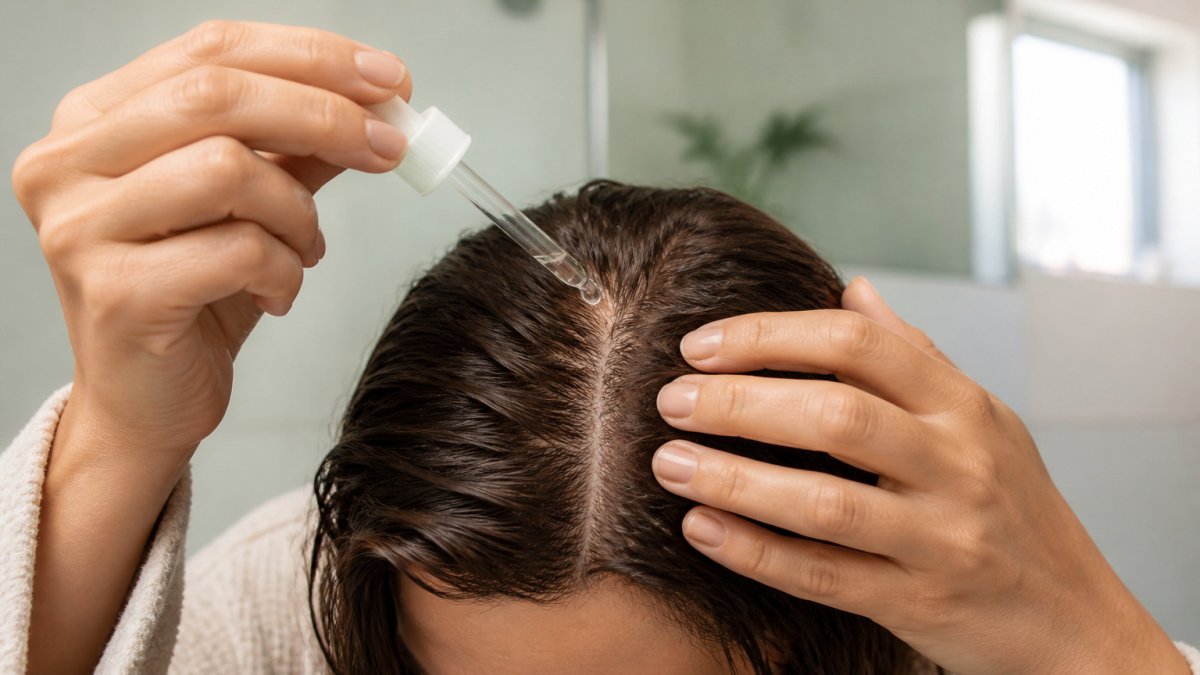
Aftercare Signs to Watch and When to Stop
Mild redness and tenderness are common in the first day or two after needling. Those usually settle on their own. Other signs need more caution. Stop using the serum and seek advice from a doctor or dermatologist if you notice any of the following:
- Burning or stinging that lasts or gets worse
- Swelling, heat or pus around the needling sites
- Rash, hives or itching that spreads beyond the scalp
- Scalp pain that does not improve within a few days
Listen to your scalp. Irritation is a sign to pause, not to push through.
Setting Realistic Expectations for GHK-Cu and Hair Thinning
It is worth being honest about results. The evidence for hair regrowth from topical GHK-Cu is still limited.
If you are experiencing hair thinning, a doctor can help work out the cause, since thinning has many possible reasons and some are treatable with established care. Peptides may be one part of a wider routine, but they are not a substitute for a proper diagnosis.
Consider giving any routine a fair trial and tracking it with photos and notes. You can also read about combining topical products in How to Combine GHK-Cu with Minoxidil for Hair Growth.
Frequently Asked Questions
Is there an established GHK-Cu dose for scalp microneedling?
No. There is no clinically validated GHK-Cu dose specifically for scalp microneedling. Most available evidence comes from skin studies and topical use alone, not from needling protocols. Product concentrations on the label, such as the 2% Copper Peptides in the Pepcare Lab Hair/Scalp Serum, describe what is in the bottle, not a studied dose for combined treatment. Use the label directions, keep the application thin and consistent, and avoid assuming that more product or more frequent needling will produce faster results.
Can you apply GHK-Cu immediately after scalp microneedling?
Evidence on immediate application is limited. Freshly needled skin has micro-channels and may be more sensitive, so many people wait until any redness has settled and the scalp is clean and dry before applying a serum. If stinging, burning or swelling occurs, wash the product off and stop until the scalp recovers. Choose a product with a simple, fragrance-free formula if you plan to apply it soon after needling.
How often can you microneedle your scalp when using a copper peptide?
There is no validated interval for scalp microneedling, so caution is the safest approach. Many people space sessions several weeks apart and allow the scalp to recover fully between treatments. Shorter intervals raise the risk of irritation and inflammation. Keep a simple log of dates, needle depth and any reaction, and pause if the scalp remains tender, flaky or itchy.
Does GHK-Cu help with hair thinning, and what does the evidence show?
GHK-Cu is studied mainly for skin repair, and direct evidence for hair regrowth in people with thinning hair is limited. Some early research and laboratory work suggest effects on follicle-related processes, but these findings do not confirm that a topical serum will regrow hair. Pair realistic expectations with a scalp-care routine, and speak with a GP or dermatologist about established treatments for hair thinning, especially if shedding is sudden or patchy.
