
Table of Contents
- Why GHK-Cu and Minoxidil Work Differently on Hair Follicles
- GHK-Cu Benefits for Hair Thinning: What Copper Peptides Actually Do
- Minoxidil Application Best Practices Before You Add Peptides
- How Long to Use Minoxidil for Results (and When Peptides Kick In)
- How to Apply Copper Peptides to Scalp Alongside Minoxidil
- Stability, pH and Storage: The Risks Most Guides Skip
- Troubleshooting Scalp Irritation and Long-Term Maintenance
- Frequently Asked Questions
Last Updated: September 14, 2026
Why GHK-Cu and Minoxidil Work Differently on Hair Follicles
Combining GHK-Cu with minoxidil works because the two act on separate mechanisms: minoxidil extends the growth phase and widens blood vessels, while copper peptides support collagen synthesis and follicle signalling. Stacking them is a scheduling question, not a chemistry experiment.
Minoxidil is a vasodilator: it prolongs the anagen phase and pushes resting follicles back into growth, which is why shedding often follows the first few weeks. GHK-Cu, a copper-binding tripeptide, works on the tissue around the follicle, collagen synthesis in the dermal papilla, angiogenesis, and reduced oxidative stress.
At Pepcare Lab, we build our scalp formulas around that second job, because a chronically inflamed or starved follicle will not respond well to any growth agent layered on top of it.
GHK-Cu Benefits for Hair Thinning: What Copper Peptides Actually Do
GHK-Cu is a copper peptide complex that supports collagen production, blood vessel formation and follicle signalling in the scalp. It is not a growth drug in the minoxidil sense. It is a repair signal.
The benefits people actually notice with consistent use:
- Thicker-looking individual strands as the follicle environment improves
- Reduced scalp tightness and irritation, which matters if you are already using a drying topical
- Better tolerance of actives because barrier function improves
- Support for vellus-to-terminal hair transition over time, though slower than most people expect
Collagen, Angiogenesis and the Dermal Papilla
The dermal papilla is the cluster of cells at the base of each follicle that directs hair growth, and it depends on a blood supply and a collagen-rich extracellular matrix. GHK-Cu supports both.
Angiogenesis, the formation of new blood vessels, is one of the better-documented actions of copper peptides. More capillary supply to the papilla means more oxygen and nutrients reaching the follicle. Collagen synthesis reinforces the structural scaffolding around it.
This is a supportive mechanism, not a cure: if a follicle has fully scarred over, no topical will bring it back.
Minoxidil Application Best Practices Before You Add Peptides
Minoxidil application best practices come down to three things: a dry scalp, correct dosing, and consistency. Adding peptides does not change that, but it does change your timing.
Timing, Dosing and Scalp Prep
Get the fundamentals right before you introduce a second active.
| Step | What to Do | Why It Matters |
|---|---|---|
| Scalp prep | Wash and dry fully before applying | Wet scalp dilutes the vehicle and reduces absorption |
| Dosing | Follow the label dose exactly | More is not better and increases irritation risk |
| Timing | Apply at the same time daily | Minoxidil works on consistency, not volume |
| Wait time | Let it dry completely before layering | Prevents dilution of the peptide serum |
| Hands | Wash immediately after | Prevents unwanted facial hair growth |
A common mistake is applying minoxidil to a damp scalp because it spreads more easily. The propylene glycol or foam vehicle needs a dry surface to carry the active into the skin.
Give minoxidil a full four hours on the scalp before you consider washing or layering anything over it.
Australian Government Department of Health therapeutic goods information
How Long to Use Minoxidil for Results (and When Peptides Kick In)
Expect visible minoxidil results at three to six months, with the first shed at two to six weeks (pubmed.ncbi.nlm.nih.gov). Peptide support typically shows up later, closer to the three-month mark, because collagen and vascular changes are slower than drug-driven follicle stimulation.
The timeline people actually experience:
- Weeks 1-6: Possible shedding as follicles shift into a new growth phase. This is normal and it is not a reason to stop.
- Months 2-3: Early vellus hair along the hairline or part line in responders.
- Months 3-6: Terminal hair thickening becomes visible. This is the honest assessment point.
- Months 6-12: Continued density gains if you have stayed consistent.
If you stop minoxidil, you lose the minoxidil gains, that is how the drug works. Copper peptides do not carry the same dependency, but they also do not produce the same magnitude of result alone.
How to Apply Copper Peptides to Scalp Alongside Minoxidil
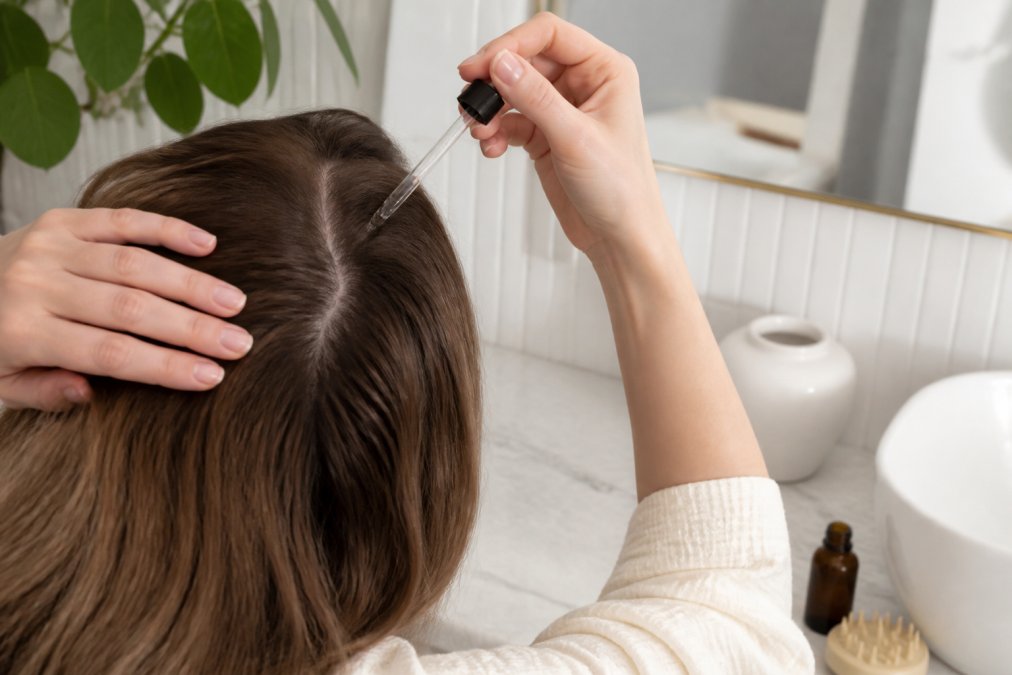
Apply minoxidil first, wait until it is fully dry, then apply your copper peptide serum. Never mix the two in your hand or apply them at the same moment.
Why the Order and the Wait Time Matter
Minoxidil needs to partition into the skin from its vehicle, propylene glycol, ethanol and water in the solution form, or a foam base. A water-based peptide serum over wet minoxidil dilutes the vehicle, changes its solvent balance, and reduces how much minoxidil crosses into the follicle.
The 15 to 30 minute wait is roughly the window in which the minoxidil vehicle has finished depositing its active and the surface has dried enough that a second water-based product will not re-dissolve it. Foam dries faster than solutions; solutions can take closer to 30 minutes in humid conditions.
The Full Protocol
- Cleanse and dry. A clean, dry scalp is the baseline for both products. Do not apply to a damp scalp, moisture interferes with minoxidil's vehicle.
- Apply minoxidil. Use the label dose. Spread it with the applicator or fingertips, do not massage aggressively. Aggressive rubbing increases systemic absorption and irritation.
- Wait 15 to 30 minutes. Foam: closer to 15. Solution: closer to 30. In humid weather, add a few minutes.
- Check the surface. It should feel dry to a light touch, not tacky. If it is still tacky, wait longer.
- Apply the peptide serum. Work it along the part lines and any thinning zones. A few drops per zone is enough, more does not mean better absorption.
- Distribute with a scalp brush. Gentle circular passes move product across the scalp without scratching. Do not press hard; you are spreading, not exfoliating.
- Leave it. Do not rinse for at least four hours. Overnight is fine if the formulation does not stain pillows.
Adapting the Protocol to Your Situation
If you use minoxidil foam: you can shorten the wait to 15 minutes, and the foam itself may be better tolerated if you have a sensitive scalp.
If you use minoxidil solution: expect a longer dry time, and consider applying it in the morning and the peptide serum in the evening rather than back-to-back. This is the single most effective change for people who get irritation from the stack.
If you have a dry or reactive scalp: apply the peptide serum to a slightly damp scalp after your evening shower, then let it dry before bed. Absorption is better than on bone-dry skin, and you avoid the greasy-pillow problem.
If you are a once-daily minoxidil user: morning minoxidil, evening peptides is the cleanest split. It removes the wait-time problem entirely and reduces the cumulative irritation load on the scalp.
Frequency: What Most People Should Actually Do
Two applications per day total, one minoxidil, one peptide serum, is the routine people stick to. Twice-daily minoxidil plus twice-daily peptides is where irritation starts, and the marginal benefit does not justify the barrier damage.
If you are tolerating the stack well after eight weeks, you can consider adding a second peptide application on non-minoxidil days, but there is no strong evidence that doubling up accelerates results. Consistency beats intensity.
Our Hair/Scalp Serum uses 2% Copper Peptides alongside niacinamide, biotin and botanical extracts, formulated to sit on the scalp without the sting that higher-concentration peptide products often cause. If you want the full routine in one purchase, the Hair and Scalp Duo pairs the serum with a scalp brush for $69.00.


Stability, pH and Storage: The Risks Most Guides Skip
This is the section that separates a stack that works from one that quietly degrades. Copper peptides are fragile, and almost no guide explains why.
Why GHK-Cu Degrades
GHK-Cu is a tripeptide (glycyl-L-histidyl-L-lysine) with a copper(II) ion held in a square-planar complex. The copper is what makes it work, and what makes it unstable.
Three things break it down:
- Oxidation. The histidine residue is vulnerable to oxidative attack, and free copper ions can catalyse further oxidation once the complex starts to unravel. Light and dissolved oxygen both accelerate this.
- pH drift. The complex is most stable in a mildly acidic environment. Push the pH too far up and the copper can precipitate out or transfer to other ligands; push it too far down and the peptide backbone itself starts to hydrolyse.
- Competing ligands. Copper binds readily to amines, thiols, carboxylates and other chelators. Anything in the same bottle that can out-compete the tripeptide for the copper will strip it.
That last point is why you never mix GHK-Cu directly into a minoxidil solution. Minoxidil formulations contain solvents, preservatives and pH adjusters chosen for minoxidil's stability, not the peptide's, you cannot control what complexes with what once the two are in the same liquid.
The pH Question
Healthy scalp surface sits around pH 4.5 to 5.5, mildly acidic, maintained by sebum and the skin microbiome. Two things follow:
- A peptide serum formulated well outside that range will disrupt the acid mantle and irritate a sensitive scalp, especially when minoxidil is already stressing the barrier.
- The peptide itself is more stable near that range than at neutral or alkaline pH, because copper-histidine complexation is favoured under mildly acidic conditions.
Most well-formulated copper peptide serums sit in the pH 4.5 to 6 range. If a product stings on contact and keeps stinging for more than a minute or two, the pH or preservative system is the likely culprit, not the copper concentration. A brief tingle is normal; sustained burning is not.
Storage Rules That Actually Matter
- Keep the bottle closed, upright and out of direct light. Amber or opaque packaging is not marketing, it is functional.
- Store below 25°C. In a hot climate, a bathroom windowsill or a car glovebox will cook the peptide.
- Refrigerate only if the label says to. Some formulations are stable at room temperature and refrigeration can cause the peptide to precipitate.
- Do not decant into unlabelled travel containers for weeks at a time. Air exposure, light exposure and contamination all accelerate degradation.
- Respect the expiry date, and treat the period-after-opening symbol (the open-jar icon) as a real deadline, not a suggestion.
How to Tell a Serum Has Gone Off
You will not always get a clear signal, but the common ones are:
- A colour shift toward green or brown, which suggests copper oxidation
- A sudden change in smell, often described as metallic or sour
- Visible particles or cloudiness in a previously clear serum
- A product that used to tingle mildly and now stings sharply
If any of those appear, replace the bottle. A degraded serum is not just ineffective, oxidised copper species can be more irritating to the scalp than the intact complex.
Therapeutic Goods Administration guidance on cosmetic and therapeutic product stability
Troubleshooting Scalp Irritation and Long-Term Maintenance
Scalp irritation on a minoxidil and peptide stack is common and usually solvable. The fix is almost always frequency, not abandonment.
Work through it in this order:
- Drop to once daily for minoxidil if you are on twice. Most people do not need the higher frequency.
- Switch vehicles. Foam is often better tolerated than propylene glycol solutions.
- Separate the applications. Morning minoxidil, evening peptides, rather than back to back.
- Add a gentle scalp brush to lift product build-up rather than adding another active.
- Pause the peptide serum for five days if irritation persists, then reintroduce every second day.
Long-term, the routine that works is boring: minoxidil daily and indefinitely, peptide serum daily or near-daily, a scalp brush a few times a week to manage build-up. Reassess at six months with photos taken under the same lighting, because progress on hair is slow enough to be invisible day to day.

If you have a diagnosed scalp condition or you are pregnant or breastfeeding, talk to your doctor before starting minoxidil. Copper peptides are generally well tolerated, but a stack is a stack.
Frequently Asked Questions
Can I use minoxidil and peptides together in the same routine?
Yes, they can be layered in one routine because they work through different pathways. Minoxidil supports blood flow and prolongs the anagen phase, while GHK-Cu copper peptides support collagen synthesis and the dermal papilla environment. Apply minoxidil first and let it dry fully, usually 15 to 30 minutes, then follow with your peptide serum. Avoid mixing them in the same bottle, as the solvents in minoxidil can degrade peptide stability.
How many mgs of GHK-Cu should I use for hair growth?
Dosing is usually expressed as a concentration rather than milligrams per application. A 2% copper peptide serum, such as the Pepcare Lab Hair/Scalp Serum, is a common starting point for scalp use. Apply a few drops along the part lines and massage gently. Higher percentages are not automatically better; peptide stability, pH and how consistently you apply matter more than chasing a stronger formula.
How long does it take to see results when using GHK-Cu for hair?
Minoxidil typically shows early shedding at weeks 2 to 6, with visible change around month 3 to 4. Copper peptides work more slowly on scalp condition and follicle environment, so most people judge them over 3 to 6 months. Track hair density and vellus-to-terminal hair changes with photos taken in the same lighting every 4 weeks rather than relying on daily mirror checks.
How should I store my peptide-based hair products?
Keep peptide serums away from heat, direct sunlight and humid bathrooms. A cool, dark cupboard or the fridge door is better than a shower shelf. Copper peptides are sensitive to oxidation and pH drift, so recap tightly and use within the period after opening. If the serum changes colour, smell or texture, replace it rather than finishing the bottle.
Hair thinning is a long game, and the hardest part is staying consistent when nothing visible happens for three months. Pepcare Lab builds simple, science-led routines for exactly that reason: a 2% Copper Peptide Hair/Scalp Serum at $59.00, a scalp brush at $19.00 to help distribute it, and a two-product routine you will actually keep up with. Get started with Pepcare Lab and give your scalp the conditions it needs to support stronger-looking hair.