
Table of Contents
- What GHK-Cu Is and Why It Matters for Skin
- How GHK-Cu Works in the Skin: From Fibroblasts to Collagen Synthesis
- GHK-Cu Collagen Production Research: What Studies Actually Show
- How to Use Copper Peptides in Skincare Routine
- Side Effects of Copper Peptides: What to Watch For
- Realistic Timelines: Short-Term vs Long-Term Results
- Conclusion: What the Science Means for Your Routine
- Frequently Asked Questions
Last Updated: September 11, 2026
What GHK-Cu Is and Why It Matters for Skin
GHK-Cu is a copper-binding tripeptide that occurs naturally in human plasma and declines with age, and ghk-cu for skin has drawn attention in skincare research for its role in collagen synthesis and skin regeneration. For anyone weighing up ghk-cu for skin, the science behind this compound is more interesting than the marketing suggests.
This guide from Pepcare Lab examines what the research actually shows, where the evidence is solid, and where claims outrun the data.

The tripeptide's natural decline is one of the more compelling findings in peptide research. NCBI research on GHK-Cu and gene expression documents how copper peptide levels fall measurably with age, which is the basis for topical supplementation.
The Tripeptide-Copper Complex Explained
GHK-Cu is a complex formed when the tripeptide glycyl-L-histidyl-L-lysine binds with a copper ion. The copper is essential to how the molecule functions, acting as a chelating agent that delivers copper into cells where it participates in enzymatic reactions.
Without the copper ion, the peptide behaves differently. The complex is what makes GHK-Cu distinct from other peptides in skincare.
How GHK-Cu Works in the Skin: From Fibroblasts to Collagen Synthesis
GHK-Cu works by stimulating fibroblasts, the cells responsible for producing collagen and elastin in the extracellular matrix. When applied topically, the peptide signals these cells to increase collagen synthesis and elastin production, supporting the structural proteins that keep skin firm.
The mechanism extends beyond collagen alone. Research indicates the peptide influences wound healing, tissue remodelling, and angiogenesis, the formation of new blood vessels that support dermal repair (peer-reviewed research).
The Signalling Cascade, Step by Step
What separates GHK-Cu from simpler peptides is that it acts as a signalling molecule rather than a building block. The copper ion is not decorative: it is the functional core of the complex. Once the tripeptide delivers copper into the cell, that copper becomes available as a cofactor for enzymes involved in dermal remodelling, including lysyl oxidase, which cross-links collagen and elastin fibres so they hold their shape.
A useful way to picture the sequence:
- The intact GHK-Cu complex crosses the stratum corneum and reaches the dermis.
- Copper is released intracellularly and the peptide fragment interacts with cellular machinery.
- Fibroblasts are stimulated to upregulate collagen (notably types I and III) and elastin production.
- Matrix metalloproteinases, the enzymes that break down old collagen, are modulated, shifting the balance toward net remodelling rather than breakdown.
- Newly formed collagen is cross-linked via copper-dependent enzymes, which is what converts 'more collagen' into measurable firmness.
Gene Expression and Cellular Modulation
The compound modulates the activity of multiple genes involved in dermal repair, rather than triggering a single pathway. This is why researchers describe it as a signalling molecule rather than a simple ingredient: it influences how cells behave, not just what they produce.
Why Delivery and Stability Decide Whether Any of This Happens
This is the part most write-ups skip, and it is the part that determines whether the mechanism above ever gets a chance to run.
Copper peptides are fragile in formulation. Free copper ions can catalyse oxidation, and the complex can dissociate in the wrong pH environment or in the presence of strong chelators and acids. A serum that lists GHK-Cu on the label but cannot keep the complex intact, or cannot get it past the stratum corneum, will underperform a lower-concentration product that solves both problems.
Two practical consequences follow:
- Penetration. The skin barrier favours small, moderately lipophilic molecules. Formulators use encapsulation, liposomal carriers, or penetration enhancers to improve dermal delivery, because molecular size and vehicle design matter as much as percentage strength.
- Stability. Packaging and pH matter. Airless or opaque pumps limit oxidation and light exposure, and a formulation buffered away from strongly acidic conditions helps preserve the copper complex. A product that has oxidised often shows a colour shift and loses potency before the bottle is finished.
What This Means for Real-World Results
The mechanism is well documented in laboratory and in-vitro work, where fibroblast activity and collagen synthesis respond clearly. The honest caveat is that large-scale human trials remain limited, so the strongest claims are mechanistic rather than outcome-proven. That does not make the ingredient ineffective, it means the science supports the pathway, and your results depend on consistent use of a well-formulated product rather than on a single dramatic study.
GHK-Cu Collagen Production Research: What Studies Actually Show
The evidence for GHK-Cu collagen production is encouraging but should be read carefully. Most published research comes from laboratory and in-vitro studies, which demonstrate clear effects on fibroblast activity and collagen synthesis.
In practice, this means the mechanism is well documented, but large-scale human trials remain limited. A common mistake is treating lab results as directly transferable to real-world outcomes.
How to Use Copper Peptides in Skincare Routine
Using copper peptides well comes down to timing and layering. Apply them to clean, dry skin before heavier moisturisers, and give the serum a moment to absorb before the next step.
A simple approach:
- Cleanse gently and pat dry
- Apply your copper peptide serum to face and neck
- Follow with a barrier-supporting moisturiser
- Use sunscreen in the morning as the final step
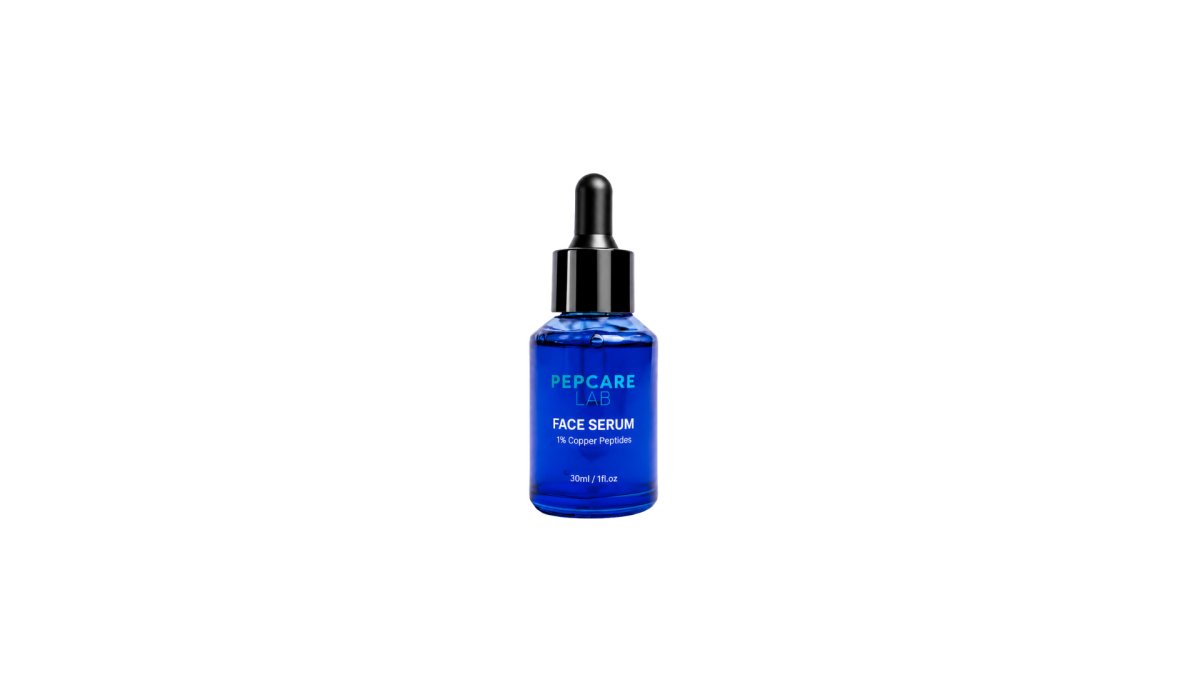
The Pepcare Lab Face Serum, formulated with 1% Copper Peptides alongside niacinamide and hyaluronic acid, fits this sequence as a lightweight step that supports the skin barrier. Pairing it with the Barrier Cream keeps the routine to two steps, which matters for sensitive skin that reacts to over-layering.

Layering Copper Peptides With Other Actives
Copper peptides do not play well with everything. The main conflict is with strong acids and pure vitamin C, which can destabilise the copper complex and reduce how well it works.
The practical fix is separation by time. Use your vitamin C or exfoliating acids in the morning, and copper peptides in the evening. Retinol is a different case: many people tolerate it alongside peptides, but sensitive skin often does better alternating nights.
Side Effects of Copper Peptides: What to Watch For
The side effects of copper peptides are generally mild. Some users notice temporary redness, tingling, or irritation when starting, particularly on compromised skin barriers (the American Academy of Dermatology).
The most common mistake is introducing copper peptides at the same time as other new actives. If irritation appears, you cannot tell which product caused it.
Realistic Timelines: Short-Term vs Long-Term Results
Short-term, expect hydration and improved skin feel within the first couple of weeks. These are barrier effects, and they show up quickly.
Long-term results, the collagen and elasticity changes, take longer. Structural improvements in the dermal layer typically become visible over several months of consistent use, because collagen remodeling is a slow biological process.
| Timeframe | What You May Notice | What's Happening |
|---|---|---|
| 1-2 weeks | Improved hydration, softer feel | Skin barrier support |
| 4-8 weeks | Smoother texture, calmer tone | Early cellular modulation |
| 3-6 months | Firmer feel, improved elasticity | Collagen and elastin changes |
That gap between short and long-term results is where most people give up. Consistency matters more than concentration here.
Conclusion: What the Science Means for Your Routine
Copper peptides are not a quick fix, and the research is honest about that. The mechanism is well supported, the timelines are realistic, and the results build gradually with consistent use.
For a simple, science-led routine built around 1% Copper Peptides, the Face Duo pairs the Face Serum with the Barrier Cream in two steps. For those also addressing scalp and hair concerns, the Complete Collection extends the same approach.

Get started with Pepcare Lab and build a routine that supports your skin barrier, encourages natural renewal, and delivers stronger-looking hair over time.
Frequently Asked Questions
Does GHK-Cu actually help skin?
Research suggests GHK-Cu supports skin by stimulating collagen and elastin production, improving elasticity and firmness. It also has antioxidant and anti-inflammatory properties that may help with wound healing and tissue repair. Studies show it can increase dermal thickness and support the extracellular matrix. While results vary, many users notice smoother texture and better hydration within a few weeks of consistent use.
What are the side effects of copper peptides on the face?
Copper peptides are generally well tolerated, but some people with sensitive skin may experience mild redness, itching, or irritation when first starting. These effects usually settle as the skin adjusts. Avoid using copper peptides with strong acids like vitamin C or retinol at the same time, as this can reduce effectiveness or cause irritation. Always patch test before full application.
How long does it take to see results from GHK-Cu?
Early changes like improved hydration and a more even tone may appear within 2-4 weeks. Visible improvements in firmness, fine lines, and skin elasticity typically take 8-12 weeks of daily use. For hair and scalp benefits, allow at least 3 months. Consistency matters more than concentration, so a simple twice-daily routine works better than occasional high-dose application.
Is GHK-Cu suitable for sensitive skin types?
Yes, GHK-Cu is often recommended for sensitive skin because it supports the skin barrier and reduces inflammation. However, start with a lower concentration and introduce it slowly. Avoid combining with exfoliating acids or alcohol-based toners in the same routine. A patch test on your inner arm for 24 hours can help confirm tolerance before applying to your face.