
Table of Contents
- What Is GHK-Cu and Why Does It Matter for Hair Thinning
- Copper Peptides for Hair Growth: The Biological Case
- GHK-Cu vs. Other Hair Loss Treatments
- GHK-Cu Hair Growth Results Timeline: What to Expect
- How to Use GHK-Cu for Scalp Health: Application Protocols
- Safety Profile and Who Is a Good Candidate
- Conclusion
Last Updated: August 22, 2026
What Is GHK-Cu and Why Does It Matter for Hair Thinning
GHK-Cu is a naturally occurring copper peptide complex, a small protein fragment bonded to copper, that regulates tissue repair, collagen synthesis, and cellular renewal. For hair thinning, it matters because it operates directly at the hair follicle, influencing whether follicles stay active or gradually shut down.
Unlike topical treatments that work at the surface, GHK-Cu penetrates into the dermis and engages with dermal papilla cells, the specialised structures at the follicle base that control hair growth. At Pepcare Lab, the focus on GHK-Cu is deliberate: its role in supporting collagen production, reducing oxidative stress, and encouraging follicle viability makes it one of the most scientifically coherent ingredients for addressing scalp health, particularly for adults experiencing early-stage diffuse thinning or pattern hair loss.

How GHK-Cu Interacts with the Dermal Papilla and Anagen Phase
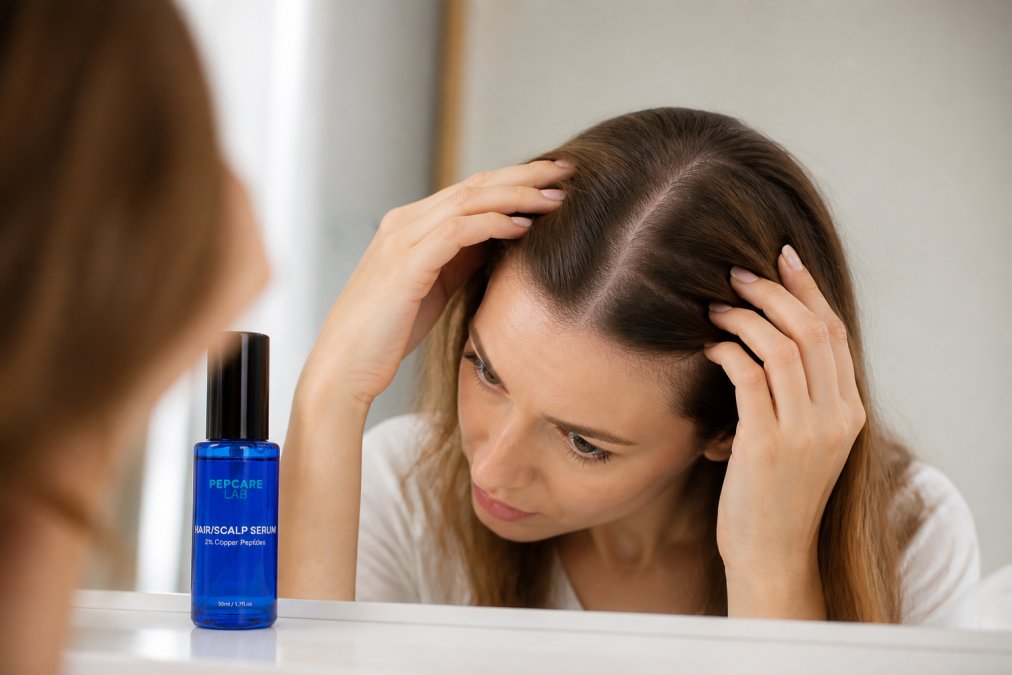
The dermal papilla is the command centre of the hair follicle, signalling when follicles enter the anagen phase (active growth), rest, and shed. Follicle miniaturisation, the gradual shrinking seen in pattern hair loss, occurs because dermal papilla cells lose their signalling capacity over time.
GHK-Cu supports dermal papilla function by upregulating growth factors associated with follicle stimulation and angiogenesis, the formation of new blood vessels that supply the follicle with nutrients. Improved scalp microcirculation means follicles receive more nutrients to sustain the anagen phase longer, allowing hair fibres more time to grow before cycling into resting and shedding phases. According to research published in the Journal of Investigative Dermatology, copper peptides have demonstrated the ability to stimulate follicle-related growth factors in laboratory settings, supporting their use in hair regrowth protocols.
Copper Peptides for Hair Growth: The Biological Case
GHK-Cu works through several converging pathways. The copper component plays a role in enzyme activity that governs collagen and elastin production in the scalp dermis. A well-structured dermis supports follicle anchoring and creates the right tissue environment for sustained hair cycle regulation.
Follicle Miniaturisation, Oxidative Stress, and Scalp Microcirculation
The three biological problems most closely associated with pattern hair loss and diffuse thinning are follicle miniaturisation, oxidative stress, and poor scalp microcirculation. GHK-Cu addresses all three.
Oxidative stress damages follicle cells and disrupts the hair cycle. GHK-Cu has demonstrated anti-inflammatory and antioxidant properties in tissue studies, reducing cellular damage that accelerates follicle decline, particularly relevant for adults over 35, where cumulative oxidative stress visibly affects hair volume.
Scalp microcirculation determines how well follicles are fed. GHK-Cu's role in angiogenesis supports fine capillary development around the follicle base, improving oxygen and nutrient delivery to follicles in reduced activity states.
Follicle miniaturisation is the end result of these compounding problems. Early intervention matters: GHK-Cu is most effective when follicles retain viability, not after they have fully closed.
| Problem | GHK-Cu Mechanism | Practical Benefit |
|---|---|---|
| Follicle miniaturisation | Supports dermal papilla signalling | Slows or partially reverses shrinkage |
| Oxidative stress | Anti-inflammatory, antioxidant activity | Reduces cellular damage to follicle |
| Poor scalp microcirculation | Promotes angiogenesis | Improves nutrient delivery to follicle |
| Collagen deficit in dermis | Stimulates collagen synthesis | Strengthens follicle anchoring tissue |
GHK-Cu vs. Other Hair Loss Treatments
GHK-Cu is not a replacement for clinically proven hair loss medications in cases of significant androgenetic alopecia. It occupies a different position, particularly relevant for early-stage thinning without pharmaceutical intervention, or as a complement to existing treatments.
Minoxidil prolongs the anagen phase and improves scalp blood flow through vasodilation, but requires continuous use and carries side effects including scalp irritation and initial shedding. Finasteride targets the hormonal pathway driving pattern hair loss by inhibiting DHT conversion, but carries systemic side effects that make many reluctant to use it long-term.
GHK-Cu operates through tissue-level mechanisms rather than hormonal or vascular pharmacology. For people with sensitive skin or those who experienced irritation from other treatments, this is meaningful. The side effect profile of topical GHK-Cu is considerably milder, making it practical for consistent daily use.
GHK-Cu genuinely excels in scalp health maintenance, early-stage hair loss prevention, and as an adjunct to other treatments. According to an overview of peptide-based therapies in dermatology, copper peptides show a favourable safety profile compared to many pharmaceutical options, with tissue-level benefits extending beyond hair follicle stimulation to broader scalp health.
GHK-Cu Hair Growth Results Timeline: What to Expect
Results from GHK-Cu are gradual, with timelines varying depending on the stage of hair thinning, consistency of application, and individual biology.
- Weeks 1-4: Scalp health improvements tend to be the first noticeable change, reduced sensitivity, less flaking, and improved texture.
- Weeks 4-8: Some users notice reduced shedding as the hair cycle stabilises, with fewer follicles entering the telogen (shedding) phase prematurely.
- Months 3-4: Early signs of hair density improvement may become visible, particularly at the hairline and crown. Hair shaft thickness often improves before visible density changes.
- Months 4-6: More consistent improvements in hair volume and follicle awakening in areas of diffuse thinning.
- Months 6+: Long-term maintenance phase. Continued use supports gains achieved and prevents further miniaturisation.
The absence of dramatic early results is not a sign of failure. Follicle biology moves slowly. Patience and consistency are the actual active ingredients in any peptide protocol.
How to Use GHK-Cu for Scalp Health: Application Protocols
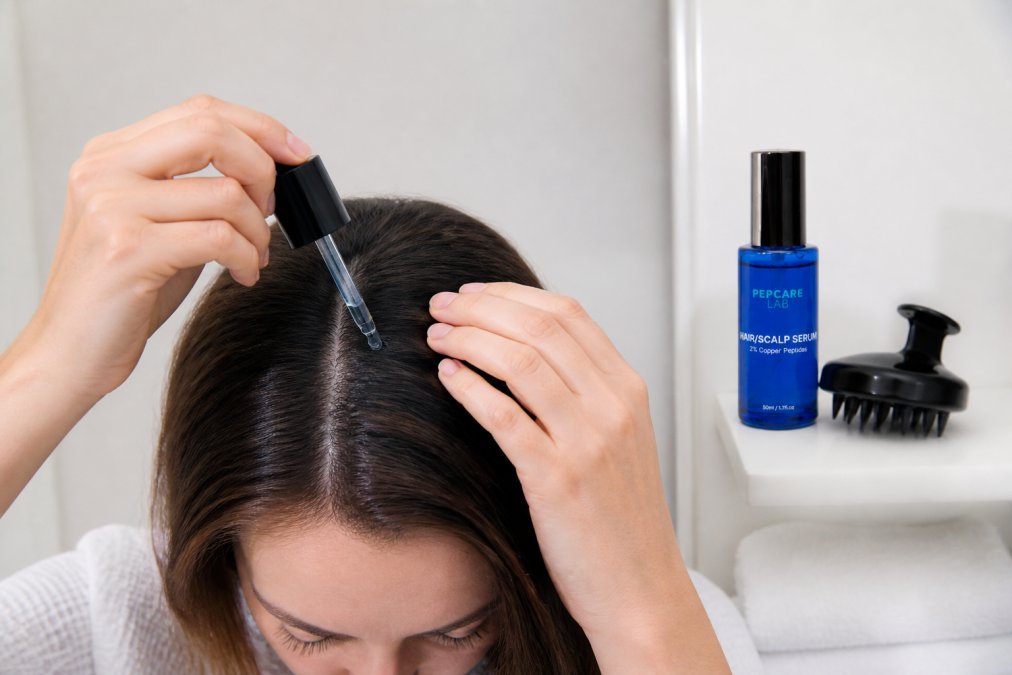
The most common mistake is applying serum to hair rather than directly to the scalp. The peptide must reach the follicle base, not coat the hair shaft.
Daily application protocol:
- Part the hair in sections to expose the scalp directly.
- Apply the serum using a dropper, placing drops directly onto the scalp at 1-2 cm intervals along each part.
- Use a scalp brush to gently work the serum into the scalp with circular motions, improving absorption and supporting scalp microcirculation.
- Do not rinse. Allow the serum to absorb fully before styling.
- Apply once daily, preferably in the evening when the scalp is clean and free of styling products.
The Pepcare Lab Hair and Scalp Duo pairs the 2% Copper Peptide Hair/Scalp Serum with a dedicated scalp brush, making this protocol straightforward to execute consistently. For those preferring the serum alone, the Pepcare Lab Hair/Scalp Serum at $59.00 delivers 2% GHK-Cu in a lightweight formula designed for direct scalp application without residue or irritation.

Formulation Stability, Delivery Systems, and the Scalp Microbiome
Formulation stability is a genuine concern with copper peptides. GHK-Cu degrades when exposed to high pH environments, certain preservatives, and UV light. Look for formulations that specify pH-optimised delivery and opaque or UV-protective packaging.
Delivery systems affect how deeply the peptide penetrates. Lightweight aqueous serums with low molecular weight carriers tend to outperform thicker creams for scalp application, as the scalp's dense follicular structure allows better absorption of water-based formulations.
The scalp microbiome is underappreciated in hair thinning. A disrupted microbiome, often caused by harsh shampoos or inflammatory scalp conditions, creates an environment that works against follicle health. GHK-Cu's anti-inflammatory properties can calm scalp inflammation that disrupts the microbiome, but the formulation should not contain ingredients that further disrupt microbial balance.
Long-Term Maintenance and Troubleshooting for Non-Responders
For ongoing maintenance after the 6-month mark, the goal shifts from follicle awakening to follicle preservation. Once-daily application remains appropriate for most users.
For non-responders: If you have used a GHK-Cu serum consistently for 16 weeks with no discernible change, consider these factors:
- Application method: Are you reaching the scalp directly, or applying to hair? This single error accounts for many non-response cases.
- Formulation quality: Not all copper peptide products deliver equivalent concentrations of active GHK-Cu. A 2% concentration in a stable, pH-appropriate formulation performs very differently from products listing copper peptide as a minor ingredient.
- Stage of hair loss: Advanced follicle miniaturisation with significant scalp fibrosis responds poorly to topical peptides. A dermatologist or trichologist consultation is warranted.
- Underlying health factors: Nutritional deficiencies (iron, zinc, B vitamins), thyroid dysfunction, and chronic stress affect hair cycle regulation independently of topical treatment.
As noted in guidance from the Australasian College of Dermatologists, a thorough assessment of underlying causes is recommended before committing to any long-term hair loss treatment protocol.
Safety Profile and Who Is a Good Candidate
Topical GHK-Cu is generally well-tolerated, including by people with sensitive skin. The most commonly reported reactions are mild and transient, occasional scalp tingling or temporary redness following application, which typically resolves within minutes. There is no evidence of systemic absorption at levels relevant to toxicity.
Good candidates for GHK-Cu-based hair thinning treatment include:
- Adults in early to moderate stages of pattern hair loss or diffuse thinning
- People who experienced scalp irritation with other treatments
- Those seeking preventive approaches before significant miniaturisation occurs
- Individuals wanting to support scalp health as part of broader skincare
- People preferring non-pharmaceutical options or complementing existing medical treatment
Less suitable candidates include:
- Those with advanced androgenetic alopecia with significant scalp fibrosis
- People with active scalp infections or open wounds
- Anyone with a confirmed copper allergy
The Therapeutic Goods Administration (TGA) regulates cosmetic and therapeutic products in Australia. GHK-Cu in topical formulations at typical cosmetic concentrations is classified as a cosmetic ingredient and does not require a prescription. If hair loss is sudden, severe, or accompanied by other symptoms, a GP or dermatologist assessment is appropriate before beginning any topical treatment.
According to the Therapeutic Goods Administration's guidelines on cosmetic ingredients, consumers should verify that any topical product is appropriately listed or registered for its intended use.
The challenge with hair thinning is that most treatments ask you to choose between effectiveness and tolerability. Pepcare Lab's copper peptide range is built around the premise that you should not have to make that trade-off. The Hair/Scalp Serum delivers 2% GHK-Cu in a stable, lightweight formula, and the Hair and Scalp Duo at $69.00 pairs it with a scalp brush to make consistent, correct application straightforward. Shop our Bestsellers and start a protocol that works with your scalp's biology, not against it.

Frequently Asked Questions
How does GHK-Cu support hair follicle health?
GHK-Cu is a copper peptide that binds to the dermal papilla and signals follicles to re-enter the anagen (active growth) phase. It supports collagen synthesis around the follicle, promotes angiogenesis to improve scalp microcirculation, and reduces oxidative stress that can accelerate follicle miniaturisation. These combined actions help maintain follicle viability and may improve hair shaft thickness over consistent use.
How long does it take to see results from copper peptides for hair growth?
Most people using copper peptides for hair growth notice reduced shedding within 6 to 8 weeks. Visible improvements in hair density and volume typically appear between months 3 and 6, because the hair cycle itself takes time to shift. GHK-Cu hair growth results timeline varies by the degree of thinning, consistency of application, and the formulation's bioavailability. Patience and daily use are essential for meaningful outcomes.
Are there any side effects of using GHK-Cu on the scalp?
GHK-Cu has a well-documented safety profile and is generally well tolerated, including on sensitive skin. Mild scalp tingling or temporary redness can occur when first introduced, particularly if the scalp is already irritated. These reactions typically settle within a few days. Unlike some other hair loss treatments, GHK-Cu does not carry hormonal side effects. If irritation persists, reduce application frequency before gradually increasing it again.
How does GHK-Cu differ from other hair growth treatments like minoxidil?
Minoxidil works primarily by widening blood vessels to extend the anagen phase, but it does not address follicle miniaturisation or oxidative stress directly. GHK-Cu works at a cellular level, supporting collagen synthesis, reducing inflammation, and signalling follicle awakening through protein fragment activity. It is also better tolerated on sensitive scalps. The two approaches target different parts of the hair loss process and are sometimes used alongside each other.
This article was written using GrandRanker