
Table of Contents
- Quick Comparison: Copper Peptide Serums for Face
- How We Evaluated These Copper Peptide Serums
- 1. Pepcare Lab Face Serum: Best Overall for Sensitive Skin
- 2. Pepcare Lab Face Duo: Best Two-Step Routine
- 3. Pepcare Lab Barrier Cream: Best for Barrier Repair
- 4. Pepcare Lab Complete Collection: Best Full Face, Skin & Scalp Routine
- What Not to Mix with Copper Peptides
- Copper Peptides vs Retinol: Which Should You Choose?
- Frequently Asked Questions
Last Updated: September 16, 2026
Quick Comparison: Copper Peptide Serums for Face
A copper peptide serum for face is a topical formula built around copper-binding peptides, most commonly GHK-Cu, that supports collagen synthesis, elastin production and skin barrier repair. This guide from Pepcare Lab compares four options across concentration, format and price.
Quick Picks:
- Best Overall: Pepcare Lab Face Serum, 1% copper peptides for sensitive skin
- Best Two-Step Routine: Pepcare Lab Face Duo, serum plus barrier cream
- Best for Barrier Repair: Pepcare Lab Barrier Cream
- Best Full Routine: Pepcare Lab Complete Collection, face, skin and scalp
| Product | Price | Size | Copper Peptides | Best For |
|---|---|---|---|---|
| Face Serum | $49.00 | 30 mL | 1% | Sensitive skin, first serum |
| Face Duo | $79.00 | 30 mL + 50 mL | 1% | Simple two-step routine |
| Barrier Cream | $49.00 | 50 mL | 1% | Dry, compromised barriers |
| Complete Collection | $149.00 | 4 full-size items | 1% and 2% | Face, skin and scalp |
How We Evaluated These Copper Peptide Serums
Copper peptides have a genuine research history, and GHK-Cu is one of the more studied peptide complexes in topical skincare. Most buying guides, however, rank products by marketing copy instead of formulation.

1. Pepcare Lab Face Serum: Best Overall for Sensitive Skin
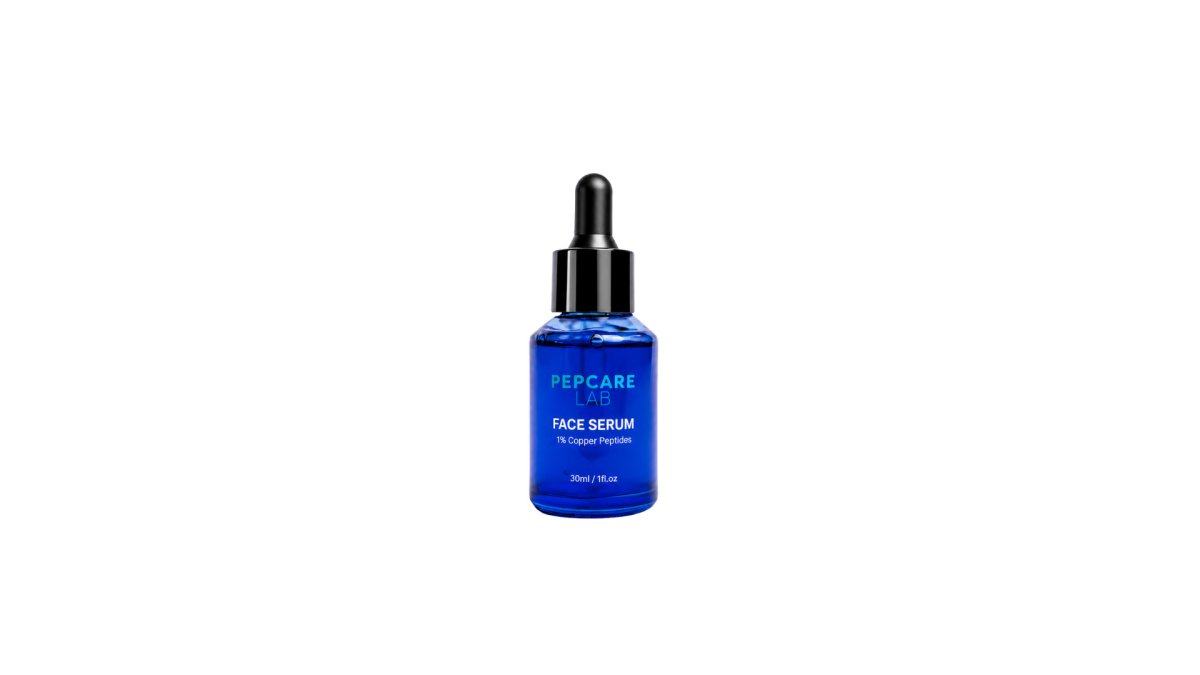
The Face Serum is our top pick and the strongest starting point for most people. It carries 1% copper peptides in a lightweight, fast-absorbing base with niacinamide and hyaluronic acid, at $49.00 for 30 mL. Sensitive skin tolerates it.
Key Ingredients and Concentration
Copper peptides at 1% anchor the formula. Niacinamide supports the barrier and evens tone, while hyaluronic acid pulls water into the upper layers for immediate hydration.
Pros and Cons
Pros:
- 1% copper peptides, clearly stated on the label
- Lightweight texture suits oily and combination skin
- Niacinamide and hyaluronic acid reduce the need for extra steps
Cons:
- 30 mL runs out quickly with twice-daily use
- Results depend on consistency over weeks, not days
2. Pepcare Lab Face Duo: Best Two-Step Routine
Two products, one routine, $79.00 instead of $98.00 bought separately, with free shipping. The Face Duo pairs the 30 mL serum with the 50 mL Barrier Cream: serums deliver actives, moisturisers lock them in.

What's Included and Pricing
- Face Serum, 30 mL, 1% copper peptides
- Barrier Cream, 50 mL, 1% copper peptides
- $79.00, saving $19 against individual pricing
Pros and Cons
Pros:
- Cheaper than buying the two products separately
- Covers hydration and barrier support in two steps
- Both formulas share the same 1% copper peptide base
Cons:
- No scalp or hair product included
- You still need a separate cleanser and sunscreen
3. Pepcare Lab Barrier Cream: Best for Barrier Repair
The Barrier Cream, $49.00 for 50 mL, is built for that: 1% copper peptides with niacinamide, squalane and skin-conditioning ingredients to improve moisture retention. It is rich but not heavy, and used after the serum it supports a softer, more resilient-looking barrier over consistent use.

Key Ingredients and Concentration
Squalane reduces water loss, niacinamide reinforces barrier function, and copper peptides support the dermal matrix over the longer term.
Pros and Cons
Pros:
- 50 mL lasts considerably longer than the serum
- Squalane and niacinamide suit dry and reactive skin
- Layers cleanly over the serum without pilling
Cons:
- Too rich for very oily skin in humid conditions
- Not a standalone treatment for active breakouts
4. Pepcare Lab Complete Collection: Best Full Face, Skin & Scalp Routine
Early hair thinning and scalp health rarely get addressed by face-only routines. Four full-size essentials for $149.00, saving $37 against individual pricing, with free shipping.
What's Included and Pricing
- Face Serum, 30 mL
- Barrier Cream, 50 mL
- Hair & Scalp Serum, 50 mL at 2% copper peptides
- Scalp Brush
- $149.00, saving $37
Pros and Cons
Pros:
- Highest concentration in the range sits in the scalp formula
- Covers face, barrier and scalp in one purchase
- Best value per millilitre of the four options
Cons:
- Largest upfront cost
- Only worth it if you intend to treat scalp and hair as well
What Not to Mix with Copper Peptides
Most guides answer this with a one-line warning and move on. The useful version is a matrix, because "don't mix" is too blunt, some pairings are incompatible in the same step, others are fine separated by time of day, and a few are actively complementary.
Why the Conflict Happens
GHK-Cu is a copper-binding tripeptide complex whose stability depends on the copper staying bound to the peptide, and that binding is pH-sensitive. Below roughly pH 4, the complex is more likely to dissociate, releasing free copper ions. The peptide needs a near-neutral environment to stay intact.
Safe vs. Unsafe: A Layering Matrix
| Ingredient | Same step? | Same routine, different step? | Notes |
|---|---|---|---|
| L-ascorbic acid (pure vitamin C) | No | Separate by 20-30 minutes, or use at opposite ends of the day | Low pH and copper ions interact; the peptide loses stability |
| AHAs (glycolic, lactic) | No | Alternate days or split AM/PM | Exfoliating acids drop surface pH well below the peptide's comfort zone |
| BHAs (salicylic) | No | Split AM/PM | Same pH issue, plus the exfoliation can increase penetration of everything layered after |
| Retinol / retinal | Caution | Yes, retinol at night, copper peptides in the morning | Different mechanisms, no direct chemical conflict; the risk is cumulative irritation, not instability |
| Benzoyl peroxide | No | Avoid on the same days where possible | Strong oxidiser; can degrade peptides and is harsh alongside them |
| Niacinamide | Yes | Yes | Compatible and commonly formulated together; supports barrier function |
| Hyaluronic acid | Yes | Yes | No conflict; improves hydration and spreadability |
| Squalane, ceramides, occlusives | Yes | Yes | Applied after the serum to seal in moisture |
| Zinc oxide / mineral sunscreen | Yes | Yes, always last in the morning | No interaction; sunscreen is non-negotiable over any active |
A Workable Daily Framework
- Morning: cleanse, copper peptide serum, moisturiser, sunscreen.
- Evening (retinol nights): cleanse, retinol, moisturiser. Skip the copper peptide serum.
- Evening (peptide nights): cleanse, copper peptide serum, moisturiser.
- Acid nights: keep them at least one full routine away from the copper peptide step, alternating nights is the simplest rule.
If you want vitamin C and copper peptides in the same morning, apply vitamin C first, wait until the skin feels dry and settled (around 20-30 minutes), then apply the peptide serum. Many people find it easier to move vitamin C to the evening on non-retinol nights.
The Part Most Guides Skip
The conflict is about timing and pH, not permanent incompatibility. Copper peptides are not "ruined" by retinol, and they are not banned from a routine that contains acids. What matters is that the peptide meets skin at a pH where it stays intact, and that you are not stacking so many actives that irritation, not chemistry, becomes the limiting factor.
Copper Peptides vs Retinol: Which Should You Choose?
For most people over 35, this is not a versus question but a sequencing one. The two ingredients work through different mechanisms, on different timelines, with very different tolerability profiles, and those differences tell you which one to start with.
Different Mechanisms, Different Jobs
Copper peptides, principally GHK-Cu, act as signalling molecules. They support collagen synthesis, elastin production and the skin's own repair processes, with a low irritation profile; the effect builds gradually in the dermal matrix. Retinol accelerates cellular turnover, which is why it produces visible change faster, and also why it can cause peeling, redness and purging. It is a stronger tool with a steeper cost.
Realistic Timelines: What to Expect and When
| Timeframe | Copper peptides | Retinol |
|---|---|---|
| Weeks 1-2 | Hydration and a slightly calmer, less tight feel | Possible purging, flaking, sensitivity |
| Weeks 4-6 | Early improvement in skin feel and smoothness | Visible texture change begins for tolerant skin |
| Weeks 8-12 | Firmer feel, more resilient barrier, softer fine lines | More pronounced texture and tone improvement |
| Months 3-6 | Gradual collagen-related firmness; the real payoff window | Continued remodelling, but irritation risk persists |
Copper peptides are often judged too early. Commit to at least twelve weeks before assessing it.
Which One for Which Skin Type
- Sensitive or reactive skin: start with copper peptides. Add retinol only if you tolerate it, and start at a low strength twice a week.
- Oily, congestion-prone skin: retinol often helps more with texture and breakouts; copper peptides support the barrier that retinol can compromise.
- Mature skin (roughly 40+): both, on a split schedule. The mechanisms are complementary rather than redundant.
- Dry or compromised barrier: copper peptides first, until the barrier is stable. Retinol on a damaged barrier tends to make things worse.
How to Run Both
The simplest sustainable pattern is copper peptides in the morning and retinol at night, two to three nights a week to start. If your skin is easily irritated, alternate nights instead: retinol one night, copper peptides the next. Do not layer them in the same step, not because they conflict chemically, but because stacking two actives makes it impossible to tell which one is causing a reaction.
The Short-Term vs Long-Term Distinction
Retinol shows visible change faster but can be harder to sustain. Copper peptides work gradually on the dermal matrix, so consistent daily use over months, not weeks, is where the payoff sits. If you want one product you can use every day, copper peptides are an easier commitment. If you want faster visible change and your skin can handle it, retinol earns its place, ideally alongside, not instead of, a peptide serum.
Frequently Asked Questions
Are copper peptides good for the face?
Copper peptides support collagen synthesis, elastin production and skin barrier repair. They help improve the appearance of fine lines, skin firmness and overall texture. The GHK-Cu peptide occurs naturally in the body, and topical application delivers it directly to the dermal matrix. For sensitive skin, copper peptides are generally well tolerated because they work with the skin's own repair mechanisms rather than stripping or resurfacing it.
What should you not mix with copper peptides?
Avoid layering copper peptides with strong acids like glycolic or lactic acid, high-concentration vitamin C, or benzoyl peroxide in the same step. If you use them, separate application times: acids or vitamin C in the morning, copper peptides at night. Retinol also needs separation, which is why alternating nights works better than combining both in one routine.
Which is better, retinol or copper peptides?
They serve different purposes. Retinol accelerates cellular turnover and reduces visible signs of aging, Copper peptides focus on skin barrier repair, collagen synthesis and wound healing with a gentler profile. For sensitive skin or compromised barriers, copper peptides are often the better starting point. Many people alternate: retinol two to three nights per week and copper peptides on the other nights.
How long does it take to see results from copper peptides?
Most people notice improved hydration and skin texture within two to four weeks of consistent daily use. Changes in skin firmness, elasticity and the appearance of fine lines typically take eight to twelve weeks because collagen remodelling happens gradually in the dermal matrix.
Can copper peptides be used every day?
Yes, copper peptides are suitable for daily use, morning or night. A 1% concentration is a common starting point for sensitive skin. Apply to clean, dry skin before heavier moisturisers. If you are new to peptides, start once daily for the first week, then increase to twice daily if your skin tolerates it well. There is no need to cycle copper peptides the way you might with retinol.