
Table of Contents
- Start With Your Skin, Not the Label
- Moisturiser Ingredients for Rosacea: What Actually Helps
- Ingredients to Avoid With Rosacea
- Cream vs Lotion for Rosacea: Which Texture Suits You
- How to Patch Test Skincare Before It Touches Your Whole Face
- A Rosacea Moisturizer Routine That Works With Your Skin Type
- Where a Rosacea Moisturizer Fits in Your Routine
- Frequently Asked Questions
Last Updated: October 15, 2026
Start With Your Skin, Not the Label
Choosing a moisturizer for rosacea prone skin starts with your skin, not the marketing on the jar.
At Pepcare Lab, we formulate with sensitive skin in mind, so we read ingredient lists the way a dermatologist does.
Most people buy a moisturiser for its claims. Buy it for its function instead: does it hold water in the skin, support the moisture barrier, and apply daily without stinging?
Moisturiser Ingredients for Rosacea: What Actually Helps
The ingredients that help rosacea-prone skin fall into two groups: those that rebuild the barrier and those that calm and soothe. Look for both, and treat everything else as optional.
Barrier ingredients: ceramides, squalane, niacinamide
Ceramides are lipids that occur naturally in the skin barrier. Applied topically, they replace what dryness and irritation strip away, supporting moisture retention.
Squalane is a lightweight emollient that softens skin without a heavy feel and absorbs quickly, suiting most skin types including oily skin.
Niacinamide supports the skin barrier and helps even out tone with consistent use. It appears in our Barrier Cream alongside squalane and copper peptides, included to support collagen production and skin renewal.

Soothing ingredients: aloe, allantoin, green tea, azelaic acid
Aloe and allantoin calm and soothe reactive skin. Green tea is a botanical extract often used in gentle formulas for its soothing properties.
Azelaic acid is different: a treatment ingredient rather than a moisturising one, it can reduce redness for some people. Introduce it slowly, only once your barrier feels stable.
Ingredients to Avoid With Rosacea
Avoid fragrance, drying alcohols, physical scrubs and strong exfoliating acids in any product you plan to use daily. These are the most common triggers for reactive skin, and the irritation can take days to settle.
But "avoid" lists are only useful if you can find these ingredients on a real label. Australian products list ingredients by their International Nomenclature of Cosmetic Ingredients (INCI) names, usually in descending order of concentration down to about 1%, after which order is flexible.
How to read an ingredient list in 60 seconds
Work through the label in this order:
- Check the first five ingredients. If fragrance, alcohol denat or a strong acid appears here, put the product down.
- Scan for fragrance in all its disguises. "Parfum", "fragrance", "aroma" and essential oils such as limonene, linalool, citronellol, geraniol, eugenol and citral are all fragrance-related. "Fragrance-free" is not the same as "unscented", unscented products may still contain masking fragrance.
- Look at the preservative system. Phenoxyethanol, sodium benzoate and potassium sorbate are common and generally well tolerated. Methylisothiazolinone (MI) and methylchloroisothiazolinone (MCI) are more likely to sting reactive skin.
- Check the emollient and occlusive base. Shea butter, squalane, glycerin, dimethicone and ceramides are usually well tolerated. Heavy occlusives such as petrolatum suit very dry skin but can feel suffocating on oily, flushed skin.
- Note the actives last. Niacinamide, azelaic acid, vitamin C and retinoids are the most likely to sting, so introduce them one at a time.
Ingredients to treat with caution
- Parfum or fragrance, including "natural" essential oils such as citrus, peppermint, lavender and eucalyptus
- Denatured alcohol and alcohol denat, which appear high in the list of some toners and gels
- Physical exfoliants such as walnut shell and coarse sugar
A common mistake is assuming "non-comedogenic" also means "non-irritating." It does not, it means the product is unlikely to clog pores, and says nothing about facial redness. Likewise, "dermatologist-tested" and "hypoallergenic" are marketing terms without a fixed regulatory definition in Australia.
What the evidence actually supports
The evidence for individual ingredients is uneven. Ceramides, glycerin, squalane and niacinamide have reasonable support for barrier support and moisture retention in sensitive skin.
In other words: a moisturiser can support the skin barrier and reduce the dryness that makes rosacea feel worse, but it does not treat rosacea itself. If a product claims to "cure" or "reverse" rosacea, treat that as a red flag.
Cream vs Lotion for Rosacea: Which Texture Suits You
Cream suits dry and reactive skin, while lotion suits oily and combination skin. Texture matters as much as ingredients, because a product you find uncomfortable is one you will stop using.
Here is how the main formats compare:
| Format | Texture | Best For | Watch Out For |
|---|---|---|---|
| Cream | Rich, occlusive | Dry to normal skin, cold climates | Can feel heavy on oily skin |
| Lotion | Light, fluid | Oily skin, humid climates | May not be rich enough in winter |
| Gel | Water-light, cooling | Oily and combination skin | Alcohol content in some formulas |
| Balm | Thick, protective | Very dry, wind-exposed skin | Occlusive; patch test first |
A gel texture feels pleasant on oily skin, but check the label for drying alcohol. In cooler months, many people with combination skin need a cream at night and a lotion in the morning.
How to Patch Test Skincare Before It Touches Your Whole Face
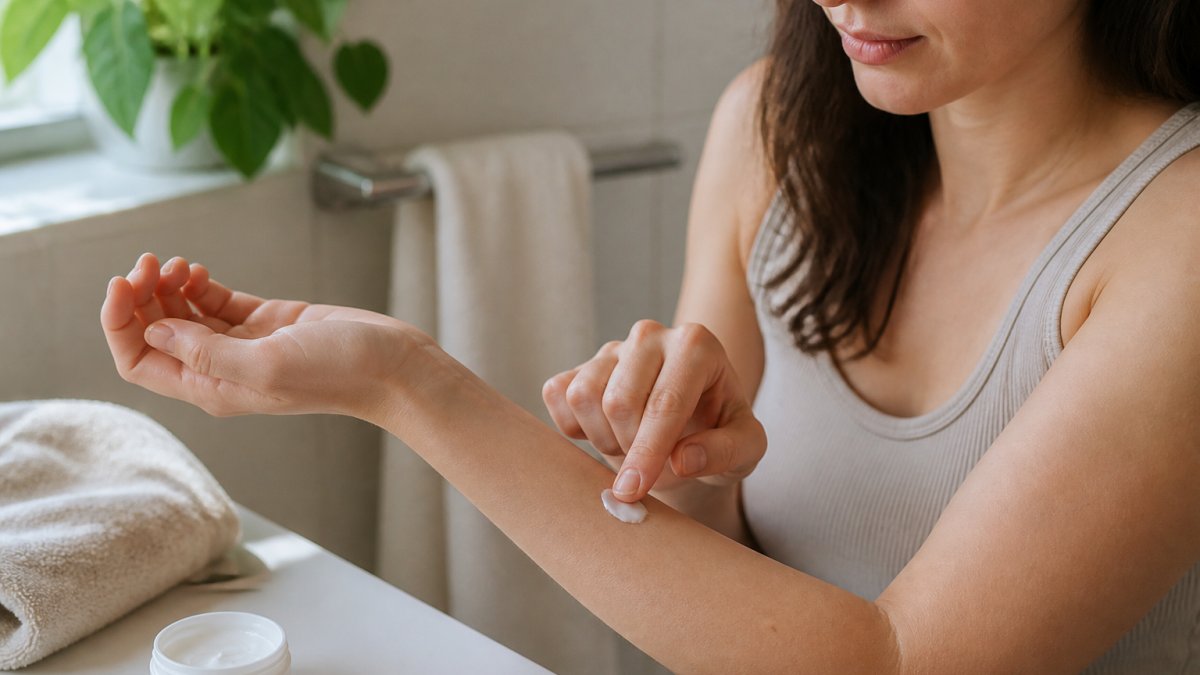
Follow these steps:
- Wash and dry a small patch of inner forearm.
- Apply a pea-sized amount of the product.
- Repeat twice daily for three to five days.
- Note any redness, itching, stinging or bumps.
- If the patch stays calm, test behind the ear for two days.
- Introduce the product to your full face, every second day at first.
Reactions can be delayed, so a single test on the back of your hand proves very little. Give each new product its own testing window, if you start three at once and react, you will not know which caused it.
A Rosacea Moisturizer Routine That Works With Your Skin Type
A workable routine is short: cleanse gently, apply moisturiser to damp skin, then sunscreen in the morning. Everything else is optional, and anything that stings should come out.
A decision path by skin type, symptom and climate
Rather than starting from a best-of list, narrow your choice using three questions.
1. How does your skin feel two hours after cleansing?
- Tight and flaky → a cream or balm.
- Comfortable but shiny → a lotion or gel.
- Oily in the T-zone, tight on the cheeks → lotion all over, cream layered on the cheeks.
2. What is your dominant symptom?
- Persistent dryness and tightness → prioritise barrier ingredients (ceramides, squalane, glycerin).
- Flushing and stinging without dryness → prioritise a short, fragrance-free formula over a rich one.
- Papules and pustules → moisturiser supports tolerance but does not replace prescription treatment.
3. What is the climate doing?
- Hot and humid → lighter lotion or gel; heavy occlusives can trap heat and worsen flushing.
- Cold, windy or air-conditioned → richer cream, and consider a balm on exposed cheeks.
- Seasonal swings → many people need a cream at night and a lotion in the morning, and should revisit their choice twice a year.
Dry, oily and combination skin: what changes
- Dry skin: use a cream, and apply it while skin is still damp to improve moisture retention.
- Oily skin: choose a lotion or gel, and skip heavy occlusives that sit on the surface.
- Combination skin: use a lighter formula on the oily areas and a cream on the cheeks.
How to introduce a new moisturiser without a flare
Introducing a product is a process, not a single decision.
- Patch test first (see above) and wait the full three to five days.
- If the patch stays calm, apply the new moisturiser to your full face every second evening for one week.
- If there is no reaction, move to twice daily.
- Only then add a second new product, giving it its own two-week window.
If you react, stop the new product, return to a moisturiser you trust, and wait until the skin settles. Keep a simple note of what you used and when, patterns are easier to spot in writing than in memory.
Fitting moisturiser around prescription treatments and sunscreen
If you use a prescription treatment for rosacea, such as metronidazole, azelaic acid or ivermectin, apply it as your prescriber directs, then moisturise over the top once absorbed.
If a prescription treatment is causing dryness, stinging or peeling, that is worth raising with your prescriber or pharmacist rather than simply adding more products. They can advise on frequency, buffering or an alternative.
Moisturiser, sunscreen and redness treatments are not the same thing
These three categories do different jobs, and conflating them is one of the most common routine mistakes.
- Moisturiser hydrates the skin and supports the barrier, reducing tightness and dryness.
- Sunscreen filters ultraviolet light. UV exposure is a well-known rosacea trigger, so daily sunscreen is one of the most useful steps you can take.
- Redness treatments, prescription topicals, or azelaic acid, target flushing, papules or pustules. They are not moisturisers.
You need all three roles covered, and they can sit in separate products. In the morning, moisturiser goes on first, sunscreen last. If your sunscreen is moisturising enough, you may not need a separate moisturiser underneath in summer, but many people with reactive skin still prefer one.
Where a Rosacea Moisturizer Fits in Your Routine
Choosing a moisturizer for rosacea prone skin comes down to three checks: a short, fragrance-free ingredient list; a texture that suits your skin type; and a patch test before it touches your face.
At Pepcare Lab, our Barrier Cream is built for exactly this job. It costs $49 for 50 mL, and it pairs with our Face Serum in the Face Duo at $79, which saves $19 and includes free Australian shipping.

If you would rather simplify further, the Complete Collection brings the Face Serum, Barrier Cream, Hair & Scalp Serum and Scalp Brush together for $149, saving $37 on the individual price.
Frequently Asked Questions
What should I look for in a moisturiser for rosacea-prone skin?
Look for a fragrance-free, non-comedogenic formula built around barrier-supporting ingredients such as ceramides, squalane, niacinamide and hyaluronic acid, plus soothing options like aloe, allantoin or green tea. Texture matters too: a lightweight lotion suits oily or combination skin, while a richer cream helps dry, reactive skin hold moisture. Pepcare Lab's Barrier Cream ($49) combines 1% copper peptides, niacinamide and squalane in a rich yet lightweight base designed to support the skin barrier without feeling heavy.
Which ingredients should I avoid if I have rosacea?
Common triggers include fragrance, essential oils, alcohol denat, menthol, peppermint, eucalyptus, physical scrubs, high-strength exfoliating acids and strong retinoids. These can provoke facial redness, stinging and skin irritation on reactive skin. Check labels for 'parfum' and botanical oil blends, which often hide fragrance. If you already use a prescription treatment, introduce new products one at a time so you can tell what caused a reaction. Patch testing before full application is the simplest way to screen a product out.
Should I use a cream or a lotion for rosacea-prone skin?
It depends on your skin type and climate. Lotions are lighter and absorb quickly, which suits oily or combination skin and humid conditions. Creams are richer and seal in hydration, which helps dry, tight or flaky skin and cold, dry weather. Many people with rosacea do well with a cream in winter and a lotion in summer. If your skin is reactive to heavy textures, start with a lightweight formula and layer more only where you feel dryness.
How do I patch test a new moisturiser safely?
Apply a small amount behind your ear or on the inner forearm, twice daily for three to five days. If no redness, itching or stinging appears, test a small area on your jawline for another two to three days before using it on your full face. Stop immediately if irritation develops. Keep the rest of your routine unchanged during the test so you can identify the cause. This approach also helps you judge product tolerance before committing to a full-size purchase.
Rosacea-prone skin rarely responds to complicated routines. It responds to consistency, gentle formulas and a barrier that stays intact. If you are tired of guessing which moisturiser will sting and which will settle, start with a short ingredient list and a proper patch test. Shop our Bestsellers at Pepcare Lab and build a routine your skin can actually tolerate.