
Table of Contents
- What Peptides Do for Thinning Hair
- GHK-Cu Benefits for Hair Thinning Explained
- How to Use Peptide Serum for Hair Growth
- Peptide Serum for Hair Density Results
- Pepcare Lab Hair and Scalp Serum: Our Top Pick
- Key Ingredients to Look for in Hair Peptide Serums
- Safety, Sensitivity and Long-Term Results
- Conclusion
Last Updated: August 25, 2026
What Peptides Do for Thinning Hair
Peptides are short chains of amino acids that signal hair follicles to strengthen and thrive. When applied topically, they penetrate the scalp to reach the dermal papilla, the living part of each hair follicle responsible for growth, where they stimulate collagen production and promote follicle repair. Thinning hair reflects weakened follicles that have shrunk during miniaturization; peptides reverse this decline by triggering growth factors that extend the anagen phase (active growth period) and reduce inflammation that accelerates hair loss.
Unlike oral supplements that must survive digestion, topical peptide serums deliver signals directly to follicle tissue. Copper peptides, specifically GHK-Cu, have become the gold standard, they repair damaged follicles and strengthen the hair shaft itself, making each strand thicker and more resilient. For anyone experiencing early thinning or seeking to maintain hair density, peptides offer a proactive scalp care approach backed by follicle biology.
GHK-Cu Benefits for Hair Thinning Explained
GHK-Cu (copper peptide) is the most researched peptide for hair health (PubMed). This compound signals your body to increase collagen production around the hair follicle, strengthening the dermal papilla and extending hair growth cycles. When follicle stimulation improves, hairs spend more time in their growth phase and less time shedding, resulting in visibly denser hair over time.
GHK-Cu reduces scalp inflammation, a major driver of hair loss, by modulating immune responses at the follicle level. It also improves scalp circulation, ensuring follicles receive the nutrients needed to produce strong, thick hair fibres. For sensitive scalps, this anti-inflammatory action addresses hair loss without irritation that stronger treatments cause.
GHK-Cu supports the scalp barrier, the protective layer that keeps harmful bacteria and irritants away from living follicles. A compromised barrier accelerates thinning; a healthy one creates the ideal environment for follicle repair. This is why copper peptides work especially well for people with sensitive skin, they strengthen rather than disrupt your scalp's natural defences.
When formulated correctly, copper peptides penetrate the scalp efficiently and remain bioavailable long enough to trigger sustained growth signalling. A poorly formulated serum might deliver the compound but won't stay active long enough to work. Product quality and ingredient pairing are decisive.
How to Use Peptide Serum for Hair Growth
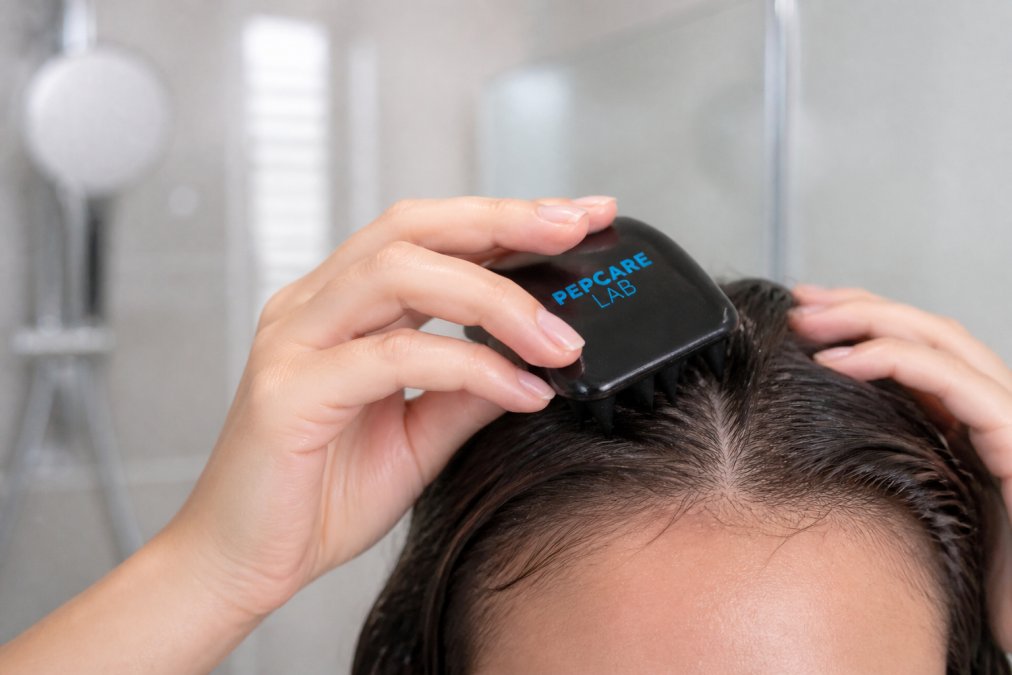
Start with a gentle shampoo to remove product build-up and dead skin cells, which block peptide absorption. Rinse thoroughly and towel-dry your hair until damp, not soaking wet, not completely dry. This moisture level allows the serum to absorb without dilution.
Apply the serum directly to your scalp in sections, focusing on areas where thinning is most visible. Dispense a coin-sized drop onto each section and use your fingertips or a scalp brush to gently massage for 2-3 minutes, which increases blood flow and ensures even distribution. Don't apply to the hair itself; peptides work on the scalp, not the strands.
Frequency matters. Most peptide serums work best with daily or twice-daily application. Morning application sets up your scalp for the day; evening application allows peptides to work during sleep when your body prioritises cellular repair. Consistency is more important than occasional heavy application.
Leave the serum on your scalp for at least 5-10 minutes before styling. If using other treatments (retinol, vitamin C, or prescription medications), apply those to different areas or at different times to avoid interaction. Most peptide serums are lightweight and non-greasy.
For very oily scalps, apply to damp rather than wet hair to reduce dilution. For dry or sensitive scalps, slightly damp hair helps the serum penetrate without irritation from alcohol or preservatives.
Peptide Serum for Hair Density Results
Hair density, the number of hairs per square centimetre of scalp, determines whether your hair looks full or thin. A quality peptide serum increases density by reactivating dormant follicles that have shrunk during miniaturization and extending the lifespan of active follicles so fewer hairs enter the shedding phase.
Visible density improvements typically emerge between 8 and 12 weeks of consistent use (peer-reviewed research). This timeline reflects the hair cycle itself: follicles in the resting phase need time to transition back to growth, and newly grown hairs need length before they visibly contribute to overall density.
The degree of improvement depends on how much miniaturization has occurred. Early thinning responds fastest because follicles are still relatively healthy and capable of reactivation. More advanced thinning requires longer treatment periods and may benefit from combining peptides with scalp stimulation or complementary treatments.
Take baseline photos of your scalp under consistent lighting before starting treatment. Photograph the same areas every 4 weeks using identical lighting and angles. This removes guesswork about whether density is actually improving, as daily observation often misses gradual changes.
Nutrient absorption determines how effectively peptides rebuild follicle health. If your diet lacks protein, iron, or B vitamins, your scalp will struggle to translate peptide signals into actual hair growth. A quality peptide serum works best when paired with adequate nutrition.
| Timeline | Expected Changes | What to Monitor |
|---|---|---|
| Weeks 1-4 | Reduced scalp inflammation, less itching | Scalp comfort, shedding rate |
| Weeks 5-8 | Early follicle reactivation, subtle density shift | Hair texture, breakage reduction |
| Weeks 9-12 | Visible density improvement, stronger hair shaft | Hair thickness, new growth visibility |
| Weeks 13+ | Sustained density gains, improved hair resilience | Long-term maintenance needs |
Pepcare Lab Hair and Scalp Serum: Our Top Pick
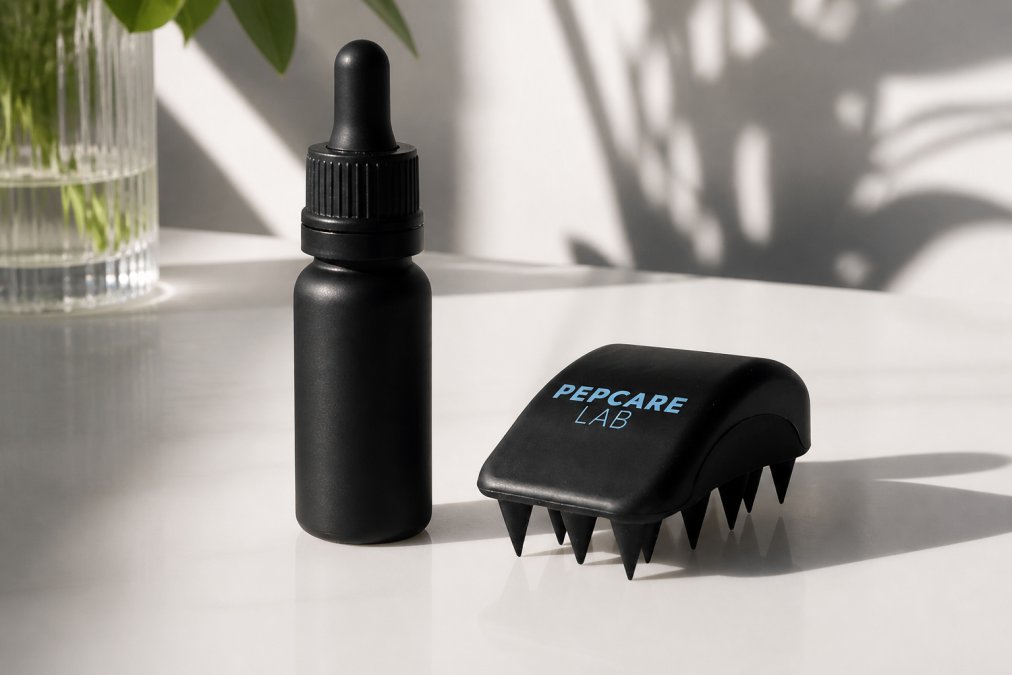
The Pepcare Lab Hair and Scalp Serum combines 2% Copper Peptides with a thoughtfully selected supporting formula. Many peptide serums rely on high peptide concentrations but skimp on ingredients that ensure bioavailability and scalp health. Pepcare Lab does the opposite: the 2% GHK-Cu concentration is clinically relevant, and the supporting blend of niacinamide, biotin, and botanical extracts amplifies peptide effectiveness while supporting the scalp barrier.
What makes this the best peptide serum for thinning hair is the inclusion of niacinamide, which reduces sebum overproduction (clogging follicles) and strengthens the scalp barrier. Biotin supports keratin synthesis, making hair stronger as it grows. Botanical extracts provide antioxidant protection without unnecessary fragrance or irritants, critical for sensitive scalps prone to thinning.
The formula is lightweight and absorbs within minutes without weighing hair down or requiring a wash-out step. For people juggling multiple treatments or sensitive to product buildup, this matters enormously.
At $59 for a 50 mL bottle (roughly $1.18 per millilitre), the Pepcare Lab Hair and Scalp Serum offers a competitive price point. A 50 mL bottle lasts approximately 6-8 weeks with daily application, making it roughly $150-200 per quarter.
The Pepcare Lab Hair and Scalp Duo ($69) bundles the serum with the Scalp Brush, which improves absorption and follicle stimulation. The brush's flexible silicone bristles provide gentle exfoliation without scratching, and the massage action increases blood flow to the scalp. For those new to peptide treatment, this duo removes guesswork about application technique.

Key Ingredients to Look for in Hair Peptide Serums
Not all peptides are equal, and not all peptide serums penetrate the scalp effectively. When evaluating any peptide serum for thinning hair, prioritise these ingredient markers of quality.
Copper Peptides (GHK-Cu) should be listed in the first five ingredients and ideally specified as a percentage. 1-3% is the clinically relevant range; below 1% is too dilute, and above 3% offers no additional benefit. The Pepcare Lab formula's 2% concentration sits in the sweet spot.

Niacinamide strengthens the scalp barrier and reduces inflammation without irritation. Look for 2-5% concentration. This ingredient is essential if you have sensitive skin or a compromised scalp barrier.
Biotin supports hair strength at the structural level. While biotin in serum form has limited bioavailability compared to oral supplements, it still provides local benefit at the scalp.
Panthenol (provitamin B5) hydrates the scalp and hair shaft without heaviness, preventing the drying effect some peptide formulas can have.
Botanical extracts like saw palmetto, green tea, or rosemary have mild anti-inflammatory properties and support scalp health without irritation risk. These are supporting players, not primary drivers of results.
Avoid or minimise: alcohol (unless a preservative at the end of the ingredient list), fragrance (unnecessary and irritating), and silicones (they coat the scalp and block peptide absorption). A clean, simple formula with transparent peptide and supporting ingredients always outperforms a complex formula with dozens of trendy extracts.
Safety, Sensitivity and Long-Term Results
Peptide serums are generally safe for sensitive skin because peptides themselves are non-irritating and actually support barrier function. Before committing to daily use, do a patch test: apply a small amount to a discrete area of your scalp and wait 24-48 hours. If no itching, redness, or irritation develops, the formula is likely safe for your skin.
Some people experience temporary scalp adjustment during the first 2-4 weeks, manifesting as mild flaking, slight itching, or changes in oil production as the scalp barrier strengthens. This is not an allergic reaction; it's your scalp adapting to improved barrier function. If uncomfortable, reduce application frequency to every other day for the first week, then gradually increase to daily use.
GHK-Cu has been used in skincare formulations for over two decades with an excellent safety profile. Copper is an essential mineral, and amounts absorbed through topical peptide serum application are negligible compared to dietary copper intake (the NIH). There's no risk of copper toxicity from using a peptide serum long-term.
If using prescription hair loss medications like finasteride or minoxidil, peptide serums complement rather than conflict with these treatments. Combining approaches often yields better results than any single treatment alone. If using other active scalp treatments (retinol, acids, or vitamin C serums), space applications at least 12 hours apart to avoid irritation.
For pregnancy and breastfeeding: while topical copper peptides are considered safe, research on this population is limited. Consult your healthcare provider before starting any new scalp treatment.
Results plateau after 6-12 months of consistent use, which is normal and expected. At this point, your follicles have recovered to their optimal state. Most people find that consistent maintenance dosing preserves density gains indefinitely.
Discontinuing use doesn't cause sudden hair loss. However, without ongoing peptide signalling, follicles gradually return to their baseline state over 3-6 months. If thinning is a chronic concern, peptide serum works best as a long-term maintenance approach.
Conclusion
The best peptide serum for thinning hair addresses the root cause of density loss: weakened follicles that have shrunk during miniaturization. Copper peptides, particularly GHK-Cu, trigger the follicle repair and collagen production that reverses this process when formulated correctly and applied consistently.
Pepcare Lab Hair and Scalp Serum delivers clinically relevant peptide concentration paired with supporting ingredients that amplify effectiveness and protect sensitive scalps. At $59 for a 50 mL bottle, it represents genuine value for a science-backed formula. The Hair and Scalp Duo at $69 adds a scalp brush that improves absorption and provides a complete routine for those new to peptide treatment.

Results require patience, expect 8-12 weeks before visible density improvement, and consistency. Daily application outperforms sporadic use because peptides work through sustained follicle signalling. Combined with adequate nutrition and complementary treatments if needed, a quality peptide serum becomes the foundation of long-term scalp health and stronger-looking hair.
Shop the Hair and Scalp Serum and start rebuilding follicle health with science-led peptide care designed for sensitive skin.
Real customer concerns about peptides and hair thinning, answered:
Many worry that peptide serums are overhyped marketing without real science. The mechanism is straightforward: GHK-Cu signals your dermal papilla to increase collagen production and reduce inflammation at the follicle level. The timeline (8-12 weeks for visible results) reflects the hair cycle itself, not a slow-acting formula.
Others ask whether peptides work differently than retinol or vitamin C. Retinol and vitamin C address skin surface renewal and collagen production systemically; peptides specifically target follicle health and growth signalling. They work through different mechanisms, which is why combining them (at different times of day) often yields better results than either alone.
Sensitivity concerns are legitimate, but peptide serums are actually gentler than many alternatives. Copper peptides support barrier function rather than disrupt it. A proper patch test identifies any individual sensitivity before it becomes a problem.
Frequently Asked Questions
Q: Does GHK-Cu really help with hair density?
A: GHK-Cu (copper peptide complex) supports the dermal papilla, the structure responsible for hair follicle stimulation. It promotes collagen production in the scalp and may help extend the anagen phase (growth phase) of the hair cycle. While individual results vary, peptide serums containing GHK-Cu are designed to create conditions that favour stronger, denser-looking hair when used consistently over several months.
Q: How long does it take to see results from a peptide serum for thinning hair?
A: Most users begin noticing visible changes in hair texture and scalp health within 6-8 weeks of consistent daily use. Meaningful improvements in hair density and thickness typically emerge after 3-4 months. Hair growth cycles are slow; patience and regular application are essential. Combining a peptide serum with scalp stimulation (such as gentle massage or a scalp brush) may accelerate results.
Q: Can I use a peptide serum if I have a sensitive scalp?
A: Peptide serums are generally well-tolerated by sensitive scalps because peptides work with your skin barrier rather than against it. Pepcare Lab products are formulated with sensitive skin in mind, using gentle ingredients like niacinamide and botanical extracts alongside copper peptides. Always perform a patch test on a small area first, and if irritation occurs, reduce application frequency or discontinue use and consult a healthcare provider.
Q: How do I incorporate a peptide serum into my existing hair care routine?
A: Apply your peptide serum to a clean, damp scalp as a leave-in treatment, typically 2-3 times weekly or daily, depending on product instructions. Gently massage it in using your fingertips or a scalp brush to improve scalp circulation and nutrient absorption. Use it before other treatments or styling products. The Pepcare Lab Hair and Scalp Duo ($69.00) combines the serum with a scalp brush for a complete, simple routine that takes just a few minutes.
Sources for further reading:
[EXTERNAL_LINK: Australian Dermatological Society guidelines on hair loss management | dermats.org.au]
[EXTERNAL_LINK: Therapeutic Guidelines: hair loss and alopecia evidence review | tga.gov.au]
[EXTERNAL_LINK: Research on copper peptides and collagen synthesis in scalp tissue | ncbi.nlm.nih.gov]
This article was written using GrandRanker