
Table of Contents
- Why Expensive Anti-Aging Serums Aren't Always Better
- Best Serum for Glowing Skin: What to Look For
- Benefits of Copper Peptides for Skin
- How to Support Skin Barrier Health on a Budget
- Cost-Per-Use: The Real Price of Anti-Aging Serums
- Building a Simple Routine with Copper Peptide Serums
- Conclusion
- Frequently Asked Questions
Last Updated: September 27, 2026
Why Expensive Anti-Aging Serums Aren't Always Better
The price on the bottle rarely reflects what's inside it. Most of what you pay for in a luxury anti-aging serum goes to packaging, marketing and retail margin, not actives. This guide from Pepcare Lab breaks down how to find effective alternatives to expensive anti-aging serums without giving up on results.
A serum priced at $180 and one at $49 can both contain 1% copper peptides, niacinamide and hyaluronic acid. The difference is often the label, not the formula.
Concentration, not cost, drives results. A serum with a well-documented active at a stated percentage will outperform a prestige product with a "proprietary blend" every time.
Best Serum for Glowing Skin: What to Look For
The best serum for glowing skin contains a proven active at a disclosed concentration, supported by humectants and barrier-friendly ingredients. Look for peptides, niacinamide, hyaluronic acid and antioxidants listed with percentages, not vague marketing terms.
A practical checklist for reading any label:
- Stated concentration: "1% copper peptides" tells you something. "Peptide complex" does not.
- Supporting ingredients: niacinamide, hyaluronic acid and squalane support hydration and barrier function.
- Short ingredient list: fewer than 30 ingredients usually means fewer irritants for sensitive skin.
- Packaging: opaque or airless bottles protect unstable actives like vitamin C and retinoids.
- pH balance: formulas designed for daily use should sit close to skin's natural pH.
Ingredient Concentration Transparency
Ingredient concentration transparency means the brand states exactly how much of each active is in the formula. A serum that lists "1% copper peptides" lets you compare it directly against another product. One that lists "peptide blend" does not.
Benefits of Copper Peptides for Skin
Copper peptides support collagen production, encourage skin renewal and reinforce the skin barrier. GHK-Cu, the most studied copper peptide in skincare, is a small molecule that delivers copper into the skin to support normal repair processes.
How Copper Peptides Compare to Retinoids and Vitamin C
Each active works differently, and the right choice depends on your skin's tolerance and your goal.
| Active | Primary Benefit | Typical Adjustment Period | Best For |
|---|---|---|---|
| Copper peptides | Collagen support, barrier repair | Minimal | Sensitive, reactive skin |
| Retinoids | Cell turnover, fine lines | 4-12 weeks of purging | Non-sensitive skin, acne |
| Vitamin C | Antioxidant, brightening | Low, but can sting | Dullness, pigmentation |
| Niacinamide | Barrier support, oil balance | Minimal | Most skin types |
How to Support Skin Barrier Health on a Budget
Supporting skin barrier health comes down to three things: gentle cleansing, consistent hydration, and avoiding ingredients that strip the barrier faster than it can repair. No ten-step routine required.
Practical steps that cost little:
- Cleanse with a mild, non-foaming cleanser, once or twice daily.
- Apply a hydrating serum to damp skin to improve absorption.
- Seal with a moisturiser containing niacinamide or squalane.
- Use sunscreen daily; photoaging undoes most repair work.
- Introduce one active at a time, and give it two weeks before adding another.
Cost-Per-Use: The Real Price of Anti-Aging Serums
Cost-per-use is the price of a product divided by the applications you actually get from it. It is the only honest way to compare a $49 serum against a $180 one, because sticker price tells you nothing about how long the bottle lasts or how much active you apply per dose.
| Product type | Typical volume | Applications per bottle | Cost per application at $49 | Cost per application at $180 |
|---|---|---|---|---|
| Serum, twice daily | 30 mL | ~120 | ~$0.41 | ~$1.50 |
| Moisturiser, twice daily | 50 mL | ~180 | ~$0.27 | ~$1.00 |
| Combined routine, monthly | , | ~60 serum + ~60 cream | ~$41 | ~$150 |
Why Some Products Cost Less Without Being Worse
Price differences between a $49 and a $180 serum rarely come from the active. Copper peptides, niacinamide and hyaluronic acid are commodity raw materials, the active in a single bottle usually costs a small fraction of the retail price. The gap comes from everything around the formula:
- Packaging: glass, magnetic closures and airless pumps cost more than a simple opaque plastic bottle. Airless packaging does protect unstable actives, so it is worth paying for when the formula contains vitamin C or retinoids, but not every product needs it.
- Marketing and retail margin: department store counter space, influencer campaigns and gift-with-purchase promotions are built into the price, not into the formula.
- Fragrance and texture: luxury sensorial experience, essential oils, silky emollients, pearlescent finishes, adds cost and, for sensitive skin, adds irritation risk.
- Brand positioning: a house name carries a premium that has nothing to do with what is inside the bottle.
The Yearly Comparison
The Face Serum from Pepcare Lab is $49 for 30 mL with 1% copper peptides, niacinamide and hyaluronic acid. The Barrier Cream is $49 for 50 mL with 1% copper peptides, niacinamide and squalane. Bought together as the Face Duo, they're $79 and save $19 on the individual price. At twice-daily use, that works out to well under a dollar a day for a two-step routine with disclosed actives.

Building a Simple Routine with Copper Peptide Serums
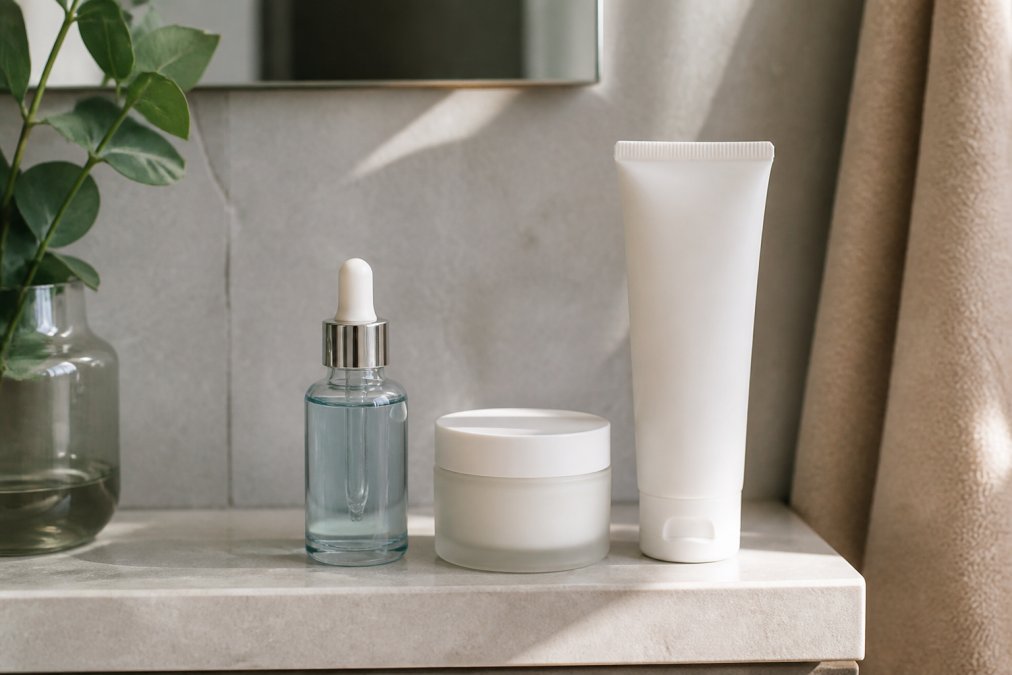
A three-step routine is enough for most people: cleanse, treat, moisturise, with sunscreen in the morning. Copper peptide serums slot into the treatment step and pair well with a barrier-supporting moisturiser. Order matters because it determines how much of each active reaches the skin.
Layering Order and What Not to Mix
The general rule is thinnest to thickest: water-based serums first, then emulsions, then creams, then occlusives. Sunscreen always last in the morning.
Some combinations are best kept apart:
- Copper peptides and vitamin C: apply at different times of day. Vitamin C's acidic pH can destabilise copper peptides if layered directly.
- Copper peptides and strong acids: keep glycolic, lactic and salicylic acid for a separate session. Acid exfoliation strips the barrier that copper peptides are trying to rebuild.
- Retinoids and copper peptides: alternate nights rather than layering. Both support renewal, but your skin only needs one strong active per session.
Introducing Potent Actives Without Irritation
Affordable alternatives often use the same potent actives as prestige products, so the same adjustment period applies. A common pattern is to start too fast, get irritation, and blame the product rather than the schedule.
A workable introduction protocol:
- Patch test first. Apply a small amount behind the ear or on the inner forearm for three consecutive nights. If no reaction, move to the face.
- Start at two nights per week. Apply the new active on those nights only, and use your barrier cream on the others.
- Increase by one night per week. Only step up if the skin is calm, no stinging, flaking or persistent redness.
- Hold at the highest comfortable frequency. Not everyone needs nightly use. Three or four nights a week is enough for many people.
- Pause if the barrier signals distress. Tightness, stinging on water contact and flaking mean back off, not push through.
Conclusion
Building a routine that supports your skin without luxury prices takes a bit of label-reading, but the payoff is real. For most people, the honest starting point is a transparent, well-formulated copper peptide serum paired with a barrier cream.
Frequently Asked Questions
What is the best inexpensive anti-aging serum?
The best inexpensive anti-aging serum depends on your skin's needs. Look for formulas with proven ingredients like copper peptides, niacinamide, and hyaluronic acid. A 1% copper peptide serum, such as Pepcare Lab's Face Serum at $49, offers a concentrated option that supports collagen production and skin barrier health without the luxury markup. Compare cost-per-use rather than upfront price to find genuine value.
How do copper peptides compare to traditional anti-aging ingredients?
Copper peptides, like GHK-Cu, support collagen production and skin barrier health with less irritation than retinoids. They also provide antioxidant benefits similar to vitamin C. For sensitive skin, copper peptides are often better tolerated. A 1% copper peptide serum can be used daily without the purging or dryness associated with some retinoids, making it a gentle yet effective alternative.
Can affordable skincare provide the same results as luxury brands?
Affordable skincare can deliver comparable results if the active ingredients and concentrations are similar. Many luxury serums rely on the same peptides, niacinamide, and hyaluronic acid found in budget options. The key is checking the ingredient list for proven actives at effective percentages. A $49 serum with 1% copper peptides can perform as well as a $200 serum with the same active, provided the formulation is stable.
How can I simplify my skincare routine without sacrificing results?
Focus on a few multi-tasking products. A copper peptide serum can address hydration, barrier support, and collagen production in one step. Pair it with a gentle cleanser and a barrier cream. This three-step routine reduces irritation risk and cost. Pepcare Lab's Face Duo includes a serum and barrier cream for $79, covering essential steps without extra products.
Are there Australian-made alternatives to high-end international serums?
Yes, Australian brands like Pepcare Lab offer science-led formulations with copper peptides. Their Face Serum contains 1% copper peptides, niacinamide, and hyaluronic acid for $49. Local manufacturing can mean fresher products and transparent sourcing. When comparing, check the concentration of active ingredients and cost per millilitre to ensure value.
This article is for general information only and is not medical advice. If you have a diagnosed skin condition or are using prescription treatments, speak with a qualified health professional before changing your routine.